Brent crude rises above $100 as attacks on tankers and energy infrastructure intensify fears over global oil supplies.
LONDON, Sept. 9, 2026 —Brent crude has climbed above $100 a barrel for the first time since July as fresh US-Iran attacks on tankers and Houthi strikes on Saudi energy infrastructure deepen fears of a wider Middle East energy crisis.
Oil has crossed a psychologically important threshold once again — and this time, the reason is not simply market speculation.
Brent crude surged above $100 a barrel on Wednesday, September 9, 2026, as escalating US-Iran military strikes, attacks on commercial shipping and renewed Houthi attacks on Saudi Arabia raised fresh fears that oil supplies through the Middle East could face even greater disruption.
Reuters reported that front-month Brent crude reached $101.58 a barrel during Wednesday’s trading session and was up about 3% at $100.95 at one point. US West Texas Intermediate crude also climbed sharply, reaching its highest level since early June.
The move marks the first time Brent futures have broken decisively above the $100 level since late July, turning what had been a geopolitical warning into a fresh economic concern for governments, businesses and consumers around the world.
Key Points
Brent crude rose above $100 a barrel on September 9, 2026, for the first time since July.
Reuters reported Brent reaching as high as $101.58 during Wednesday’s session.
US forces said they destroyed five Iranian oil tankers after attacks involving a US warship.
Iran claimed retaliatory attacks against US vessels and oil tankers, although the US disputed claims that two US warships were struck.
Houthi attacks on Saudi energy infrastructure have added another threat to regional oil supplies.
Shipping through the Strait of Hormuz has fallen sharply.
Higher oil and fuel prices could add further pressure to global inflation.
Why oil has crossed $100 again
At the centre of the latest shock is the Strait of Hormuz, the narrow waterway linking the Persian Gulf with the Gulf of Oman.
The strait normally handles roughly one-fifth of global oil and gas shipments. But shipping activity has fallen dramatically as the conflict between the United States and Iran has intensified.
Reuters reported that only six commodity vessels passed through the strait on Tuesday, compared with nine the previous day and a 10-day average of roughly 12. Oil flows that had recently recovered to around 8 million to 9 million barrels per day have more recently fallen below 2 million barrels per day, according to estimates cited by the news agency.
That matters because oil markets do not need the entire supply to disappear before prices react.
When traders begin to fear that cargoes may not arrive on time, insurance costs rise, shipping becomes more dangerous and buyers compete for alternative supplies. Prices can move sharply even before an actual global shortage develops.
And that is precisely what the market is now confronting.
US strikes on Iranian tankers escalate the crisis
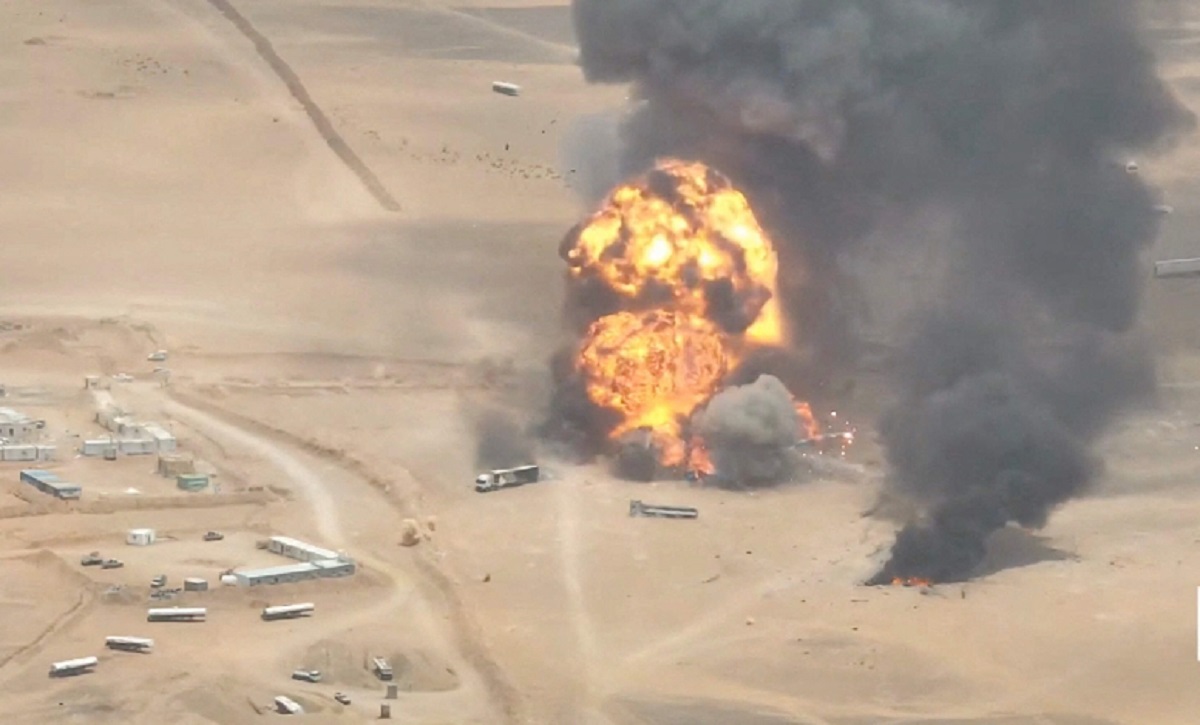
The latest escalation followed US military strikes against Iranian oil tankers.
The US Central Command said American forces destroyed five Iranian tankers after the Islamic Revolutionary Guard Corps launched ballistic missiles toward a US warship. According to the US military, the crews were ordered to abandon the vessels before the strikes.
Iran subsequently claimed it had attacked US military vessels and oil tankers in retaliation. The US military disputed Tehran’s claim that two American warships had been hit.
The competing claims underline a crucial feature of the crisis: the danger is no longer confined to military targets. Commercial shipping itself has become part of the conflict.
Reuters reported that UK Maritime Trade Operations had received reports of merchant vessels being subjected to disabling fire in the Gulf and Gulf of Oman. Another vessel was reportedly seen listing near the United Arab Emirates after what appeared to be an attack.
That is precisely the kind of development energy traders fear most.
If shipping companies begin avoiding the Gulf in large numbers, the disruption could become significantly harder to contain.
Houthi attacks widen the oil threat
The crisis is also spreading beyond the Strait of Hormuz.
Iran-backed Houthi forces in Yemen have intensified attacks on Saudi Arabia, including strikes affecting energy infrastructure. Reuters reported that the attacks caused fires at Saudi oil facilities and temporarily disrupted operations.
The significance goes beyond Saudi Arabia itself.
The Houthis have also threatened shipping around the Red Sea and Bab al-Mandab, another strategically important maritime route for global energy trade.
That creates a dangerous second front for the oil market.
For years, traders have viewed alternative routes as an important safety valve when Gulf shipping faces disruption. But if both the Strait of Hormuz and Red Sea corridors become increasingly dangerous, the number of practical alternatives shrinks.
As Reuters analyst commentary noted, attacks on Saudi energy infrastructure raise concerns that disruption could spread from Iranian supply to the wider infrastructure and alternative routes that have helped keep Gulf crude moving.
The $100 oil question is bigger than the number itself
The return of $100 oil carries enormous psychological weight.
Before the current US-Iran war began, Brent crude was trading around $70 a barrel. The latest move represents a dramatic change in the cost environment facing airlines, manufacturers, shipping companies, transport operators and households.
Reuters reported that US gasoline prices were averaging around $4.22 a gallon, while diesel prices had reached record levels. European fuel markets have also become increasingly tight.
AP likewise reported that US gasoline prices rose sharply, while diesel reached approximately $5.94 a gallon. The news agency noted that expensive jet fuel has already contributed to airlines cutting flights or increasing fares and fees.
For ordinary consumers, the consequences may appear gradually.
A higher crude price can eventually mean more expensive petrol and diesel. Those costs then filter into transportation, food distribution, manufacturing and other everyday goods.
That is why the oil market is being watched far beyond trading floors.
Could oil go even higher?
The biggest question is whether the latest spike becomes another temporary surge — or the beginning of a longer energy shock.
Reuters quoted market analysts warning that the market has become considerably more vulnerable because physical supplies are already tight and shipping through Hormuz remains severely impaired.
The situation could worsen quickly if attacks damage additional oil infrastructure or force more tankers to avoid the region.
At the same time, the market could stabilize if military activity declines, shipping resumes and diplomatic efforts succeed.
That leaves traders watching two things almost obsessively: military developments and the number of ships actually moving through the region.
The price of oil may be the headline, but the shipping lanes are the story underneath it.
What $100 oil means for the global economy
A prolonged period of expensive oil could complicate the fight against inflation.
Higher energy prices raise transportation and production costs, potentially keeping consumer prices elevated at a time when major central banks are already trying to balance inflation against economic growth.
Reuters reported that the renewed oil surge has added pressure to global financial markets, while AP reported declines in major US stock indexes as investors reassessed the inflationary consequences of the conflict.
For oil-producing countries, higher prices can increase revenues.
For oil-importing economies, however, the equation is far less comfortable.
Countries dependent on imported crude may face higher fuel bills, pressure on currencies and increased costs across their economies.
And if the conflict continues to restrict one of the world’s most important energy corridors, the problem could move from oil-price volatility to supply security.
What happens if oil stays above $100?
If Brent crude remains above $100 for an extended period, consumers are likely to feel the impact through higher fuel and transportation costs. Businesses could also face increased production and shipping expenses, potentially feeding into broader inflation.
Why is the Strait of Hormuz so important?
The Strait of Hormuz is one of the world’s most important energy chokepoints, carrying a substantial share of global oil and gas shipments. Disruption there can quickly affect international energy prices.
Has oil reached $100 before during this conflict?
Yes. Brent has moved around the $100 threshold during earlier stages of the conflict, but Wednesday’s move was particularly significant because it came amid a fresh escalation involving commercial shipping and renewed attacks on energy infrastructure. Reuters described it as the first breach since late July.
Will petrol prices rise because of $100 oil?
They could, particularly if elevated crude prices persist. However, retail fuel prices also depend on refining costs, taxes, transportation, currency movements and local market conditions, so the impact will not be identical in every country.
Is this another global oil crisis?
It is too early to make that declaration. But the combination of restricted Hormuz shipping, attacks on tankers, threats to Saudi energy infrastructure and uncertainty surrounding the US-Iran conflict has created a significantly higher supply-risk environment.
The bigger story
The return of $100 oil is not just a market milestone.
It is a warning about how quickly a regional conflict can spill into the global economy.
For months, traders had been hoping that military tensions would eventually cool enough for energy shipments to normalize. That assumption has now been badly tested.
Every tanker attacked, every energy facility damaged and every vessel diverted adds another layer of uncertainty.
And uncertainty is expensive.
For consumers watching petrol prices, for airlines buying jet fuel and for governments trying to control inflation, the next few weeks may matter far more than the headline price seen on Wednesday.
Do you think oil prices will remain above $100 if the conflict continues, or will the market settle back down? Share your view.
Follow Star Struck Times for continuing coverage of the Iran war, Middle East tensions, oil prices, energy markets and breaking global news.
Hello! I'm M Muzamil Shami, the founder and lead editor of Star Struck Times, your trusted source for trending news, entertainment scoops, celebrity gossip, sports highlights, and global headlines.
With a passion for storytelling and journalism, I created this platform to bring you breaking news, viral moments, and deep insights into the worlds of Bollywood, Hollywood, sports, politics, tech, and more — all in one place.