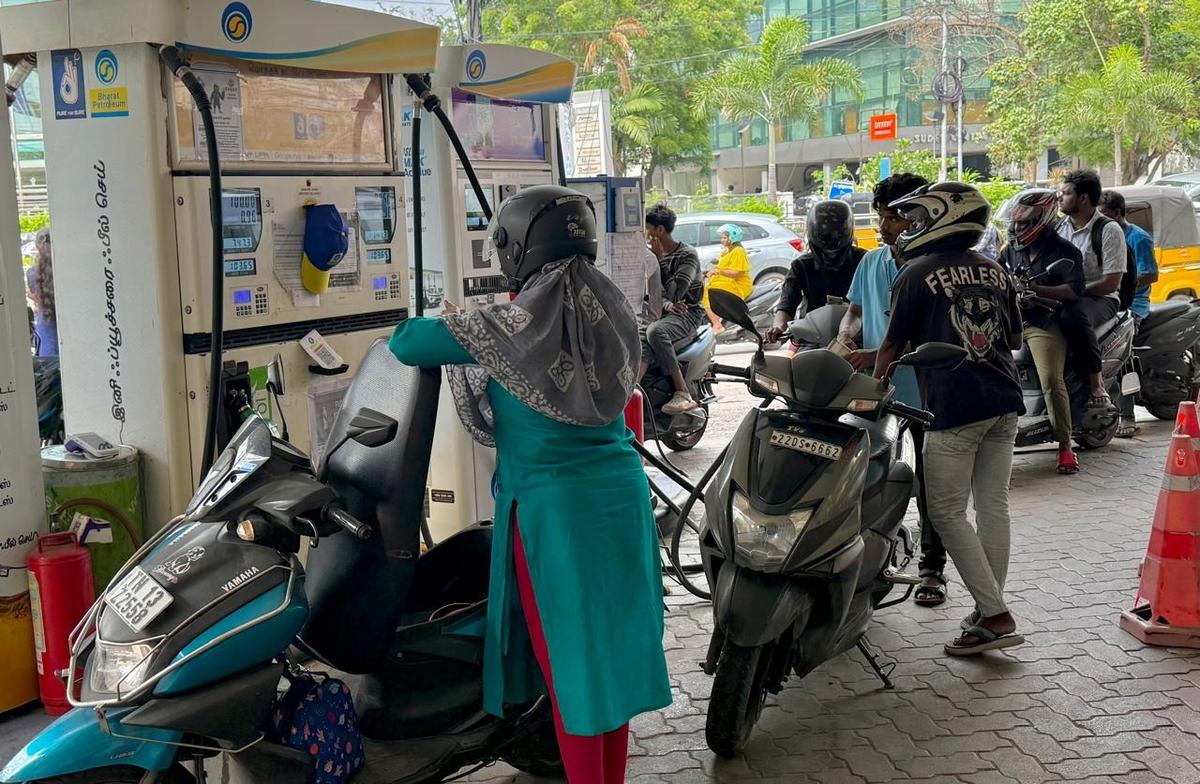
India has officially ended its four-year freeze on retail fuel prices today, as state-run oil marketing companies (OMCs) implemented a nationwide hike of ₹3 per litre for petrol and diesel. The move comes as the escalating Iranwar pushes global Brent crude toward $110 per barrel, leaving Indian refiners with staggering daily losses of nearly ₹1,000 crore.
Key Highlights
Price Revision: Petrol and diesel rates hiked by approximately ₹3.14 and ₹3.11 respectively in New Delhi.
First in Years: This marks the first retail price increase since April 2022, ending a long-standing price freeze.
The War Factor: Global crude prices have surged by nearly 50% since the onset of the Iran-Israel-US conflict.
CNG Impact: City gas distributors followed suit, raising CNG prices by ₹2 per kg in the national capital.
India Yields to “Iran War Premium” as OMCs Face Financial Collapse
The honeymoon period for Indian motorists officially ended at dawn on Friday. After shielding consumers for over 1,500 days, the central government has allowed state-run giants—Indian Oil (IOCL), Bharat Petroleum (BPCL), and Hindustan Petroleum (HPCL)—to pass on a fraction of the soaring global energy costs.
In the national capital, petrol now retails at ₹97.77 per litre, while diesel has climbed to ₹90.67. According to data analyzed by Star Struck Times, while the ₹3 hike seems significant to the average commuter, it represents only a “drop in the ocean” compared to the actual under-recoveries. Industry experts suggest refiners are still losing between ₹15 and ₹20 per litre on diesel sales.
The Strait of Hormuz Crisis: Why Prices Are Climbing
The root of the hike lies thousands of miles away in the Strait of Hormuz. As a critical artery for 20% of the world’s oil, the ongoing maritime blockade and conflict involving Iran have triggered what the International Energy Agency (IEA) calls the “greatest global energy security challenge in history.”
For India, which imports 85% of its crude requirements, the disruption is catastrophic. Brent crude was trading at $107 per barrel on Friday morning, a level that makes the previous price of ₹94 per litre fiscally unsustainable for the government.
Hidden Context: What Other Reports Missed
While most outlets are focusing on the ₹3 figure, Star Struck Times has identified a shift in the government’s strategy toward “staggered hikes.” Sources within the Petroleum Ministry indicate that this is likely the first of several planned increases. The goal is to reach a “break-even” point of $80-$85 per barrel equivalent without triggering a massive inflationary shock.
Furthermore, the timing—occurring immediately after the conclusion of regional elections—suggests a return to market-linked pricing that was temporarily suspended for political stability.
Public Outcry and Political Reaction
The reaction on the ground has been swift and sharp. In Shimla, tourists and locals expressed shock at the overnight revision. “Our household budget was already stretched. This hike will ripple through everything from vegetables to milk,” said Aditya Mishra, a resident.
Politically, the opposition has seized the moment. Congress leader Rahul Gandhi criticized the move on X (formerly Twitter), stating that the “public is paying the price for the government’s mistakes.” Meanwhile, Tamil Nadu CM C. Joseph Vijay called the hike “unacceptable,” citing its impact on the buying capacity of the poor.
“The hikes are not enough to cover the losses, but they represent a necessary pivot toward fiscal reality. We expect this to be the start of multiple staggered increases as long as the West Asia conflict persists.”
— Madhavi Arora, Chief Economist at Emkay Global Financial Services.
The market is bracing for volatility. Shares of OMCs like Hindustan Petroleum fell as much as 2.9% following the news, as investors realized the ₹3 hike is insufficient to stem the daily loss of ₹1,000 crore. If Brent crude stays above $100, analysts at ICRA predict that gasoline demand growth in India will slow to 3-4%, down from the previous 6% estimate.
The government has already urged “fuel austerity,” with several states moving to work-from-home models for government employees to reduce consumption. Expect more “demand-side management” policies if the Strait of Hormuz remains closed.
FAQs on India’s Fuel Price Hike
1. Why did fuel prices increase today after four years?
The ongoing war involving Iran has caused global crude oil prices to surge. State-run OMCs were facing massive losses and could no longer absorb the cost without a retail price adjustment.
2. Is this the only price hike we should expect in 2026?
No. Most economists believe this is the start of “staggered hikes.” Small, frequent increases are expected until the retail price aligns with the $100+ global crude reality.
3. How does the Iran war affect my petrol bill in India?
India imports the majority of its oil from the Middle East. Conflict in the region disrupts supply chains and increases insurance and shipping costs, which are eventually passed to consumers.
4. Will public transport and food prices also go up?
Yes. Since diesel is the primary fuel for freight and public transport, a 3% hike in diesel often leads to a “second-round impact” on food and essential commodity prices due to higher logistics costs.
5. Has the government reduced taxes to provide relief?
While the government reduced some excise duties in March 2024, the current global price of $107/barrel has far exceeded the relief provided by those tax cuts.
Hello! I'm M Muzamil Shami, the founder and lead editor of Star Struck Times, your trusted source for trending news, entertainment scoops, celebrity gossip, sports highlights, and global headlines.
With a passion for storytelling and journalism, I created this platform to bring you breaking news, viral moments, and deep insights into the worlds of Bollywood, Hollywood, sports, politics, tech, and more — all in one place.