


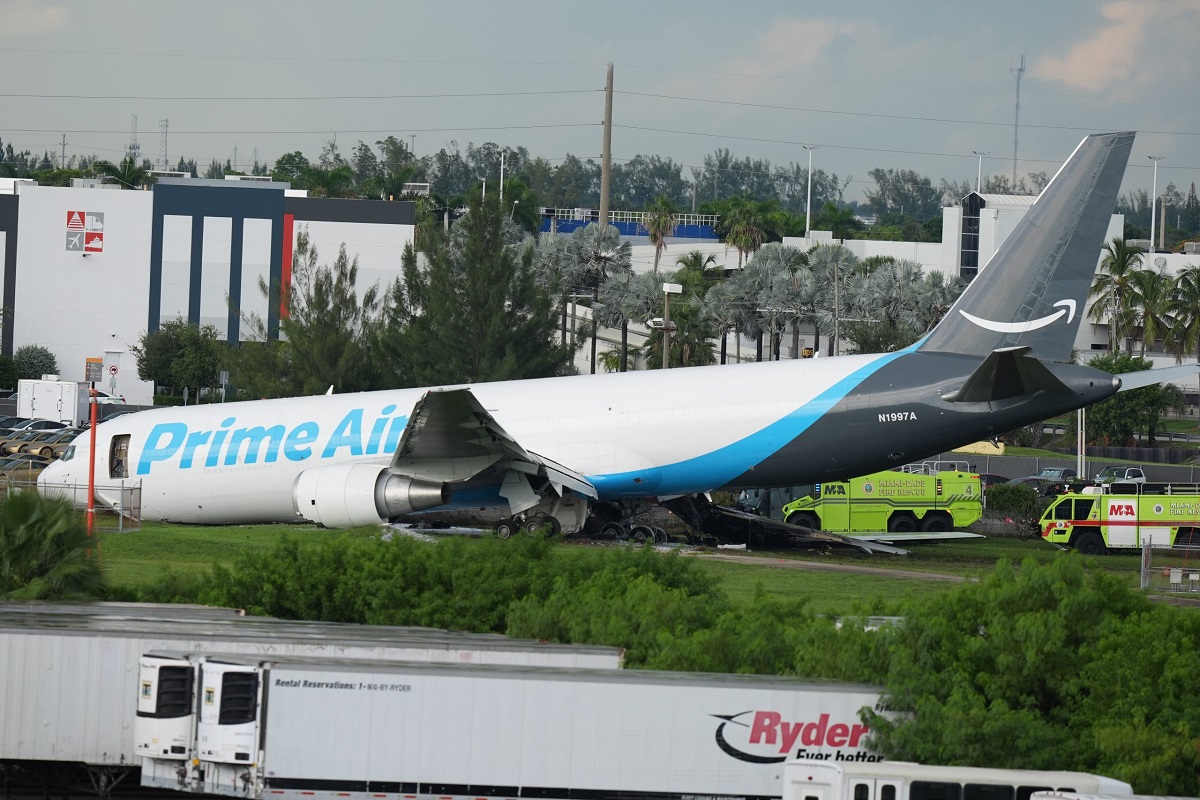
A deadly Amazon Prime Air crash at Miami International Airport has left five people dead and five injured, as federal investigators examine why a Boeing 767 ran beyond the runway during landing.
A routine cargo flight turned into a deadly disaster Sunday afternoon when an Amazon Prime Air Boeing 767-300 overran a runway at Miami International Airport, crossed a roadway and slammed into vehicles before erupting in flames.
At least five people were killed and five others injured, including three who were critically hurt, according to Miami-Dade officials. The aircraft was operated by North Carolina-based cargo carrier 21 Air and had arrived from San Juan, Puerto Rico.

The National Transportation Safety Board (NTSB) has launched a federal investigation. Investigators are expected to focus heavily on the aircraft’s landing, including where it touched down, its speed, braking performance, weather conditions and whether mechanical or operational factors contributed to the runway overrun.
Key Points
- Five people died and five were injured in the Miami airport crash.
- The aircraft was an Amazon Prime Air Boeing 767-300 operated by 21 Air.
- The plane overran a runway shortly before 2 p.m. Sunday.
- The aircraft struck vehicles after leaving the runway.
- Three of the injured were reported to be in critical condition.
- The NTSB is leading the investigation.
- Weather, landing position, aircraft performance and other factors are being examined.
- The crash caused major flight disruptions at Miami International Airport.
What happened to the Amazon cargo plane in Miami?
The aircraft, identified by Reuters as Prime Air Flight 7598, was attempting to land at Miami International Airport after departing San Juan.
According to Reuters, the Boeing 767-300 exited the usable runway at approximately 112 knots, or 129 mph (207 km/h). It then crossed a roadway and struck multiple vehicles on the ground.
The crash produced a large fire and a thick column of black smoke that could be seen around the airport.
Emergency crews responded rapidly. Miami-Dade Fire Rescue said more than 60 rescue units and roughly 200 personnel were involved in the response. Firefighters faced a significant aircraft fire and a fuel leak while rescuers worked to free people trapped inside vehicles and the aircraft.
Miami-Dade County Mayor Daniella Levine Cava described the incident as an exceptionally difficult day for the community. Rescue crews reached the crash scene within seconds, according to officials.
The identities of those killed had not initially been released.

Why did the plane overrun the runway?
That is the central question facing investigators.
The NTSB has not established a cause, and it would be premature to blame pilots, weather, the aircraft or airport infrastructure before investigators complete their work.
However, early analysis has highlighted the aircraft’s landing sequence.
The Associated Press reported that video appeared to show the Boeing 767 remaining airborne for an unusually long distance before touching down. Aviation experts said investigators will want to establish exactly where the aircraft touched down and whether it was within the normal touchdown zone.
If an aircraft touches down too far along a runway, the remaining stopping distance can become critically limited. Investigators will therefore examine the aircraft’s approach, touchdown point, speed and braking.
Weather could also become part of the investigation. Thunderstorms and wind gusts were reported in the Miami area around the time of the accident. But there is currently no confirmed finding that weather caused the crash.
The unanswered question about the runway
One of the most important investigative issues is whether the aircraft touched down where the crew expected it to.
Aviation safety experts told AP that investigators are likely to study whether the aircraft landed inside the designated touchdown area and, if it did not, why the landing was continued rather than abandoned.
The answers will depend on evidence including cockpit data, flight recorders, radar information, runway markings, aircraft maintenance records and video footage.
That evidence will take time to analyze.
For now, the NTSB’s investigation—not speculation online—will determine what happened.
Five killed as plane hit vehicles beyond the runway
The tragedy was not confined to the aircraft.
After leaving the runway, the Boeing 767 crossed a road serving businesses and warehouse operations near the airport. Several vehicles were struck.
Some victims were trapped in or beneath vehicles, according to Miami-Dade Fire Rescue. The pilot and co-pilot were also trapped inside the aircraft following the crash, although early reports did not establish whether they were among those killed.
The scene quickly became one of smoke, fire, damaged vehicles and emergency crews.
Witnesses described the aftermath as surreal.
Grace Mercado, who spoke with CBS News, described seeing the aircraft engulfed in smoke and compared the scene to something from a movie. Another witness, Beth Tilman, told The New York Times that she saw a black cloud and noticed an unusual, acrid smell.
Those accounts capture the shock of an accident that unfolded beside a major commercial airport during one of the busiest travel periods of the year.
Miami airport faces major travel disruption
The crash also created a second crisis for thousands of travelers.
Flights were halted following the accident before operations resumed later Sunday. But disruption continued into Monday, with significant delays and cancellations affecting passengers traveling through Miami. Reuters reported that average inbound delays exceeded five hours by Monday afternoon, while hundreds of flights had been canceled or disrupted over the preceding 24 hours.
The timing made the situation especially difficult.
The incident occurred during the U.S. Labor Day travel period, traditionally one of the busiest periods of the year. The Transportation Security Administration had forecast millions of travelers moving through U.S. airports around the holiday.
Miami International Airport is particularly important because of its role as a major passenger and international freight hub.
For travelers, the crash therefore meant more than a frightening headline. It meant missed connections, canceled flights, long lines and unexpected overnight stays.
Amazon and 21 Air respond
Amazon said it was heartbroken by the loss of life and expressed condolences to the families and everyone affected.
The company said the aircraft was operated by 21 Air and that it was working with authorities to determine what happened.
21 Air also expressed condolences and said its immediate priorities were supporting those affected, assisting authorities and providing accurate information as it became available.
Neither company has publicly assigned a cause to the accident.
That distinction matters. The investigation is still developing.
What happens next in the NTSB investigation?
The NTSB has sent an investigative team to Miami led by Chairwoman Jennifer Homendy. The agency scheduled a media briefing for Monday afternoon to provide an initial update.
Investigators are expected to examine several areas:
1. The aircraft’s landing
Investigators will reconstruct the approach and determine when and where the aircraft touched down.
2. Speed and braking
Flight-data information, cockpit recordings and aircraft systems will help establish the plane’s speed and braking performance.
3. Weather
Wind direction, gusts, thunderstorms and other atmospheric conditions will be examined to determine whether they affected the landing.
4. Aircraft condition
Maintenance records and the aircraft’s mechanical systems will be reviewed for evidence of a malfunction.
5. Airport infrastructure
Investigators may also examine the runway environment, safety areas and what happened after the aircraft left the paved surface.
The Boeing 767 involved was about 32 years old. According to Reuters and Flightradar24 information cited by the agency, it originally operated as a passenger aircraft before being converted to cargo service in 2015.
Age alone does not establish a safety problem, however. Investigators will need to determine whether the aircraft’s condition had any connection to the crash.
A painful reminder of the risks after a runway overrun
Runway excursions are among the aviation accidents that safety investigators study closely because several layers of protection can influence the outcome: approach stability, touchdown location, braking, runway length, weather, runway-end safety areas and the presence of additional stopping systems.
AP reported that Miami’s runways do not use engineered arresting systems designed to stop aircraft that overrun the paved surface, although officials said the airport’s existing safety area means such a system was not required there.
That issue could become part of a broader safety discussion, but it should not be confused with a finding about the cause of Sunday’s crash.
The immediate priority remains establishing exactly how the aircraft ended up beyond the runway and why it could not be stopped.
Frequently Asked Questions
How many people died in the Miami cargo plane crash?
Five people were killed in the crash, while another five were injured. Three of the injured were reported to be in critical condition.
What airline operated the Amazon cargo plane?
The Boeing 767 was operated by 21 Air, a North Carolina-based cargo carrier, on behalf of Amazon Prime Air.
What caused the Miami plane crash?
The cause has not yet been determined. Investigators are examining the landing, aircraft performance, weather, mechanical condition and other possible factors.
Where did the Amazon cargo plane come from?
The aircraft had departed Luis Muñoz Marín International Airport in San Juan, Puerto Rico, before attempting to land in Miami.
Who is investigating the crash?
The National Transportation Safety Board (NTSB) is leading the federal investigation, with assistance from other aviation authorities and organizations.
The investigation now begins
For the families of those who died, the investigation is about far more than aviation statistics or runway procedures. It is about understanding how a normal Sunday flight became a catastrophe.
For Miami, the crash has left a busy airport dealing with disruption while investigators begin the painstaking process of reconstructing the final moments of the flight.
And for the aviation industry, the most important questions remain unanswered: Where did the aircraft touch down? Why did it continue beyond the runway? And could anything have stopped the chain of events before it became fatal?
Those answers will have to come from evidence.
What do you think investigators should examine first—the landing, weather, aircraft condition or runway safety?
Follow StarStruckTimes for further updates as investigators release verified information.


