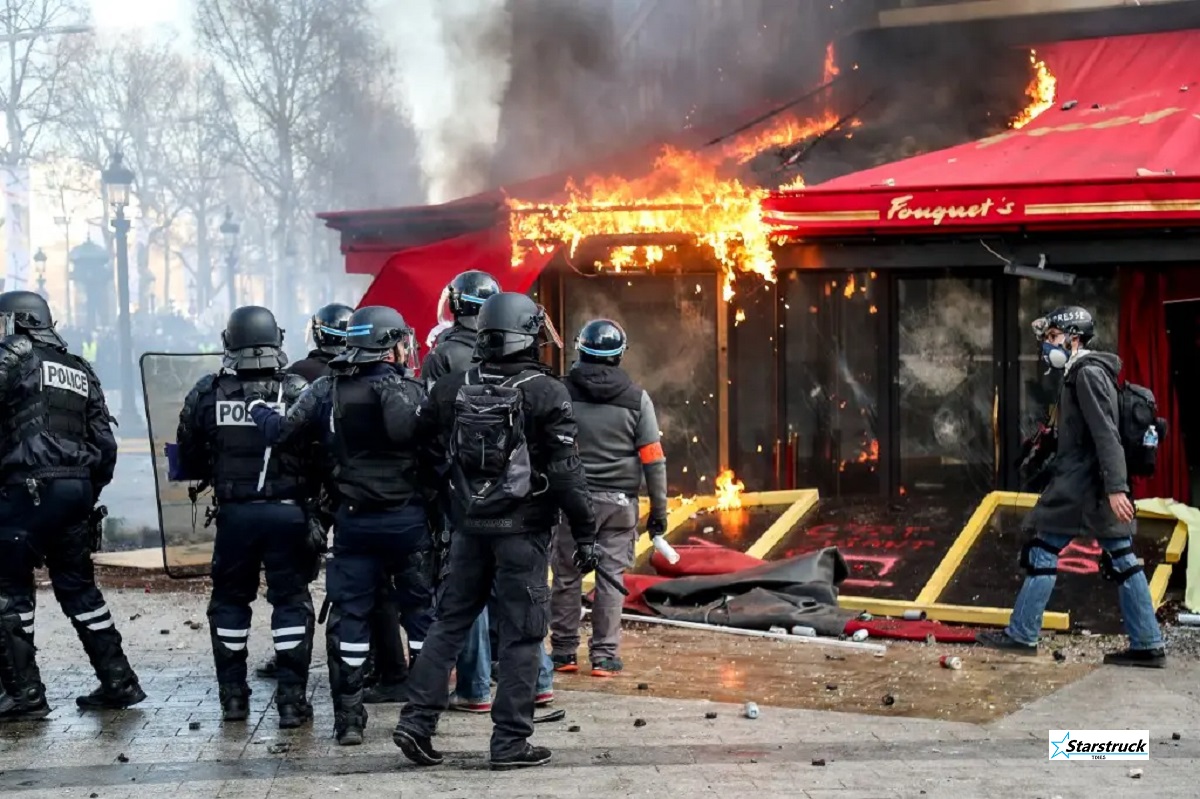
Clashes, fires and looting were reported during nationwide protests in France on October 17, 2026. Photo credit: Use the original photographer or licensed news agency credit.
PARIS, October 18, 2026
Violent clashes, looting and fires erupted in several French cities during nationwide protests against rising living costs and deteriorating public services, with Prime Minister Sébastien Lecornu later reporting more than 1,200 arrests following demonstrations that drew hundreds of thousands of people onto the streets.
The demonstrations on Saturday, October 17, brought together students, trade union members and supporters of France’s Yellow Vest movement. Protesters called for action on household expenses, higher wages, better pensions and poor conditions in public schools. However, confrontations between some demonstrators and police overshadowed much of the unrest, with damage reported at businesses and public buildings.
The Associated Press reported that Interior Minister Laurent Nuñez initially put the number of arrests at around 400, while estimating that approximately 550,000 people had participated in 110 marches nationwide. Organizers gave a higher estimate of about 800,000 participants. The subsequent figure of more than 1,200 arrests was reported in later coverage citing the prime minister, highlighting how official totals changed as the situation developed.
Key Points
More than 1,200 arrests were reported in later updates following Saturday’s demonstrations.
Authorities estimated that about 550,000 people joined protests across France, while organizers put attendance at approximately 800,000.
Fires, looting and clashes with police were reported in Paris, Lyon, Marseille and other cities.
Protesters cited rising living costs, inequality and deteriorating school conditions among their main concerns.
President Emmanuel Macron condemned violence and said those responsible for vandalism and attacks would face prosecution.
Disorder Spreads Across French Cities
Paris was among the main flashpoints. At Place de la République, police used tear gas and water cannons against groups throwing fireworks, paving stones and other objects at officers. Fires involving vehicles, bicycles, rubbish bins and a newspaper kiosk were reported, while several shops were looted.
The violence was not confined to the capital. In Lyon, a fire broke out inside a tourist office. In Marseille, shops and a municipal police station were damaged, and demonstrators briefly entered the lobby of City Hall. Limoges also saw a serious incident when its City Hall was set on fire, according to the Associated Press.
Authorities reported further disturbances in several other cities, including Bordeaux, Rennes, Toulouse, Montpellier and Grenoble.
Despite these incidents, the demonstrations were not uniformly violent. The Associated Press reported that many protesters continued marching peacefully, chanting slogans and waving French flags as they called for improvements to public services and living standards.
Why Are People Protesting in France?
The latest unrest developed from weeks of student demonstrations over conditions in schools, including concerns about teacher shortages and inadequate facilities. The movement subsequently expanded into a broader expression of dissatisfaction with the cost of living, economic inequality and the state of public services.
Trade unions and student organizations backed the mobilization. The CGT, one of France’s major labor unions, called for higher wages and pensions, lower prices and the protection of public services.
The protests also revived memories of the Yellow Vest movement, which began in 2018 and became a major expression of anger over economic pressures and perceived social injustice. The renewed presence of yellow vests underlines how household costs and concerns about government priorities continue to bring different groups into the same demonstrations.
Reuters reported that the movement had grown from school-based protests in the northern suburbs of Paris into a wider campaign focused on inequality, public spending and living standards.
Macron Condemns Violence as Arrest Figures Rise
President Emmanuel Macron condemned attacks on businesses and public buildings, saying those responsible for vandalism and looting would be prosecuted. His response drew a distinction between the right to demonstrate peacefully and criminal acts committed during the rallies.
Interior Minister Nuñez also blamed what he described as radical far-left groups for some of the violence. That characterization was the government’s assessment; it should not be taken as evidence that all demonstrators participated in or supported the disorder.
The authorities also faced scrutiny over police tactics. The Associated Press reported that an investigation was opened after a young protester suffered a severe hand injury in Saint-Étienne. Nuñez did not confirm media reports that a police grenade caused the injury.
The incident has added to questions about the use of riot-control weapons during the wider wave of student protests.
What the Protests Reveal Beyond the Headlines
The immediate story is one of mass demonstrations, disorder and arrests. The wider issue is whether France can address public frustration over living standards and underfunded services while maintaining public order.
The difference between the government’s initial arrest count and later reports also matters. Early figures reflected the situation at a particular point in time, while subsequent updates captured additional developments. Likewise, the gap between official and organizer crowd estimates means the scale of participation should be presented with attribution rather than as a single undisputed total.
The demonstrations have brought economic grievances, educational concerns and public-order questions into sharper focus. Whether the protests lead to policy changes remains uncertain, but the scale of Saturday’s mobilization demonstrates that the underlying concerns extend well beyond individual clashes in the streets.
Sources: Associated Press, Reuters and reporting on statements by French government officials.
Hello! I'm M Muzamil Shami, the founder and lead editor of Star Struck Times, your trusted source for trending news, entertainment scoops, celebrity gossip, sports highlights, and global headlines.
With a passion for storytelling and journalism, I created this platform to bring you breaking news, viral moments, and deep insights into the worlds of Bollywood, Hollywood, sports, politics, tech, and more — all in one place.