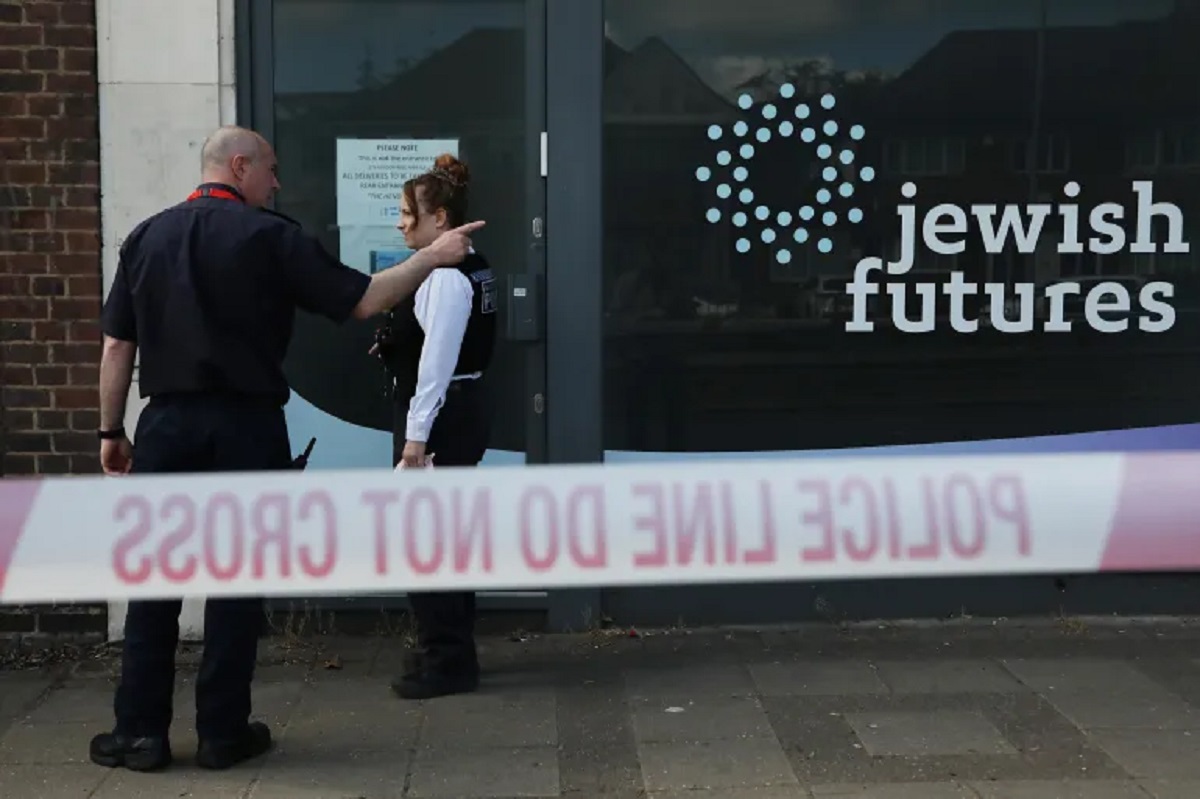
London police examine suspected arson attacks at Jewish sites amid Iran link investigation
London, United Kingdom, April 19, 2026 — Star Struck Times
The Met Police Iran arson attacks London probe has intensified after a series of coordinated fire-related incidents targeting Jewish sites across North London raised serious national security concerns. Counter Terrorism Policing is now leading the investigation, examining whether the attacks could be connected to Iranian-linked proxy networks operating through online extremist groups.
The latest incident at Kenton United Synagogue caused minor damage overnight, but authorities warn the pattern suggests a wider and more organized campaign. According to Metropolitan Police officials, multiple incidents have already been claimed by a group identifying itself as Harakat Ashab al-Yamin al-Islamia, also known as Ashab al-Yamin.
Authorities, including statements reported by BBC News and Financial Times coverage, are now assessing whether these claims indicate external state-linked coordination or independent extremist activity.
Star Struck Times examines what is known so far, what investigators are focusing on, and the deeper geopolitical implications behind the unfolding probe.
Key Highlights
Met Police investigating suspected links between Iran and London arson attacks
Jewish community sites in North London repeatedly targeted in recent incidents
Counter Terrorism Policing leading the ongoing investigation
Group “Ashab al-Yamin” has claimed responsibility for multiple attacks in Europe
UK Prime Minister Keir Starmer condemns attacks as “abhorrent”
No fatalities reported, but authorities warn escalation risk remains
What Happened in the London Arson Incidents
The Met Police Iran arson attacks London probe began escalating after a string of fires and attempted arson incidents between late March and April 2026. The most recent case involved Kenton United Synagogue, where minor structural damage was reported but no injuries occurred.
Earlier incidents included a bottle containing accelerant thrown inside Finchley Reform Synagogue and Jewish-owned emergency service vehicles set on fire in Golders Green. Another attempted attack targeted a Jewish community charity building in Hendon.
Deputy Assistant Commissioner Vicki Evans confirmed that investigators are examining claims made by a group called Ashab al-Yamin, which has surfaced online since March and has reportedly claimed responsibility for attacks across Europe.
Evans noted that authorities are also reviewing “public reporting that this group may have links to Iran,” while stressing that no final attribution has yet been confirmed.
Official Reaction and Government Response
UK leadership has strongly condemned the incidents.
Prime Minister Keir Starmer described the attacks as “abhorrent” and warned that those responsible will face justice. In a public statement, he emphasized that “attacks on our Jewish community are attacks on Britain itself.”
Chief Rabbi Ephraim Mirvis also issued a stark warning, calling the incidents a “sustained campaign of violence and intimidation” and urging authorities not to wait for escalation before taking decisive action.
Counter Terrorism Policing has confirmed it is analyzing digital communication patterns, funding trails, and possible foreign coordination links, including the operational behavior of groups claiming responsibility.
According to reporting referenced by BBC News and Al Jazeera, investigators are particularly focused on whether the attacks represent “proxy-style operations” rather than isolated extremist acts.
Why Iran Links Are Being Examined
One of the most sensitive aspects of the Met Police Iran arson attacks London probe is the alleged connection to Iran-based proxy strategies.
Security experts referenced in Financial Times analysis suggest that Iran has historically been accused of using indirect networks or “plausible deniability” tactics to influence or destabilize foreign targets.
Deputy Assistant Commissioner Evans referred to this as “recruiting violence as a service,” a phrase highlighting concerns that non-state actors could be used to execute politically motivated attacks without direct attribution.
However, investigators caution that while similarities exist with known proxy patterns, there is currently no publicly confirmed evidence directly linking the Iranian state to the incidents.
What Other Reports Missed: Hidden Context
While mainstream coverage has focused on individual arson events, a deeper pattern is emerging that is often overlooked:
The group claiming responsibility, Ashab al-Yamin, appeared only recently in March, raising questions about its sudden operational activity
Claims of responsibility span multiple countries, not just the UK, suggesting coordinated messaging rather than isolated action
Digital footprints suggest overlapping narratives with broader geopolitical tensions in the Middle East
Security analysts suggest that whether or not Iran is directly involved, the emergence of fast-forming online extremist networks presents a growing challenge for European counterterrorism agencies.
This dimension shifts the case from a local criminal investigation to a potential transnational security issue involving hybrid digital-extremist ecosystems.
Why This Case Matters Beyond London
The Met Police Iran arson attacks London probe is not just about isolated arson incidents—it highlights a broader shift in how modern geopolitical conflict can manifest in urban environments.
If confirmed links to foreign proxy systems exist, it could reshape how the UK and European Union classify hybrid threats involving:
Religious site targeting
Online extremist propaganda networks
Cross-border operational coordination
State-linked indirect influence strategies
Even without confirmed attribution, the case underscores rising concerns about security vulnerabilities in public religious and community spaces.
What Happens Next
Counter Terrorism Policing continues to analyze forensic evidence, digital communications, and international intelligence cooperation.
Authorities are expected to increase patrols around vulnerable sites in North London while further assessing whether the Ashab al-Yamin group has operational capacity beyond online claims.
A formal attribution—if any—is likely to take weeks or months, as investigators must distinguish between propaganda-driven claims and verifiable operational links.
For now, officials stress caution, emphasizing that premature conclusions could hinder the investigation.
FAQ
What is the Met Police Iran arson attacks London probe about?
It investigates a series of arson incidents targeting Jewish sites in North London and possible foreign-linked coordination.
Has Iran been confirmed as involved?
No official confirmation has been made; investigators are examining possible links but no attribution is established.
Who is Ashab al-Yamin?
It is a group claiming responsibility for multiple arson incidents across Europe, first appearing online in March 2026.
Were there any casualties in the attacks?
No injuries or fatalities have been reported so far, only minor property damage.
Why are these attacks considered serious?
Authorities believe they may represent coordinated extremist activity with potential international links.
Hello! I'm M Muzamil Shami, the founder and lead editor of Star Struck Times, your trusted source for trending news, entertainment scoops, celebrity gossip, sports highlights, and global headlines.
With a passion for storytelling and journalism, I created this platform to bring you breaking news, viral moments, and deep insights into the worlds of Bollywood, Hollywood, sports, politics, tech, and more — all in one place.