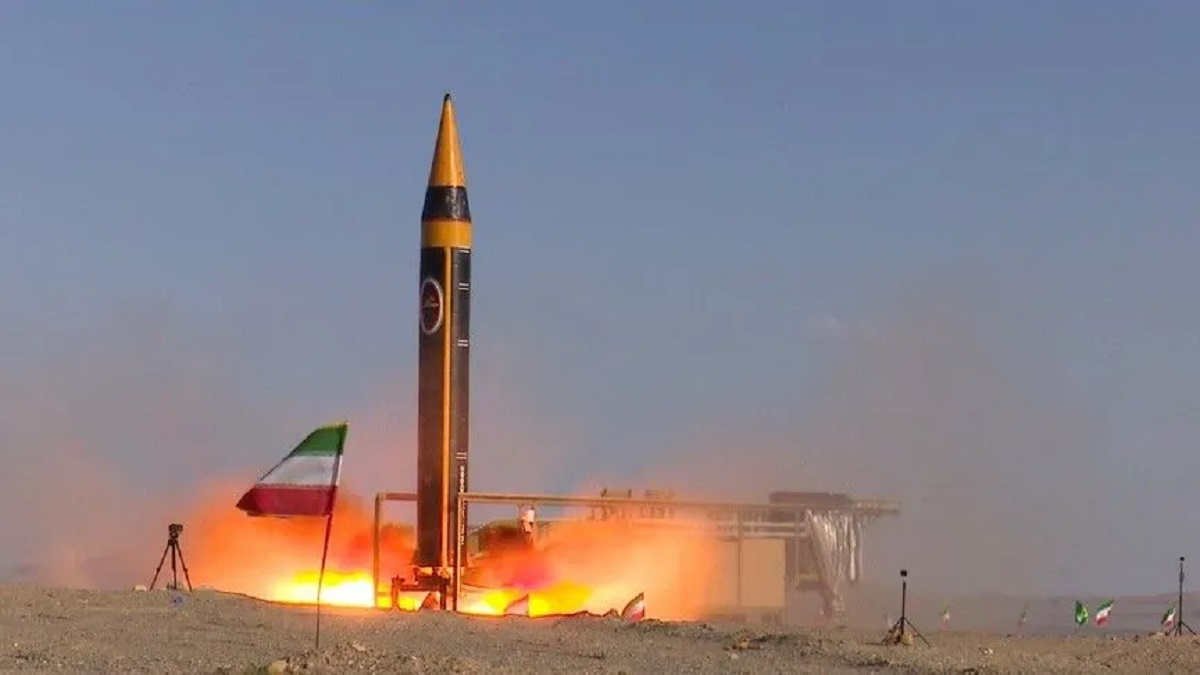
The key development is not a confirmed new missile test. Iran has announced that it has lifted its self-imposed 2,000-kilometre limit on ballistic missile range, while a new image released by Supreme Leader Mojtaba Khamenei’s office has raised questions about ambitions to develop missiles with a potential range of up to 5,000 kilometres.
The distinction matters: Iran has announced a change in policy, but that does not establish that it has successfully tested or deployed a 5,000-kilometre missile. AP News+2
TEHRAN, Iran — November 22, 2026

Key Points
- Iran’s Revolutionary Guard says the country’s self-imposed 2,000-kilometre ballistic missile range restriction has been lifted.
- A November 17 poster from Supreme Leader Mojtaba Khamenei’s office depicts a missile with a potential range of 5,000 kilometres.
- Iran has not publicly confirmed a successful test or deployment of a missile with that range.
- The policy shift could change the regional military balance and raise security concerns beyond the Middle East.
- Iran’s nuclear programme remains difficult to assess because international inspectors lack access to key damaged facilities.
Iran Prepares to Expand Missile Range: Could the Change Shift the Balance of Power?
TEHRAN, Iran — Iran is preparing to expand its ballistic missile capabilities after its Revolutionary Guard announced the removal of a long-standing 2,000-kilometre range restriction, a development that could change the balance of power in the Middle East and increase concerns among Western governments. The announcement, combined with a recent image suggesting a possible 5,000-kilometre missile range, has drawn attention to Tehran’s longer-term military ambitions. However, there is no independently verified confirmation that Iran has successfully tested or deployed such a missile. AP News+1
Iran removes its 2,000-kilometre missile restriction
On November 7, Islamic Revolutionary Guard Corps (IRGC) spokesman Brigadier General Hossein Mohebbi said Iran’s previous restriction on ballistic missile ranges had been lifted.
According to the Associated Press, Mohebbi made the announcement at a news conference in Tehran following a directive from Supreme Leader Mojtaba Khamenei calling for an immediate and effective response to threats without geographical limitations.
Iran had previously maintained a self-imposed range limit of approximately 2,000 kilometres (1,200 miles). That distance already placed Israel, the Arabian Peninsula and several US military installations in the region within the potential reach of Iranian ballistic missiles.
Mohebbi did not confirm that Iran had developed operational missiles capable of travelling beyond the previous limit. He indicated that the country’s military capabilities would need to be demonstrated in practice. AP News+1
Does the 5,000-kilometre missile image indicate a new test?
Questions about Iran’s next missile development phase increased on November 17, when the office of Supreme Leader Mojtaba Khamenei published an image depicting a ballistic missile surrounded by distance markers extending to 5,000 kilometres.
Iran International reported that the image carried a message attributed to Khamenei calling for an immediate and effective response to potential threats without geographical restrictions.

A missile with a range of 5,000 kilometres could potentially reach targets across much of Europe, depending on its launch location and actual performance.
However, the image should not be confused with evidence of a successful missile test. It indicates a possible strategic ambition, not confirmation of an operational weapon with that range.
That distinction is important because missile announcements, proposed capabilities and independently verified military achievements are not the same thing. Iran International+1
How could Iran change the regional balance of power?
Iran’s expanding missile ambitions could influence military calculations across the Persian Gulf and beyond.
Longer-range missiles would potentially give Tehran more options for threatening distant military installations and responding to attacks. They could also increase pressure on regional governments to strengthen missile defence systems and reconsider their security arrangements.
The development is particularly significant amid continuing tensions involving Iran, the United States and Israel.
Iran’s March 2026 attempted ballistic missile strike against the joint US-UK military base at Diego Garcia also demonstrated the strategic importance of longer-range capabilities. According to the Institute for the Study of War, one missile failed during flight while the other was intercepted. The actual distance travelled by the missiles remains unclear.
This incident does not establish that Iran possesses a reliable 5,000-kilometre missile, but it illustrates why military analysts are paying attention to the country’s expanding ambitions. Critical Threats+1
Is Iran preparing to become a nuclear power?
Iran’s missile developments have also renewed questions about its nuclear ambitions. However, ballistic missile capability and nuclear weapon possession are two separate issues.
Iran has developed an advanced uranium enrichment programme, but the current status of its nuclear activities remains uncertain.
A major obstacle to establishing the full picture is the lack of international inspections at several Iranian nuclear facilities damaged during US-Israeli strikes in June 2025.
In a November 19 report, Reuters said the International Atomic Energy Agency (IAEA) had not received access to those facilities since the attacks. The whereabouts of Iran’s previously declared stockpile of highly enriched uranium, including material close to weapons-grade levels, also remained unaccounted for.
The IAEA’s inability to verify the stockpile means international observers cannot confidently establish the current status of all Iran’s nuclear material.
This does not prove that Iran has built a nuclear weapon or that it is about to do so. Nor does the lifting of the missile-range restriction establish a decision to pursue nuclear weapons. Reuters+2
What happens next?
The important question is whether Iran will move beyond political announcements and military imagery to demonstrate a new, independently verifiable missile capability.
A successful longer-range test would represent a more substantial development than the removal of a self-imposed restriction. Until such evidence emerges, claims about a fully operational 5,000-kilometre Iranian missile should be treated cautiously.
For regional governments and international security observers, the combination of expanding missile ambitions and unresolved nuclear inspections creates a difficult strategic situation.
Iran’s decision to remove its previous range restriction is significant. Whether it ultimately changes the military balance of power will depend on what Tehran can actually develop, demonstrate and deploy.