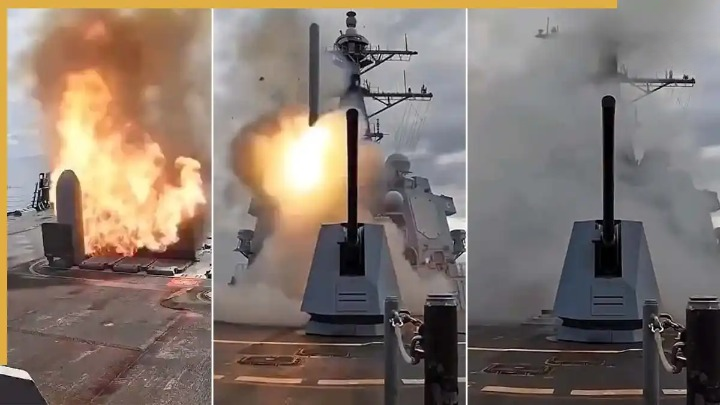
US Navy missile operations have come under scrutiny after its acting secretary confirmed the use of recoded munitions during the Iran war.
WASHINGTON, November 18, 2026 — The US Navy used previously unserviceable munitions during its military campaign against Iran after restoring or reclassifying some weapons for use, Acting Navy Secretary Hung Cao told lawmakers at a Senate confirmation hearing. His remarks have renewed questions about the condition of American weapons stockpiles and the military’s ability to replace precision missiles after months of conflict.
Cao disclosed the practice on November 17 while facing questions from senators about the cost of the Iran war and pressure on the Navy’s weapons inventory. He said some munitions used during Operation Epic Fury had carried condition codes Echo and Foxtrot, which he described as expired.
“For some of these munitions, we recoded them. And so we’re able to shoot off the expired munitions,” Cao told the Senate Armed Services Committee.
He compared the process to making stale bread usable again, explaining that he had grown up in a family where food was not wasted. However, he did not disclose which specific weapons had been recoded, how many were used or how they performed during the campaign.
Key points
Acting Navy Secretary Hung Cao confirmed that the Navy recoded and used some previously unserviceable munitions during Operation Epic Fury.
He did not identify the weapons, quantities or their battlefield performance.
The disclosure comes amid concerns about depleted US missile stockpiles.
Cao said Tomahawk production had increased to more than 60 missiles per month.
Military analysts have warned that rebuilding depleted inventories could take years.
What Does Using Expired Munitions Mean?
The disclosure does not necessarily mean the Navy fired weapons that had simply passed their expiration dates without inspection. According to Defense Logistics Agency classification guidance cited by Military Times, Code Echo and Code Foxtrot refer to equipment considered unserviceable but potentially suitable for restoration, repair or overhaul.
That distinction matters because the condition of a weapon and its ability to function are not necessarily the same thing. Munitions can require inspection, maintenance and technical assessment before they are cleared for further use.
Nevertheless, Cao did not explain the Navy’s precise recertification process or provide details about the weapons involved. As a result, the effectiveness and reliability of the recoded munitions cannot be independently assessed from his testimony.
Iran War Puts Pressure on US Missile Stockpiles
The comments came amid growing congressional concern about the weapons consumed during Operation Epic Fury.
The Navy’s Tomahawk cruise missiles have been particularly important to the US campaign because they allow warships and submarines to strike targets hundreds of miles inland without sending aircraft directly into heavily defended airspace.
A March report by The Washington Post said the US military had fired more than 850 Tomahawk missiles during the first four weeks of the conflict, citing people familiar with the matter. The scale of that expenditure raised concerns about how quickly the United States could replenish its inventory while maintaining military capabilities in other regions.
The Center for Strategic and International Studies also examined the impact of the conflict on American missile inventories. Its analysis warned that depleted stockpiles could create longer-term risks, particularly if the United States faced another major military confrontation before supplies were restored.
Navy Says Missile Production Is Increasing
Cao also pointed to efforts to expand weapons production as the military works to address concerns about ammunition supplies.
He told senators that Tomahawk production had increased significantly. According to his testimony, output had risen from approximately 125 missiles annually during his time in uniform to more than 60 per month.
He added that the Navy was working to increase production of interceptors used by warships to defend against incoming missiles.
The production figures offer an important part of the story: the Navy is not simply relying on existing stockpiles but is also trying to expand its supply of critical weapons. However, increasing monthly production does not immediately replace weapons already expended, particularly when manufacturing and delivery require time.
The hearing also highlighted wider concerns about the demands placed on naval forces during the conflict, including extended deployments, pressure on sailors and resources diverted from other strategic priorities.
For now, Cao’s testimony confirms that the Navy used recoded munitions during the Iran war. It does not establish that those weapons were ineffective, that they failed against Iranian defences or that the Navy’s entire missile inventory is outdated.
The larger question is how quickly the United States can rebuild its weapons reserves while maintaining its military commitments in the Middle East and elsewhere.
Hello! I'm M Muzamil Shami, the founder and lead editor of Star Struck Times, your trusted source for trending news, entertainment scoops, celebrity gossip, sports highlights, and global headlines.
With a passion for storytelling and journalism, I created this platform to bring you breaking news, viral moments, and deep insights into the worlds of Bollywood, Hollywood, sports, politics, tech, and more — all in one place.