


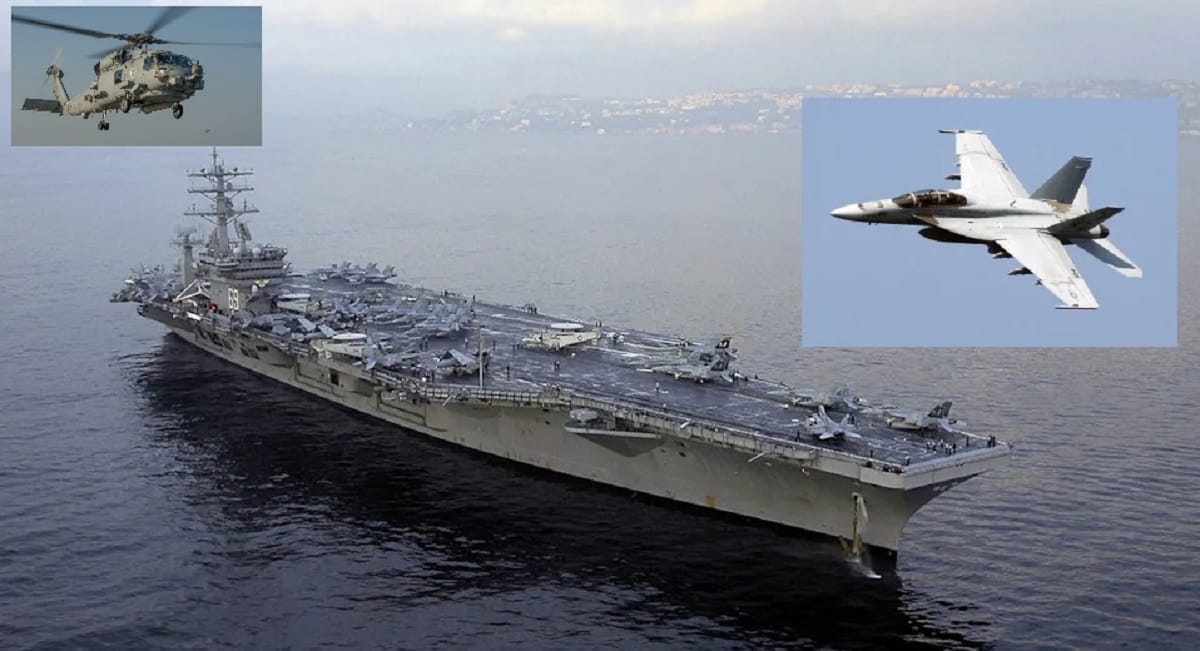
Washington D.C. (Star Struck Times) — In a rare and dramatic second-by-second sequence, two U.S. Navy aircraft from the aircraft carrier USS Nimitz crashed into the South China Sea on Sunday afternoon during routine flight operations, with all five crew members safely rescued, according to a statement from the U.S. Pacific Fleet.
The first incident involved a MH‑60R Seahawk helicopter assigned to Helicopter Maritime Strike Squadron 73 (“Battle Cats”) at approximately 2:45 p.m. local time, the Navy said. Roughly 30 minutes later, at 3:15 p.m., a F/A‑18F Super Hornet fighter jet from Strike Fighter Squadron 22 (“Fighting Redcocks”) crashed during its own routine operations from the same carrier.
The Navy confirmed all crew members were rescued and returned to the Nimitz for medical evaluation and are in stable condition. The cause of both mishaps remains under investigation, the fleet stated.

It is highly unusual for two aircraft from the same carrier to crash within half an hour of each other during routine operations — a scenario the White House described as “very unusual.” President Donald Trump, speaking from Air Force One, suggested the possibility of “bad fuel” but cautioned that the investigation must run its course.
Why It Matters
The Nimitz, based at Naval Base Kitsap, Washington, is on its final deployment before decommissioning and has been operating in the Indo-Pacific region as part of the U.S. effort to sustain freedom of navigation and maritime security in contested waters. The fact these crashes occurred in the South China Sea — a strategic waterway claimed almost wholly by China yet contested by multiple nations — raises fresh questions about operational risk in the region.
Immediate Response & Reaction
Search-and-rescue teams ashore and aboard the carrier strike group responded swiftly to retrieve the crews. In the first incident, all three members of the Seahawk were rescued; in the second, the two Super Hornet crew members ejected successfully and were recovered. One aviation analyst noted: “The odds of back-to-back losses like this are extremely low, making this a red-flag situation.”
U.S. Navy leadership has announced a full technical and operational review into both crashes. The investigation will examine aircraft maintenance logs, fuel quality, weather conditions, carrier deck operations and other possible contributing factors. The White House has insisted there will be “nothing to hide.”
Broader Context
These incidents follow a troubling pattern: the Navy has lost at least four Super Hornet jets in various incidents this year, including crashes in the Red Sea and off the Virginia coast. Given the high-stakes environment in the South China Sea — where the U.S. and China increasingly operate in close proximity — even non-fatal mishaps attract intense scrutiny. China’s maritime claims and naval build-up in the region have long been viewed as destabilizing by U.S. officials.
What Happens Now?
The upcoming investigation will be watched closely not just for technical findings but for what it signals about U.S. carrier aviation readiness and broader operational posture in contested waters. If a systemic issue is uncovered, it could lead to changes in how the Navy stages and conducts patrols in the Indo-Pacific.
FAQs
Q: Were there any fatalities?
A: No. All five crew members are safe and in stable condition, according to the U.S. Pacific Fleet.
Q: What caused the crashes?
A: The cause is under investigation. The White House has floated “bad fuel” as a possibility, but no official determination has been made.
Q: Where exactly did the crashes occur?
A: The Navy gave only a general location: over the South China Sea while operating from the USS Nimitz. Exact coordinates have not been released.
Q: Does this incident heighten U.S.-China tensions?
A: Potentially yes — any mishap in the region adds to existing friction over freedom-of-navigation operations, carrier patrols and China’s maritime claims.
Q: What happens to the Nimitz now?
A: The carrier remains deployed while the investigation is under way. Its scheduled decommissioning remains planned for next year.

Stay tuned as we will update this story with official investigation findings, regional military responses and detailed impact analysis.


Thanks for sharing. I read many of your blog posts, cool, your blog is very good.