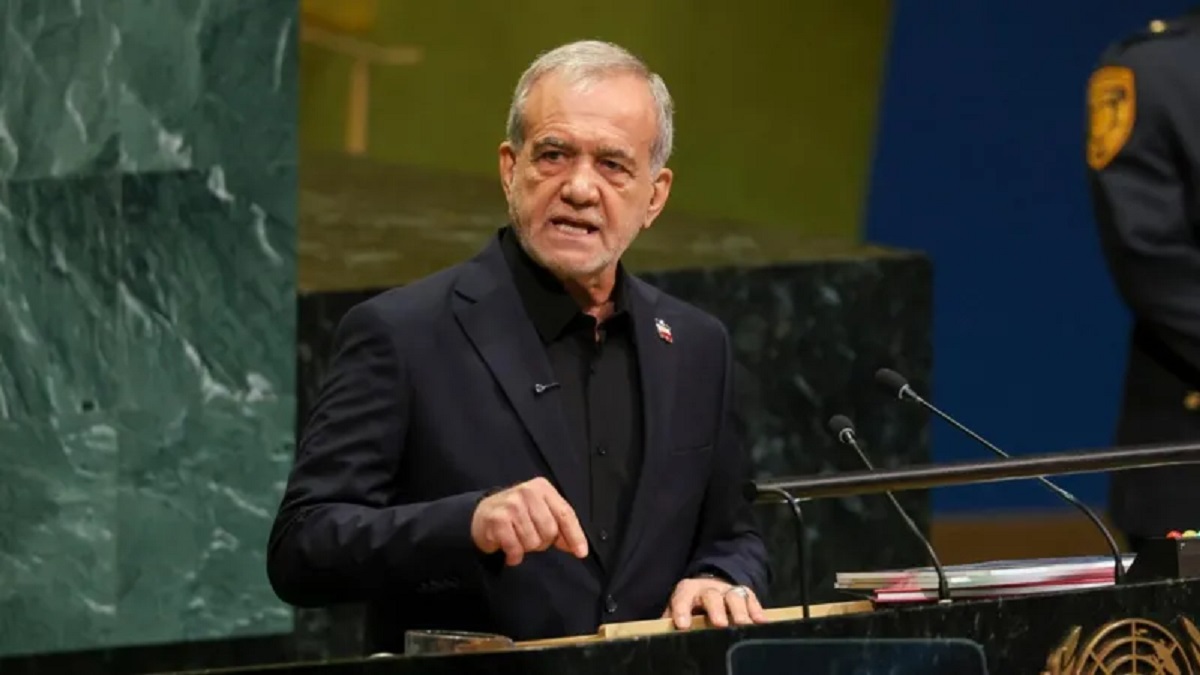
Iranian President Masoud Pezeshkian speaks at the UN General Assembly on September 23, 2026, as diplomatic contacts between Tehran and Washington resume.
NEW YORK — September 23, 2026 — Iranian President Masoud Pezeshkian told the United Nations on Wednesday that Iran would not surrender to U.S. pressure, while leaving the door open to diplomacy as Washington and Tehran resumed indirect contacts over ending their seven-month war. His remarks came a day after U.S. President Donald Trump warned that he could “annihilate” Iran if an agreement is not reached.
Pezeshkian said threats, sanctions and what he described as a “bullying mentality” would strengthen resistance rather than force Tehran to capitulate. Reuters reported that he also said Iran remained prepared for diplomacy, drawing a distinction between rejecting surrender and rejecting negotiations.
“We will never bend the knee,” Pezeshkian said, according to reports of his address.
The speech came as the United States and Iran were making their first significant diplomatic contact since earlier negotiations collapsed. Iranian Foreign Minister Abbas Araghchi and U.S. envoy Steve Witkoff held indirect discussions in New York with Qatari mediation, with the two sides still divided over the conditions for ending the conflict.
Key points
Pezeshkian rejected surrender while saying Iran remains open to a diplomatic settlement.
Trump had threatened to “annihilate” Iran if negotiations fail to produce an agreement.
US-Iran diplomatic contacts resumed on the sidelines of the UN General Assembly, mediated by Qatar.
The Strait of Hormuz is central to the negotiations: Tehran has indicated it could reopen the strategic waterway if Washington eases military pressure and lifts its blockade of Iranian ports.
No breakthrough has been announced. Iranian officials continue to demand an end to the blockade and other concessions, while Washington has maintained pressure on Tehran.
The Strait of Hormuz has become one of the most important bargaining points. Reuters reported Tuesday that an Iranian official said Tehran could reopen the waterway within a week if the United States reduced military pressure and lifted its blockade on Iranian ports. The proposal illustrates how maritime access and energy security have become directly linked to the diplomatic effort.
The latest developments therefore leave two tracks running simultaneously: public confrontation and private diplomacy. Pezeshkian’s UN address rejected Trump’s demand for Iranian capitulation, but the continuation of mediated talks suggests that Tehran has not closed the diplomatic channel.
For now, neither side has announced a new agreement or a confirmed timetable for ending the war. The UN General Assembly’s high-level debate continues through Sept. 26, with another scheduled session on Sept. 28.
The key development is not simply Pezeshkian’s defiant language. The more consequential issue is that his rejection of surrender came alongside continued diplomatic engagement, while the reopening of the Strait of Hormuz has emerged as a concrete condition in negotiations. That combination makes the latest exchange more complicated than a straightforward escalation in rhetoric.
Hello! I'm M Muzamil Shami, the founder and lead editor of Star Struck Times, your trusted source for trending news, entertainment scoops, celebrity gossip, sports highlights, and global headlines.
With a passion for storytelling and journalism, I created this platform to bring you breaking news, viral moments, and deep insights into the worlds of Bollywood, Hollywood, sports, politics, tech, and more — all in one place.