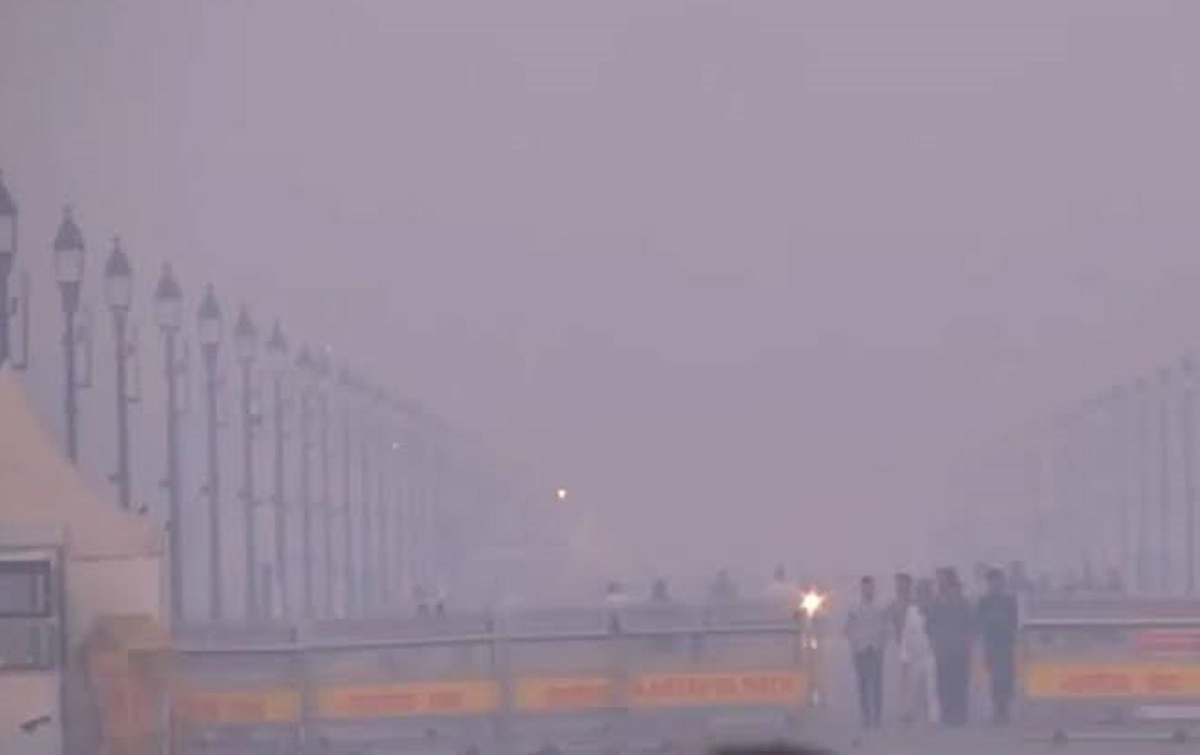
Delhi’s air pollution worsened further on Wednesday as the capital’s Air Quality Index (AQI) climbed to 373 in the ‘very poor’ category, raising concerns about another severe smog episode ahead of Diwali on November 8. The deterioration comes despite anti-pollution restrictions already being enforced across Delhi-NCR and a Supreme Court order limiting the use of fireworks to certified green crackers during designated hours.
According to Hindustan Times, Delhi recorded an AQI of 373 at 7:05 am on Wednesday, November 4, compared with Tuesday’s 24-hour average of 350. A separate Press Trust of India report put the CPCB reading at 379 later on Wednesday morning, illustrating how pollution readings can change throughout the day. India News+1
Key Points
Delhi’s AQI reached 373 at 7:05 am on Wednesday, remaining in the very poor category.
Twenty-one of the capital’s 59 monitoring stations recorded severe pollution.
GRAP Stage 2 restrictions are in force across Delhi-NCR.
The Supreme Court has permitted certified green crackers only during limited hours on November 7 and 8.
Forecasts indicate that Delhi’s air quality could remain very poor or deteriorate to severe levels in the coming days.
Several Delhi Areas Record Severe Pollution
The worsening citywide average is only part of the problem. Local monitoring stations have reported substantially higher pollution levels.
Hindustan Times reported that 21 out of 59 monitoring stations had entered the severe category on Wednesday morning. Punjabi Bagh recorded an AQI of 452, followed by Jahangirpuri at 450 and IIT Delhi at 446.
PM2.5, fine particulate matter capable of penetrating deep into the lungs, was the primary pollutant at 54 monitoring stations.
Under the Central Pollution Control Board’s classification, an AQI between 301 and 400 is very poor, while readings above 400 fall into the severe category. India News+1
Why Delhi’s Air Is Getting Worse
The deterioration is linked to several overlapping sources of pollution rather than fireworks alone.
During the pre-winter period, cooler temperatures, weaker winds and unfavourable atmospheric conditions can prevent pollutants from dispersing. Vehicle emissions, construction dust, industrial activity and agricultural residue burning also contribute to the seasonal pollution problem.
The Air Quality Early Warning System for Delhi, operated by the Ministry of Earth Sciences, forecast very poor air quality from November 4 to November 6. Its longer outlook warned that conditions could fluctuate between very poor and severe during the following six days. Air Quality Early Warning System+1
The problem is not confined to India’s capital. A Reuters report published on November 3 described worsening pollution across northern India and neighbouring Pakistan.
Reuters reported that Lahore’s AQI had reached 447 on IQAir’s scale, while Delhi recorded 215 on the same platform. India’s Central Pollution Control Board, however, reported Delhi’s AQI at 332.
The difference reflects the two organisations’ different measurement systems and classification methods. It is important not to compare their figures as though they were readings from the same scale. Reuters+1
What the Firework Restrictions Actually Allow
With Diwali approaching, the Supreme Court has introduced a temporary relaxation for certified green crackers rather than permitting unrestricted fireworks.
Under its October 29 order, made public on November 2, the court allowed the bursting of approved green crackers in Delhi-NCR during two daily windows on November 7 and 8:
Morning: 6 am to 7 am.
Evening: 8 pm to 10 pm.
The order also requires restrictions around sensitive locations. Fireworks are prohibited within 300 metres of hospitals, nursing homes, healthcare centres, old-age homes, educational institutions and designated silence zones.
The court’s directions also require product-specific QR codes and certification for permitted green crackers. The manufacture and sale of firecracker chains, commonly known as ladis, are not permitted.
Importantly, the temporary permission ends after November 8, with the complete firecracker ban scheduled to return from November 9. Legal News – The Indian Express+2
GRAP Stage 2 Restrictions Are Already in Force
The Commission for Air Quality Management (CAQM) activated Stage 2 of the Graded Response Action Plan across Delhi-NCR on November 2 after pollution levels crossed the 300 mark.
The measures include higher parking charges to discourage private vehicle use, restrictions on coal and firewood in restaurants and hotels, tighter controls on diesel generator sets and additional road-cleaning and dust-suppression measures.
Authorities have also been instructed to strengthen public transport services and enforce pollution-control requirements.
However, the worsening readings show that these measures have not yet brought immediate relief to the capital. Their effectiveness will depend on enforcement, weather conditions and the combined impact of pollution sources across the wider region. India Today+1
The Challenge Ahead
Delhi is entering Diwali week with already elevated pollution levels, several monitoring stations recording severe conditions and forecasts offering little immediate reassurance.
The limited green-cracker permission establishes when certain fireworks may be used, but it does not eliminate the emissions already accumulating from transport, construction, industrial activity and agricultural burning.
The coming days will therefore be an important test of whether enforcement measures and favourable weather can prevent the city’s air quality from deteriorating further.
For residents, the immediate concern is not simply how much pollution Diwali celebrations may add, but how much pollution the city is already struggling to clear before the festival begins.
Hello! I'm M Muzamil Shami, the founder and lead editor of Star Struck Times, your trusted source for trending news, entertainment scoops, celebrity gossip, sports highlights, and global headlines.
With a passion for storytelling and journalism, I created this platform to bring you breaking news, viral moments, and deep insights into the worlds of Bollywood, Hollywood, sports, politics, tech, and more — all in one place.