Emergency evacuation in Sindh as rivers swell under deep monsoon depression Pakistan’s flood warnings.
As Pakistan Battles Nature’s Fury: What Happens When a Monsoon Depression Weakens Too Late?
Pakistan is in the grip of unprecedented chaos as a deep monsoon depression moving from Gujarat into southeast Pakistan begins to weaken—but the storm’s damage has already begun. With thousands evacuated and riverbanks bursting, questions are rising: Can warnings and reactions keep pace with the rapidly escalating flood threat?
Key Points
A deep monsoon depression crossed from Gujarat into southeastern Pakistan, weakening in strength but bringing massive rainfall and flood risk.
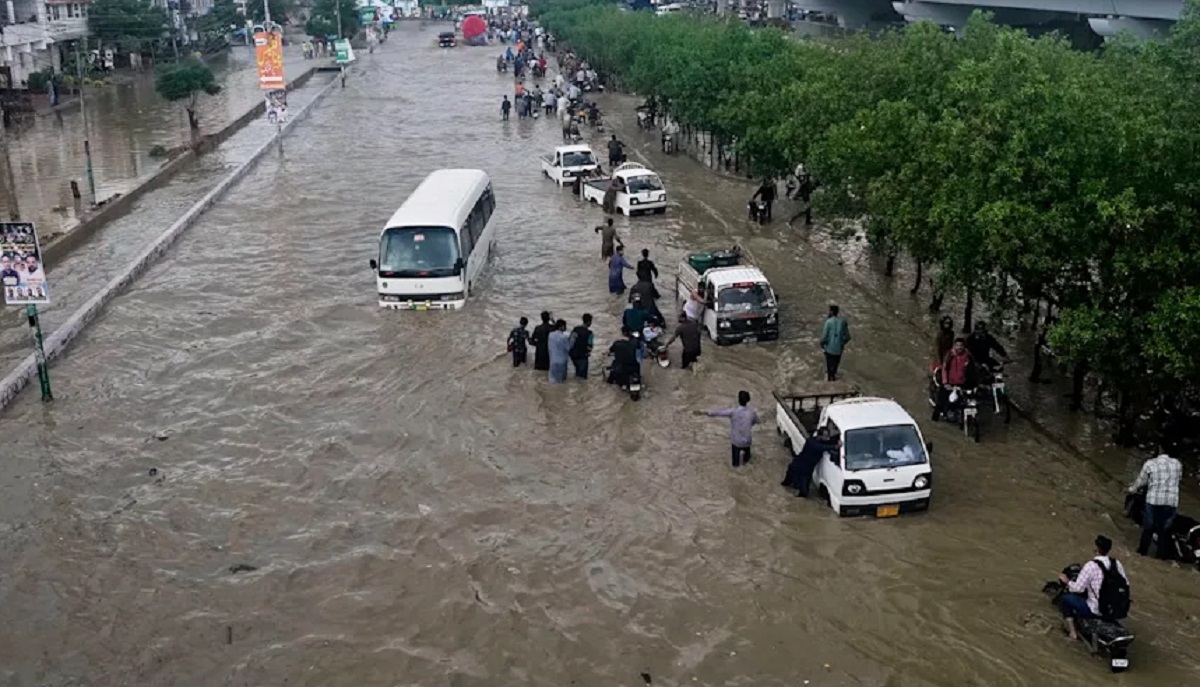
Sindh and parts of Punjab saw mass evacuations as rivers surged and low-lying areas flooded.
Local communities reported delays, miscommunication, and lack of resources for timely evacuation.
Experts emphasized that weakening does not equate to safety—the system’s moisture and rainfall can continue to fuel flooding downstream.
Government defended actions, saying warnings, shelters, rescue operations activated, but acknowledged gaps.
Severe agricultural damage, displacement, and health risks are expected in the wake of flooding.
Background: How the Deep Monsoon Depression Pakistan Emerged
Meteorological experts had been tracking a low-pressure area over Gujarat for days when it intensified into a depression. As forecasted, it crossed the border and strengthened into a deep monsoon depression—setting the stage for heavy rains and surging rivers in southern Pakistan. The Pakistan Meteorological Department (PMD) issued its first alerts as the system approached Sindh and southern Punjab, warning of potential river swells and flooding downstream.
Conflict: Warnings Versus Reality
Despite early alerts, many rural communities in Sindh and Punjab were underprepared. Local authorities called for mass evacuations, but logistical challenges—poor roads, sparse infrastructure, delayed communication—slowed the process. Meanwhile, heavy rainfall already swamped low-lying areas.
Residents like Amir Khan, a small-scale farmer in Thatta, recount:
“They told us to leave, but the water rose faster than our tractors. We had nowhere safe to go.”
Community leaders and NGO workers say the warnings were too technical, not localized, and thus failed to reach vulnerable families early enough.
Escalation: Floods, Evacuations, and Rapid Response
As the depression weakened in strength, rainfall did not let up. River systems—Indus, its tributaries—surged beyond warning levels.
Mass evacuations were ordered in Thatta, Badin, and Sujawal districts in Sindh. Tens of thousands of residents moved to higher ground or government shelters.
In southern Punjab, districts like Rahim Yar Khan braced for mudflows and inundation.
Local agencies deployed rescue teams, relief camps, and started distributing food and medical aid.
The PMD released its flood risk bulletin on “orange watch,” indicating imminent danger. “We were caught between weakening wind speeds and unabating rainfall,” admitted PMD Director General Ahsan Iqbal in a press briefing.
Reaction: Public Outcry & Expert Analysis
As rivers crested and villages submerged, anger and fear spread. Critics accuse local governments of delays in evacuations and insufficient support. Social media is lighting up with posts showing flooded homes, stranded families, and destroyed crops.
Experts step in with commentary:
“Even a weakening depression carries enormous moisture,” explained Dr. Farah Hussain, hydrology specialist at Karachi University. “What matters is not just wind or pressure but rainfall duration and topography.”
Agricultural economists warn of long-term impacts, particularly on rice and sugarcane crops. Displaced families now worry about shelter, hygiene, and disease outbreaks.
Defence: Government & Agencies Respond
Facing criticism, authorities say they have acted swiftly given the scale. Federal disaster management claims to have pre-positioned supplies, mobilized rescue teams, and set up temporary shelters. The military and civil defense have been involved in outreach to remote villages.
PMD stresses that while the system is weakening in terms of wind strength and central pressure, rainfall intensity and flood risk downstream remain high. The fact that the depression has weakened does not reduce the urgency.
Officials say:
“Weakening does not mean safe,” reiterated Sindh Chief Minister Syed Murad Ali Shah. “Our priority now is saving lives, not metrics.”
Conclusion: What’s Next for Deep Monsoon Depression Pakistan
With the depression slowly diminishing, the focus shifts to recovery, relief, and learning. Floodwaters will recede only gradually; risks of waterborne diseases loom. Crop damage, infrastructure loss, and displacement are expected to have lasting effects.
Going forward, stakeholders emphasize the need for:
improved early-warning systems in localized dialects,
better evacuation infrastructure,
quicker disaster relief deployment,
climate-resilient agricultural planning.
For Pakistan, the episode is a somber reminder: even a weakening monsoon system can trigger devastation when poverty, geography, and infrastructure gaps collide with nature’s force.
FAQs
Q: What exactly is a “deep monsoon depression”? A: It’s a meteorological system with low atmospheric pressure that brings heavy rainfall, strong winds, and moisture over a region. “Deep” refers to its strength in rainfall and moisture load, even if wind speeds weaken.
Q: Is a weakening depression still dangerous? A: Yes. Even as wind speeds or central pressure drop, the rainbands can be intense. Flood risk, river overflow, landslides, and downstream damage often depend more on rainfall amount and duration than wind alone.
Q: Which areas of Pakistan are most affected by this depression? A: Sindh province—especially districts like Thatta, Badin, Sujawal—and southern Punjab (e.g. Rahim Yar Khan) are bearing the brunt due to geography, river systems, and low elevation.
Q: What measures are government and agencies taking? A: Evacuations to shelters, disaster management deployments, rescue operations, flood warnings from PMD, medical and relief aid distribution, coordination with local NGOs and authorities.
Q: How can people stay safe during flood threats? A: Heed local evacuation orders immediately, keep emergency supplies ready, avoid crossing flooded roads, move to higher ground, stay updated via radio, TV or official apps, and follow guidelines from disaster management authorities.
Have you or your community seen flooding? Share your story, photos or updates in the comments. Follow us for live alerts, maps, and expert guidance as this situation unfolds. Share this article to raise urgent awareness — lives depend on timely action.
Hello! I'm M Muzamil Shami, the founder and lead editor of Star Struck Times, your trusted source for trending news, entertainment scoops, celebrity gossip, sports highlights, and global headlines.
With a passion for storytelling and journalism, I created this platform to bring you breaking news, viral moments, and deep insights into the worlds of Bollywood, Hollywood, sports, politics, tech, and more — all in one place.
4 thoughts on “Deep Monsoon Depression Teeters on Collapse Over Pakistan — Mass Evacuations & Flash Flood Drama Unfolds”
Thank you for your sharing. I am worried that I lack creative ideas. It is your article that makes me full of hope. Thank you. But, I have a question, can you help me?
Thank you for your sharing. I am worried that I lack creative ideas. It is your article that makes me full of hope. Thank you. But, I have a question, can you help me?









Thank you for your sharing. I am worried that I lack creative ideas. It is your article that makes me full of hope. Thank you. But, I have a question, can you help me?
Thank you for your sharing. I am worried that I lack creative ideas. It is your article that makes me full of hope. Thank you. But, I have a question, can you help me?
Can you be more specific about the content of your article? After reading it, I still have some doubts. Hope you can help me. https://www.binance.bh/register?ref=MBLCVVZG
Can you be more specific about the content of your article? After reading it, I still have some doubts. Hope you can help me. https://www.binance.bh/register?ref=QCGZMHR6