


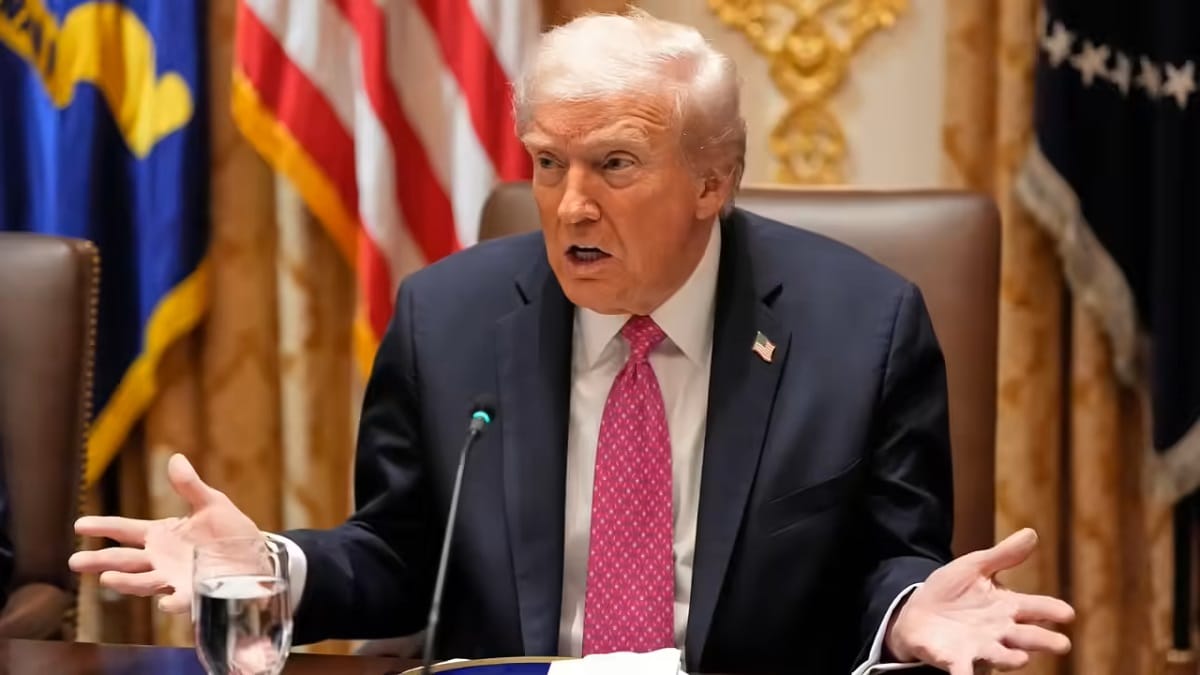
Kuala Lumpur (Star Struck Times) — US President Donald Trump has vowed to “solve very quickly” the escalating crisis between Pakistan and Afghanistan, stating the cross-border dispute is the final “war” on his list after earlier claims of ending eight conflicts in eight months.
In remarks made on the sidelines of the ASEAN Summit in Kuala Lumpur, President Trump directly addressed the gathering of regional leaders, praising Pakistan’s Prime Minister Shehbaz Sharif and Army Chief Asim Munir as “great people,” and declaring that he would intervene to bring about a resolution.
The announcement comes at a critical juncture: Islamabad and Kabul are engaged in round-two peace talks in Istanbul, following a fragile cease-fire struck earlier this month after deadly border clashes—the worst in years.

Trump’s comments signal both a bold diplomatic push and a high-stakes gamble. “I heard that Pakistan and Afghanistan have started up,” he told reporters. “But I’ll get that solved very quickly.”
Conflict background & urgency:
The neighbouring states have been locked in escalating tensions after Pakistani authorities accused the Afghan Taliban regime of harbouring militants launching cross-border attacks—a charge Kabul denies. The cease-fire agreement, brokered under Qatari and Turkish mediation, entered its next phase in Istanbul as both sides discuss establishing a joint monitoring mechanism to prevent further violence.
In praising Pakistan’s leaders and offering US mediation, Trump appears to be reshaping his administration’s diplomatic posture toward South Asia—making regional conflict-resolution a visible component of his global agenda. According to one report:
“We’ve ended eight wars in eight months… There’s just one left, between Pakistan and Afghanistan, and I’ll take care of that very soon.”
Strategic implications & regional reaction:
The promise has stirred a mix of cautious optimism and scepticism among analysts. On one hand, Pakistan’s leadership welcomed the public endorsement, confident it elevates Islamabad’s leverage and signals closer ties with Washington. On the other, observers warn that Trump’s ambitious timetable may raise unrealistic expectations—especially given the deep-rooted mistrust and militant dynamics that have stymied past efforts.
One Pakistani official, speaking off-record, stated:
“His words matter to us — the US coming into the equation changes the dynamics.”
Meanwhile, a Kabul-based analyst commented:
“This is the easiest part: signalling. The real test will be on the ground implementing mechanisms.”
What comes next:
The Istanbul talks must now transition from verbal assurances to concrete frameworks. According to Afghan state media, one proposal submitted calls for Pakistani non-interference in Afghan airspace and territory, and creation of a four-party monitoring channel to track cease-fire violations. Should either side fail to concede or cooperate, Islamabad’s defence minister has warned that the alternative could be “open war.”

President Trump’s intervention may accelerate progress, but much hinges on mutual trust, enforcement mechanisms, and sustained engagement beyond sensational headlines. The world will watch whether the pledge to “solve very quickly” is followed by steps that make the difference.
FAQs
Q: What exactly did President Trump say?
A: He said on the sidelines of the ASEAN Summit that despite recent flare-ups, he would get the Pakistan-Afghanistan conflict “solved very quickly”.
Q: Why is the conflict considered so urgent now?
A: Because the recent border clashes between Pakistan and Afghanistan resulted in deaths and a fragile cease-fire, with both sides seeking to avoid a return to open hostilities.
Q: What role will Pakistan’s leaders play?
A: President Trump specifically praised Pakistani Prime Minister Shehbaz Sharif and Army Chief Asim Munir, boosting Pakistan’s diplomatic standing and signaling US alignment with Islamabad’s leadership.
Q: What happens if the talks fail?
A: Pakistan’s defence minister has warned that failure to reach an agreement could lead to “open war” with Afghanistan.
Q: Is this just rhetoric or a real mediation offer?
A: While President Trump’s commitment is bold, actual mediation requires frameworks, timelines and enforcement. Analysts caution this may be a high-visibility diplomatic gesture that still needs substance.
Stay tuned for updates as developments emerge from the Istanbul talks and Washington’s engagement unfolds.




Thanks for sharing. I read many of your blog posts, cool, your blog is very good. https://www.binance.com/register?ref=JW3W4Y3A