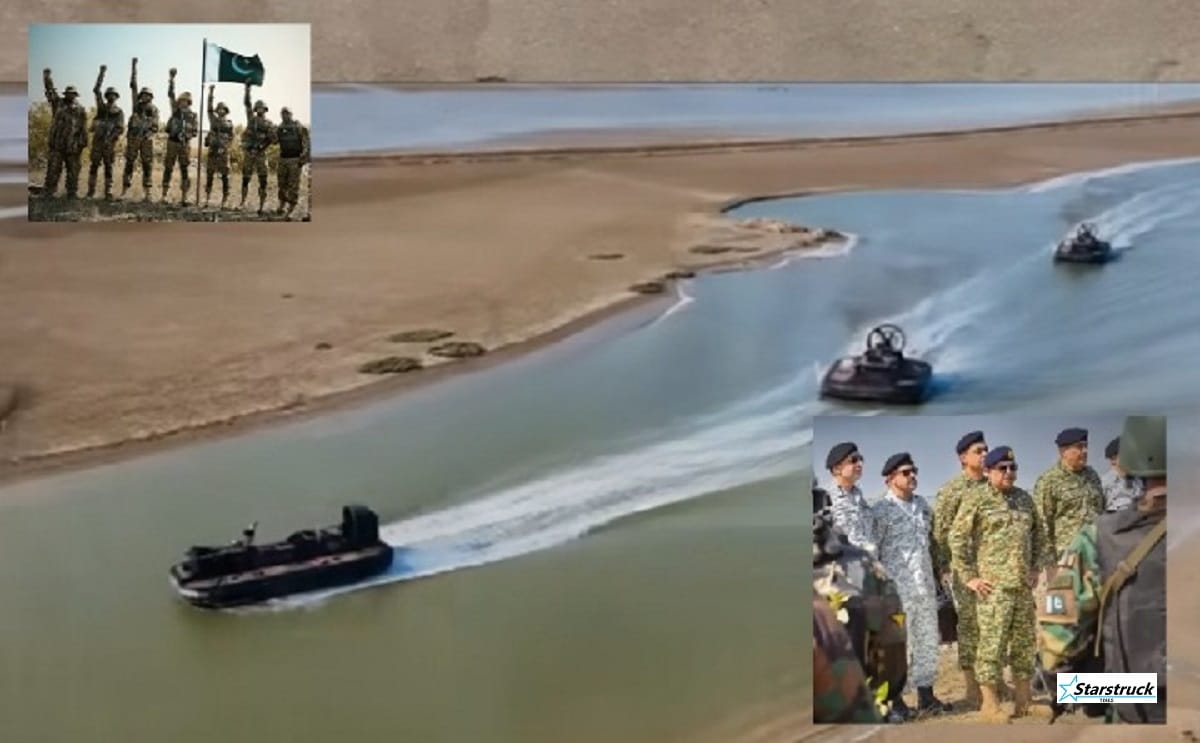
Indian and Pakistani forces on alert near Sir Creek — a disputed marshland now at the heart of a growing regional standoff.
Karachi/New Delhi (Star Struck Times) — A sharp escalation of military positioning by Sir Creek — the 96-km tidal estuary separating India’s Gujarat from Pakistan’s Sindh province — has ignited heightened tension between Pakistan and India, with New Delhi issuing a stern warning that any “misadventure” will be met with a decisive response.
India’s Defence Minister Rajnath Singh, during a visit to a military station near Bhuj in Gujarat, stated that Pakistan’s recent infrastructure build-up around Sir Creek “reveals its intentions” and warned that any move would “change both history and geography.”
According to multiple reports, satellite imagery and intelligence indicate that Pakistan has accelerated deployment of fortified bunkers, roads, amphibious posts and surveillance assets in and around Sir Creek. The region has long been a contested zone over maritime boundaries and resource rights, but the recent mobilisation appears to reflect a strategic shift rather than routine posture.
India is responding in kind. The country has issued a NOTAM (Notice to Air Men) for airspace restrictions in Rajasthan and Gujarat and announced the large-scale tri-service exercise Exercise Trishul on its western frontier from October 30 to November 10.
Why this matters now Sir Creek is more than a marshy border zone. According to experts at The Diplomat, its location gives it a “flashpoint” potential: it lies just 200 km from Karachi and adjacent to major Indian ports in the Gulf of Kutch, making any escalation likely to have wider maritime and economic consequences.
Furthermore, the unresolved boundary dispute—Pakistan claiming the eastern bank, India insisting on the Thalweg (mid‐channel) principle—adds fuel to the strategic calculus. Analysts caution that this terrain is difficult, with marshland, shifting waters, and limited infrastructure making military operations especially challenging.
Regional and domestic ripples Indian fan forums and defence commentators have reacted with alarm at the build-up. One observer wrote: “Pakistan’s moves near Sir Creek can’t just be defensive—they’re shaping a claim.”
On Pakistan’s side, official silence is notable. Local media round-ups cite no formal response yet, while Islamabad may prefer to observe rather than provoke. But the build-up suggests it is taking the region seriously—possibly linking it to broader conventional and maritime deterrence strategy.
India’s strong public stance also feeds into domestic narratives about deterrence and regional balance. Defence Minister Singh’s invocation of past wars (“In 1965 we reached Lahore… today one route to Karachi passes through the Creek”) underscores the symbolic weight the area holds in Indian strategic thinking.
What comes next? Diplomatic channels remain open, but the risk of miscalculation is higher than usual. If Pakistan proceeds with infrastructure expansion or manoeuvres unilaterally in the disputed zone, India has already warned it will respond with “force” to alter the status quo.
Conversely, India’s military exercise and airspace restrictions signal readiness—not just for border skirmishes but for a broader multi-domain response. This raises questions: Is this build-up simply posturing, or a prelude to more aggressive signalling? And how will both nations manage escalation control given nuclear overhang and regional instability?
Bottom line: The Sir Creek region, long overlooked compared with Kashmir or LoC disputes, is now taking centre-stage in Indo-Pak rivalry. The marshlands may look quiet, but beneath they host strategic tensions that could ripple across South Asia’s security architecture.
FAQs
What is Sir Creek? Sir Creek is a 96-kilometre tidal estuary between Gujarat (India) and Sindh (Pakistan) that flows into the Arabian Sea.
What is the dispute about? The dispute centers on maritime boundary demarcation. India invokes the Thalweg principle (mid-channel rule), Pakistan rejects it and claims the eastern bank. The boundary outcome influences Exclusive Economic Zones and resource control.
Why is military build-up happening now? According to Indian defence sources, Pakistan has expanded military infrastructure near Sir Creek following India’s operations earlier in 2025 (e.g., Operation Sindoor) and is positioning for amphibious, surveillance and maritime operations.
Could war break out? While neither side has signalled intent for full-scale war, the strategic messaging is strong. India has warned of “history-changing” responses. Escalation remains a risk if missteps occur.
What does this mean for Pakistan and India? For India: A successful deterrence would reinforce regional posture; a failure could embolden Pakistani ambitions. For Pakistan: The build-up may be calculated risk, but miscalculation could backfire, especially given India’s greater resources.
Hello! I'm M Muzamil Shami, the founder and lead editor of Star Struck Times, your trusted source for trending news, entertainment scoops, celebrity gossip, sports highlights, and global headlines.
With a passion for storytelling and journalism, I created this platform to bring you breaking news, viral moments, and deep insights into the worlds of Bollywood, Hollywood, sports, politics, tech, and more — all in one place.