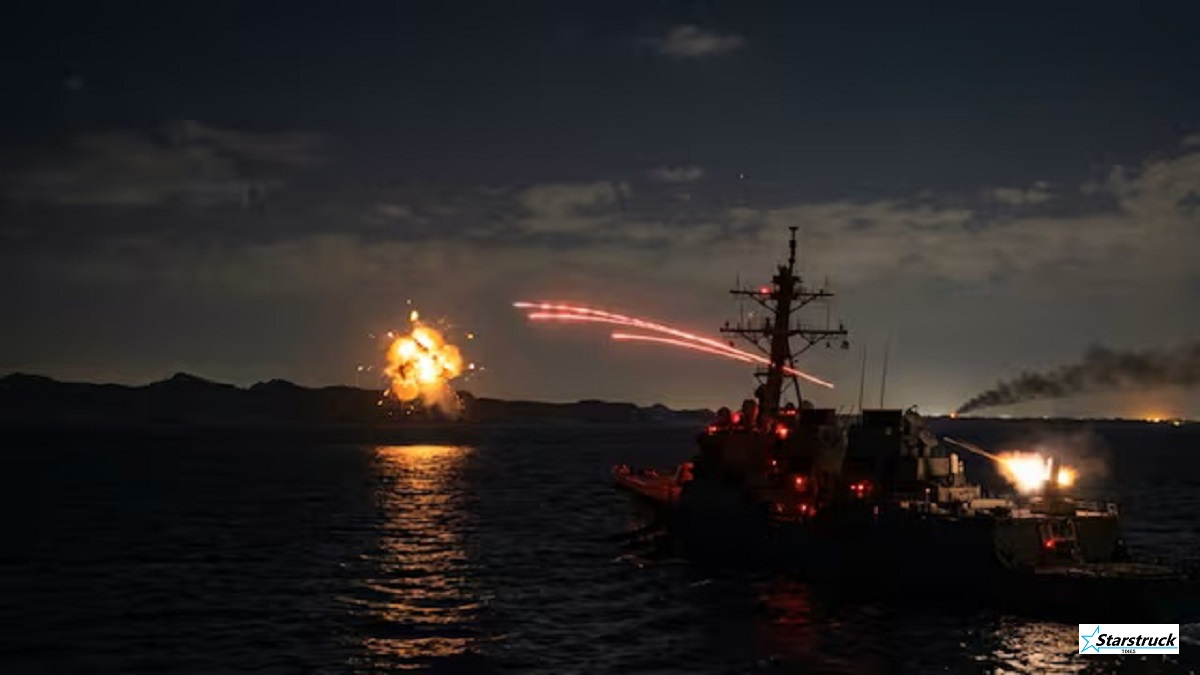
In a shocking mid-night escalation that has stunned global markets and sent shockwaves through Washington, US PresidentDonald Trump has officially ordered a devastating second consecutive night of precision military airstrikes deep inside Iranian territory. The high-stakes military action comes immediately after an unauthorized Iranian one-way attack drone smashed directly into the M/T Kiku, a massive Panama-flagged oil tanker carrying over two million barrels of volatile crude oil near the vital Strait of Hormuz bottleneck. This sudden outbreak of kinetic warfare has completely dismantled a fragile, hard-fought Middle East ceasefire established just eleven days ago under a highly confidential bilateral memorandum of understanding. As anti-aircraft fire illuminated the night skies over the strategic Persian Gulf coastline, elite global intelligence networks warned that the world’s most critical energy corridor is teetering on the edge of an all-out, catastrophic conflagration.
Key Points
Ceasefire Shattered: The historic June 17 Memorandum of Understanding (MoU) between Washington and Tehran is in absolute ruins after less than two weeks of calm.
Double Night Strikes: US Central Command (CENTCOM) confirmed that a fleet of multi-role fighter jets blasted Iranian military surveillance infrastructure, communication nodes, and coastal minelayer capabilities.
Shipping Under Siege: Two commercial vessels—the Singapore-flagged Ever Lovely and the Panama-flagged M/T Kiku—were violently targeted by suspected Islamic Revolutionary Guard Corps (IRGC) suicide drones within a 48-hour window.
Trump’s Ultimatum: Speaking directly from the Oval Office, President Donald Trump warned that “foolish violations” of international law would be met with overwhelming, lethal American military force.
Inside the Oval Office: How Donald Trump Directed the Retaliation
According to a senior White House correspondent and entertainment-political reporter for Star Struck Times, the atmosphere inside the West Wing shifted from cautious diplomacy to intense war-footing within mere minutes of the M/T Kiku distress call. For months, the administration had touted the June 17 interim agreement as a landmark foreign policy triumph that would stabilize runaway global energy prices and secure safe passage for international maritime commerce.
When international journalists gathered in the Oval Office early Friday and boldly pressed the commander-in-chief on whether the United States would hit back against early maritime provocations, Trump delivered a chilling, viral four-word warning:
“You’ll find out.”
Hours later, the sky over the southern Iranian port of Sirik erupted in flames. But it was the second wave of attacks on Saturday night that proved Washington has discarded its playbook of measured deterrence. White House insiders reveal that Trump was furious that Tehran ignored his initial Friday warning, interpreting the subsequent drone strike on the M/T Kiku at 4:30 a.m. ET as a direct, calculated insult to American resolve.
Vice President JD Vance, who served as the chief US negotiator during the tense backchannel talks in Oman, took to social media to reinforce the administration’s aggressive posture. “If Iran has disagreements about how the MOU is being applied, they can pick up the phone,” Vance stated bluntly. “But violence will be met with violence.”
The Battle for the Strait of Hormuz: Drones vs. Tomahawks
The tactical details released by US Central Command paint a picture of a meticulously synchronized aerial assault. Utilizing a deadly mix of carrier-based strike fighters and standoff precision-guided munitions, the second night of strikes targeted highly specific, high-value assets along Iran’s rugged southern coastline and the heavily fortified Qeshm Island.
Target Class
Military Function
Operational Status Post-Strike
Coastal Radar Arrays
Tracking international commercial shipping
Completely Blinded
IRGC Drone Storage
Launching one-way suicide UAVs
Destroyed / Secondary Explosions
Minelayer Assets
Capabilities to physically choke the Strait
Heavily Damaged
Command & Control
Sub-surface communication infrastructure
Severely Disrupted
According to authoritative updates from Reuters and the BBC, British military monitors confirmed that while the Ever Lovely suffered upper-deck structural damage from a four-drone swarm on Thursday, the ship miraculously escaped crew casualties. However, the subsequent targeting of the M/T Kiku—a supertanker loaded to maximum capacity with crude—raised the stakes from a localized skirmish to an existential threat to western supply chains. The International Maritime Organization (IMO) moved rapidly to halt all planned U.N.-backed merchant vessel evacuations through the alternative Omani coastal channels, declaring the waterway fundamentally unsafe until permanent security guarantees are established.
What Other Reports Missed: The Secret Oil Toll Dispute
While mainstream media networks remain hyper-focused on the kinetic aspect of the missile exchanges, veteran intelligence insiders point to a deep-seated economic dispute that secretly doomed the June 17 agreement from its inception.
According to classified documents leaked to regional maritime analysts, the 14-point memorandum of understanding required Iran to permit the free transit of all commercial cargo “at no charge for 60 days” while permanent terms were hammered out. However, hardline factions within Iran’s Islamic Revolutionary Guard Corps vehemently opposed this concession, labeling it a subversion of their national sovereignty over the strait.
Just 24 hours before the first drone took flight, Iranian Deputy Foreign Minister Kazem Gharibabadi signaled the regime’s incoming defiance in a highly public, combative social media post:
“Safe passage cannot be guaranteed by vague arrangements, parallel routes, or decision-making outside of Iran’s consideration as a coastal state. Any credible framework must be based on direct coordination with Iran.”
In essence, Iran attempted to retroactively impose a steep “transit tariff” on western-affiliated container ships. When companies like the operators of the Ever Lovely refused to pay or log their cargo logs with Tehran’s port authorities, the IRGC unleashed its lethal drone arsenal to enforce its unofficial toll booth. This hidden economic friction is what transformed a standard diplomatic misunderstanding into an explosive, multi-theater military crisis.
Frequently Asked Questions
Why did the US launch a second night of strikes against Iran?
The US launched a second wave of airstrikes because Iran launched a subsequent one-way attack drone that struck the Panama-flagged oil tanker M/T Kiku on Saturday morning, directly violating the freshly signed June 17 ceasefire agreement.
What is the significance of the Strait of Hormuz?
The Strait of Hormuz is the world’s most critical maritime energy choke point. Roughly 20% of the world’s petroleum liquids pass through this narrow waterway daily, making its operational status vital to global economic stability.
Did Iran retaliate against the US military installations?
Yes. Following the initial Friday strikes near the port of Sirik, the Islamic Revolutionary Guard Corps (IRGC) issued a statement via state media claiming they targeted US military logistics assets in the region and warned of an even larger response if American aggression continues.
What happened to the cargo ships Ever Lovely and M/T Kiku?
The Singapore-registered Ever Lovely was struck on its upper deck by an Iranian projectile on Thursday but sustained no crew casualties. The M/T Kiku, carrying two million barrels of oil, was hit early Saturday morning, sparking the second round of US retaliatory bombardments.
The Looming Threat of Global Escalation
The immediate fallout of this military escalation is already manifesting in global financial markets. Brent crude futures surged by over 6% within hours of CENTCOM’s second press briefing, as energy traders factored in the very real possibility of a prolonged closure of the Persian Gulf.
For Donald Trump, the situation represents a volatile trial by fire for his “peace through strength” foreign policy doctrine. By hitting Iran directly on its home soil rather than targeting localized regional proxies, the Trump administration has signaled that the traditional rules of asymmetric engagement are completely off the table.
As long-range B-1B bombers remain deployed to regional forward operating bases and Iranian fast-attack missile boats swarm the shipping lanes, the next 48 hours will decide whether diplomacy can be salvaged, or if the Middle East is destined to descend into a historic, uncontainable conflict.
What do you think? Is President Donald Trump’s aggressive military response the right way to protect international shipping, or is Washington walking straight into a dangerous trap? Let us know your thoughts in the comments section below!
Check out our World News and Global Politics categories for live, minute-by-minute updates on the unfolding military situation in the Middle East.
Hello! I'm M Muzamil Shami, the founder and lead editor of Star Struck Times, your trusted source for trending news, entertainment scoops, celebrity gossip, sports highlights, and global headlines.
With a passion for storytelling and journalism, I created this platform to bring you breaking news, viral moments, and deep insights into the worlds of Bollywood, Hollywood, sports, politics, tech, and more — all in one place.