Washington, USA — Star Struck Times
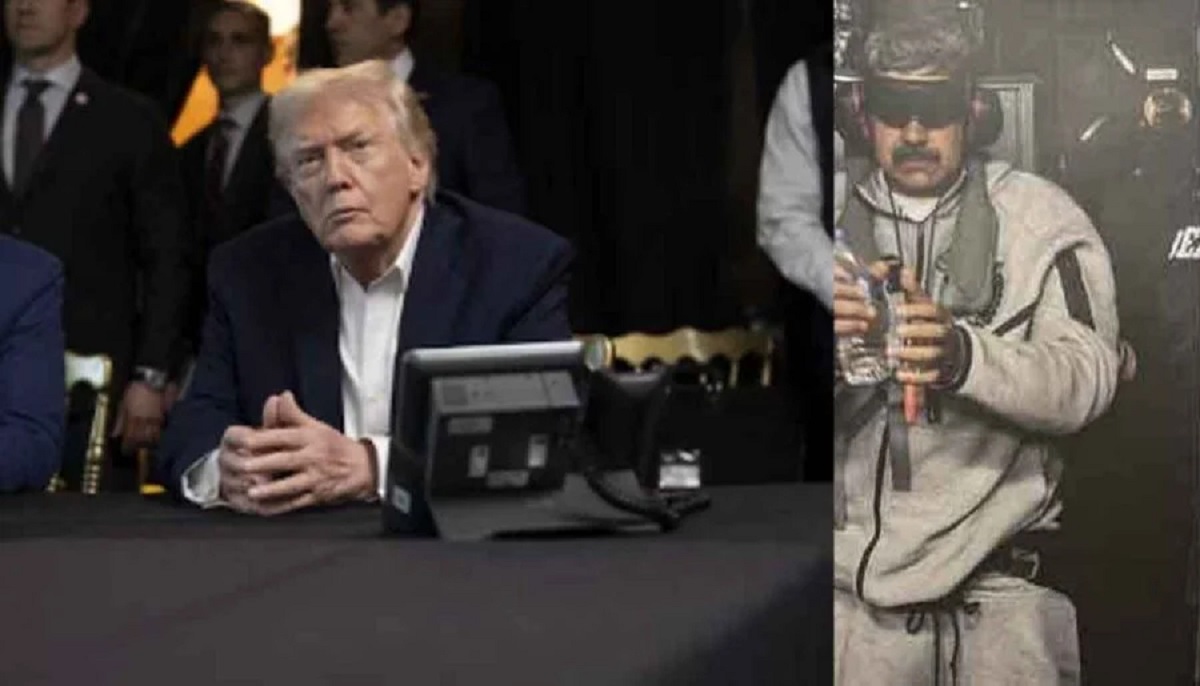
In a dramatic escalation of U.S.–Venezuela tensions, President Donald Trump released a photograph on January 3 showing Venezuelan President Nicolás Maduro aboard the U.S. Navy amphibious assault ship USS Iwo Jima after a large‑scale U.S. military operation in Venezuela, according to multiple international news agencies. The U.S. carried out coordinated strikes across Caracas and other locations, capturing Maduro and his wife, Cilia Flores, and transporting them to the United States where they are expected to face federal narcotics and weapons charges. The unprecedented action has drawn mixed global reactions and raised legal and geopolitical questions.
Key Highlights
- U.S. forces conducted “large‑scale strikes” in Venezuela on January 3, 2026.
- Maduro and his wife were captured and taken aboard USS Iwo Jima. CBS News
- The couple is being flown to New York to face federal charges.
- World leaders express a mix of support and condemnation.
- Legal experts question the operation’s compliance with international law.
What Happened
In the early hours of January 3, 2026, the United States launched a massive military operation targeting key Venezuelan infrastructure, including military bases and strategic sites in Caracas, the capital city. President Trump announced that the attacks were aimed at dismantling criminal networks and capturing Maduro, who had been indicted in U.S. courts on narco‑terrorism, drug trafficking, and weapons charges dating back to a 2020 federal case.

In a public post on his Truth Social platform, Trump shared an image purportedly showing Maduro blindfolded and in restraints aboard the USS Iwo Jima, a U.S. Navy amphibious assault ship. The president stated the operation was successful and that Maduro would be transferred to federal custody in New York for arraignment.
Official and Public Reactions
U.S. Government
President Trump described the operation as a “brilliant” execution of U.S. policy, claiming that removing Maduro was necessary to combat drug trafficking and destabilizing activities linked to his regime. Senior officials have suggested the U.S. may administer Venezuela’s governance temporarily until a “safe and proper transition” can occur.
Venezuela
Venezuelan authorities have condemned the strikes as a violation of sovereignty and international law. Vice President Delcy Rodríguez asserted Maduro remains the legitimate president and demanded proof of life, while other officials called on global institutions to intervene.
Global Leaders
World leaders have issued mixed responses. Some Western officials expressed cautious support for the removal of an authoritarian figure, while countries like Russia, China, and Iran condemned the U.S. action as an act of aggression. The United Nations Security Council is expected to convene over the incident.
Why It Matters
The capture of a sitting head of state by another nation’s military forces is extremely rare and carries significant implications:
- International Law: Legal scholars argue the operation may contravene international norms that protect sovereignty and restrict unilateral military action without UN authorization. Reuters
- Regional Stability: Latin American leaders worry the incursion could destabilize the region and trigger refugee flows.
- U.S. Foreign Policy: Analysts note this marks one of the most forceful assertions of U.S. power in the Western Hemisphere in decades, comparable to historical interventions like the 1989 Panama operation.
International relations expert Dr. Helen Krieg commented, “This operation will redefine how powerful states engage with alleged criminal regimes, but it also risks setting dangerous precedents under international law.”
Context: Past U.S.–Venezuela Tensions
Relations between Washington and Caracas have been strained for years. Maduro’s government has faced ongoing accusations of corruption, electoral manipulation, and human rights abuses. The U.S. has maintained sanctions and issued arrest warrants for Venezuelan officials, with pressure intensifying under Trump’s current administration.
What Happens Next
Maduro and Flores are expected to be arraigned in U.S. federal court later this week. The United Nations and regional blocs may pursue diplomatic or legal measures in response. Meanwhile, the U.S. is positioning itself to manage Venezuela’s interim governance and natural resources, including its vast oil reserves.

FAQs
Q: Is Nicolás Maduro confirmed to be in U.S. custody?
Yes. President Trump released a photo of Maduro aboard the USS Iwo Jima and U.S. officials say he is being transported to New York federal courts.
Q: Why did the U.S. launch strikes in Venezuela?
The U.S. government says the strikes were part of efforts to dismantle criminal networks and arrest Maduro on longstanding federal charges.
Q: How are international leaders responding?
Reactions are mixed: some condemning the operation as unlawful, others welcoming the removal of an authoritarian leader.
Q: Will this affect oil markets?
Potentially. Venezuela holds one of the world’s largest oil reserves; U.S. policy statements suggest engagement with its energy sector may follow.
Q: Could this spark further conflict?
Yes. Regional instability and diplomatic tensions may escalate as governments react to the U.S. military action.
Sources / Further Reading
© 2025 Star Struck Times. All rights reserved.