


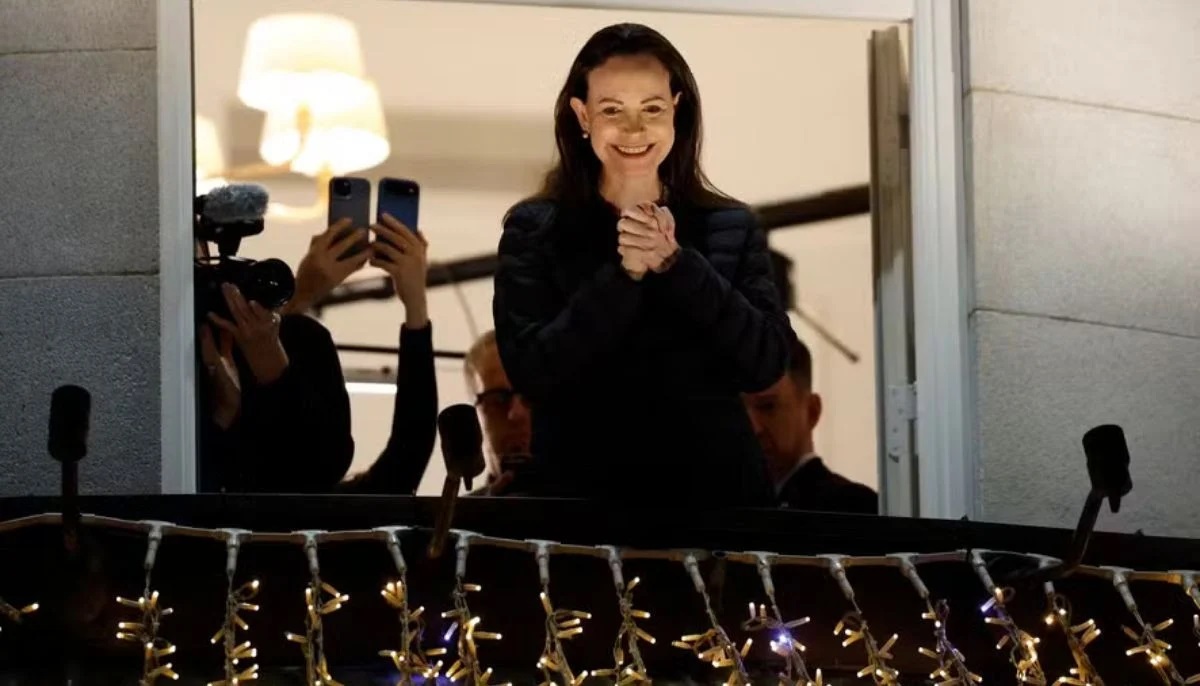
Venezuelan opposition leader breaks months of silence in a dramatic return to the spotlight, telling supporters that Venezuela “will be bright, democratic, and free.”
According to BBC reports and international observers, Nobel Peace Prize laureate Maria Corina Machado resurfaced in Oslo after months in hiding, marking her first public appearance since winning the award. Her surprise arrival, despite a travel ban and threats from the Maduro government, has triggered global reactions and renewed scrutiny on Venezuela’s political crisis.
Key Points
- Maria Corina Machado made her first public appearance in Oslo after months out of sight.
- She travelled secretly despite a government travel ban and threats of being labelled a fugitive.
- Her daughter accepted the 2025 Nobel Peace Prize on her behalf one day earlier.
- Machado vowed that Venezuela will soon be “bright, democratic, and free.”
- Supporters erupted into emotional chants as she appeared at Oslo’s Grand Hotel balcony.
OSLO (Star Struck Times) — Maria Corina Machado, the Venezuelan opposition leader and Nobel Peace Prize laureate, made her long-anticipated public appearance in Oslo on Thursday, December 11, 2025, ending months of uncertainty about her whereabouts. The 58-year-old activist emerged at the balcony of Oslo’s Grand Hotel to greet cheering supporters, marking her first sighting since she went underground following her Nobel recognition earlier this year. Her sudden appearance came despite a strict travel ban imposed by the Nicolás Maduro regime and threats that she would be declared a fugitive if she attempted to leave Venezuela.

International observers had speculated for months about Machado’s safety after she declined to attend the Nobel ceremony, leaving her daughter to accept the award on her behalf. On Wednesday, December 10, her daughter Ana Corina Sosa collected the Peace Prize in her name, prompting renewed questions about whether Machado would surface in Norway. The following day, she arrived in Oslo through what she described as a “covert journey,” crediting unnamed supporters who risked their lives to ensure her safe passage.
Machado confirmed that she was aware of the dangers involved in traveling to Norway while under an authoritarian government’s watch. “I know exactly the risks I’m taking,” she said in an interview with international media outlets. “I’m here today because many men and women risked their lives for me to arrive in Oslo.” Her comments referenced months of repression in Venezuela, where opposition voices continue to face intimidation, arrests, and enforced disappearances.
As she stepped onto the balcony above the Christmas-lit streets of Oslo, a visibly emotional Machado pressed her palms together and smiled at the crowd. Dozens of supporters chanted her name—“Maria! Maria!”—while holding their phones to capture the moment. In a symbolic gesture, she climbed past the security barricades to greet supporters more closely. “For over 16 months I haven’t been able to hug or touch anyone,” she shared. “In just a few hours, I’ve seen the people I love, touched them, cried with them, and prayed with them.”
Her appearance drew immediate reactions from Venezuelan officials, who have repeatedly dismissed her international recognition. Vice President Delcy Rodríguez earlier condemned the Nobel decision as “a total failure,” accusing Machado of avoiding the ceremony out of fear. Rodríguez escalated the rhetoric by claiming the 2025 Nobel Prize was ‘stained with blood,’ reflecting rising tensions between the government and the opposition diaspora.
Critics of the Maduro government argue that Machado’s travel and re-emergence highlight the lengths to which Venezuelan dissidents must go to avoid government retaliation. A Caracas-based political analyst noted, “Her presence in Oslo is a direct challenge to the regime’s attempts to silence her. It’s a powerful message.” On social media, supporters celebrated what they described as a “historic act of courage,” while others expressed concern for her potential return.
Machado addressed those fears directly, insisting she intends to go back to Venezuela despite the risks. “Of course I’m going back,” she said. “I will be wherever I am most useful for our cause. Until recently, that place was Venezuela. Today, I believe that place is Oslo—on behalf of our fight for freedom.” She added that she and her team are prepared to form a transitional government when the moment arrives, reiterating her commitment to a democratic future.
The Nobel Committee awarded Machado the Peace Prize for her “struggle to achieve a just and peaceful transition from dictatorship to democracy in Venezuela.” Her decades-long activism, characterized by frequent clashes with authorities and periods of forced silence, has made her a global symbol of democratic resistance. International human rights organizations have repeatedly documented threats against her and other opposition figures.

Despite the uncertainty surrounding her return, supporters in Oslo saw her appearance as a moment of hope. Many waved Venezuelan flags, and some broke into tears as she blew kisses and joined them in singing. A Venezuelan student living in Norway said, “Seeing her here, alive, standing strong—it gives us strength. She represents our dream for a free Venezuela.” Another supporter remarked, “This is the moment we’ve been waiting for. She showed the world she won’t be silenced.”
Questions remain about whether Machado will be permitted to re-enter her home country or if the government will arrest her upon arrival. Yet her message remained unwavering. “Venezuela will be bright, democratic, and free,” she declared. “And that day is closer than many believe.”
For now, her presence in Oslo has reignited international attention on Venezuela’s political turmoil, underscoring the powerful symbolism of a leader who risked arrest to stand before the world. Whether she can transform this momentum into political change back home remains an urgent question for millions of Venezuelans watching from afar.
FAQs
Q: Why did Maria Corina Machado take months to appear publicly?
A: She was hiding in Venezuela due to threats and a travel ban by the Maduro government.
Q: Who accepted her Nobel Peace Prize?
A: Her daughter, Ana Corina Sosa.
Q: Will she return to Venezuela?
A: Yes—Machado says she will return despite the risks.
Q: Why is the government calling her a “fugitive”?
A: The regime claims she violated a travel ban.
Q: What does Machado plan next?
A: She says she and her team are prepared to form a government when possible.
Stay updated on major global political developments.
Follow us for real-time breaking news and international updates.
© 2025 Star Struck Times. All rights reserved.


Your point of view caught my eye and was very interesting. Thanks. I have a question for you. https://www.binance.info/register?ref=IHJUI7TF