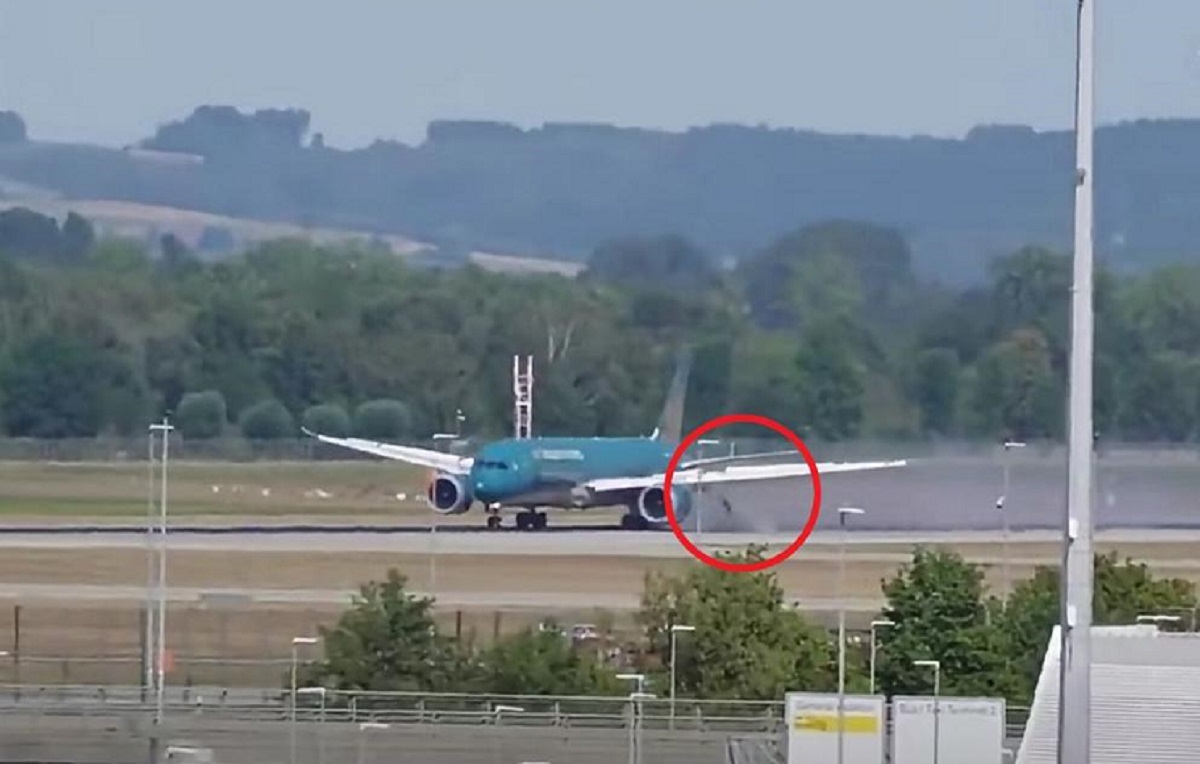
MUNICH, GERMANY, August 18, 2026 — Star Struck Times — Terror gripped 271 passengers and 16 crew members aboard Vietnam Airlines Flight VN34 when their long-haul Boeing 787-9 Dreamliner overran the runway at Munich Airport, striking its tail violently against the tarmac before scrambling into the sky. Newly emerged video recorded from inside the passenger cabin captures the harrowing exact moment the massive twin-engine jet crossed the end of Runway 26L, plowed through dirt and grass, and shuddered under a loud metal-crunching bang. As alarms sounded in the cockpit and a massive cloud of dust billowed past the cabin windows, passengers were instructed to assume the brace position for a nerve-shredding two-hour ordeal above the Bavarian countryside.
Key Points Summary
- Terrifying Takeoff: Flight VN34 bound for Hanoi failed to rotate in time, overshooting Munich Airport’s 4,000-meter runway and tearing into grassy overrun space.
- Severe Structural Damage: The tail section scraped the paved buffer, causing heavy fuselage skin punctures, blown tires, and runway light destruction.
- Panic in the Cabin: Terrified travelers described bracing for an emergency impact after hearing a violent thud and feeling violent cabin vibrations.
- Two-Hour Fuel Dump: The fully loaded Boeing 787-9 circled for over 90 minutes to dump jet fuel before making an emergency touchdown trailing smoke on shredded landing gear.
Seconds From Catastrophe
The routine afternoon departure to Noi Bai International Airport in Hanoi degenerated into a near-disaster within seconds of roll. As the 10-year-old Boeing Dreamliner (registration VN-A867) accelerated down Munich’s Runway 26L, jet engine thrust pushed the heavy aircraft down the strip. However, as the end of the paved runway rapidly approached, the plane failed to lift off at the standard rotation point.
Instead of climbing smoothly, the jet continued past the tarmac threshold. It plowed roughly 120 meters past the runway end—crossing paved blast pads, kicking up grass, dirt, and crushing runway approach lights—before the pilots aggressively pulled the nose up. The extreme angle of attack caused the rear ventral fuselage to scrape violently along the ground, creating a loud structural thud that echoed throughout the passenger cabin.

Inside the cabin, passengers described a sudden shudder that shook seat rows. “We thought this was the end of us,” one passenger traveling with her family recounted to reporters, describing how flight attendants frantically instructed everyone to kick off their shoes, place their heads down, and assume the brace position as tire pressure failure alerts triggered in the cockpit.
| VIETNAM AIRLINES VN34 INCIDENT TIMELINE | ||
| Stage | Event Details | Impact & Status |
| Takeoff Roll | Late rotation past 4,000m threshold onto grass buffer | Runway lights smashed; dust cloud produced |
| Rotation Strike | Aft composite fuselage scrapes tarmac at extreme pitch angle | Tail module punctured; main tires blown |
| Airborne Holding | Jet climbs to 9,000-10,000ft to dump fuel over Bavaria | Two-hour weight reduction maneuver |
| Emergency Landing | Low-pass flybys followed by hard touchdown on Runway 26R | Gear trails smoke; runway closed for 8+ hours |
Hidden Context: What Other Reports Missed
While initial news bulletins framed the emergency as a simple “technical glitch,” preliminary findings from air safety investigators and telemetry analysts paint a far more complex picture. Data reviewed by aviation specialists indicates that the right main-wheel brake assembly may have partially activated or dragged near the end of the runway roll, causing unexpected drag and lagging acceleration.
Inspection photos taken on the Munich apron show that the carbon-fiber composite skin on the lower tail section suffered severe puncture wounds, tearing structural frame elements and exposing inner systems. Aviation engineers note that composite airframe tail-strikes require specialized multi-month structural rebuilds, leaving the $250 million aircraft grounded indefinitely. Furthermore, two low-altitude flybys were executed over Munich Airport so ground crews could visually confirm whether the landing gear was jammed before the pilots risked bringing the disabled airframe down.
ENGAGEMENT
- What happened to Vietnam Airlines Flight VN34 at Munich Airport?Vietnam Airlines Flight VN34 overran Runway 26L during takeoff from Munich Airport, striking its tail on the ground, destroying runway lights, and blowing main tires before returning for a safe emergency landing.
- Was anyone injured in the Vietnam Airlines Munich tail strike incident?No injuries were reported among the 271 passengers and 16 crew members aboard the Boeing 787-9 Dreamliner.
Frequently Asked Questions (FAQs)
Q1: Why did the Boeing 787 need to dump fuel for two hours before landing?
A1: Because Flight VN34 was loaded with heavy fuel for a long-haul journey to Hanoi, it exceeded its maximum safe landing weight. Circling to jettison fuel prevented structural landing gear failure upon touchdown.
Q2: How much damage did the Vietnam Airlines aircraft sustain?
A2: The aircraft suffered substantial composite hull punctures along its lower tail module, shredded main landing gear tires, and damaged braking systems.

Q3: Is Munich Airport operating normally after the runway incident?
A3: The airport’s north runway was closed for over eight hours to clear debris and tow the stranded aircraft, causing temporary rerouting, but normal operations have since resumed.
Does seeing cabin footage during aviation scares make you more anxious about flying, or does it reassure you that modern planes can survive extreme incidents? Share your thoughts below!