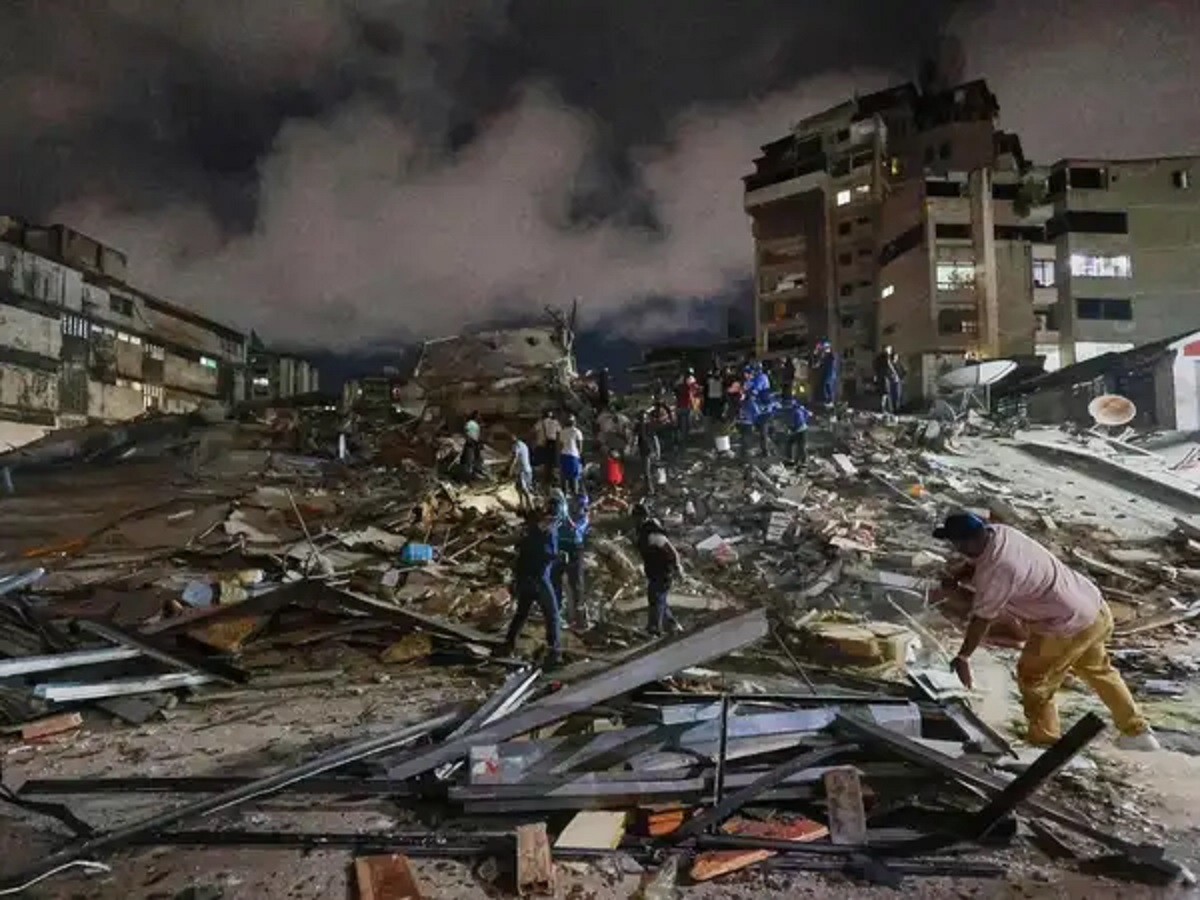
CARACAS, VENEZUELA, June 26, 2026, 11:30 PM EST — Star Struck Times.
TRENDING NOW: The global scientific community and millions across South America are reeling after a historic, terrifying seismic anomaly struck Venezuela. In a shocking twist that went viral instantly, the ground ripped open not once, but twice, leaving world-renowned seismologists and panicked residents scrambling for answers. The devastating phenomenon has catapulted Venezuela into the global spotlight, forcing researchers to rewrite what we know about planetary disasters.
The 39-Second Terror: Unpacking the Venezuela Doublet Earthquake
When the ground began to roll under Caracas, citizens assumed they were enduring a standard, albeit massive, tectonic event. But according to veteran Latin American entertainment and breaking news reporter Elena Gomez, what followed was an unprecedented geological nightmare that left even seasoned field researchers in absolute shock.
Within a mere 39 seconds, two monster tectonic events pulverized the region. The initial shockwave measured a massive magnitude 7.2. Before the dust could even begin to settle, a second, even more violent magnitude 7.5 convulsion tore through the exact same fault system. This isn’t just a localized disaster; it is a globally trending scientific mystery.
Key Points: What You Need to Know
Unprecedented Back-to-Back Ruptures: A rare Venezuela doublet earthquake hit northern Venezuela, registering magnitudes of 7.2 and 7.5 just 39 seconds apart.
The Aftershock Myth Shattered: Unlike normal earthquakes that taper off into minor aftershocks, a doublet earthquake features two equally catastrophic main shocks.
Tectonic Ground Zero: The disaster occurred at the volatile boundary where the Caribbean plate grinds past the South American plate.
Unresolved Scientific Debate: Top global researchers are actively fighting over whether this was two separate events or one single massive rupture.
What Other Reports Missed: The Hidden 200-Year Fuse
While mainstream outlets like the BBC and Reuters have focused heavily on the immediate structural damage, insider details obtained by Star Struck Times reveal a far more ominous backstory. Academic data indicates that the specific strike-slip faults cutting through northern Venezuela had been quietly locking up, accumulating immense, uninterrupted friction for more than two centuries.
Instead of releasing this 200-year-old energy budget in a single burst, the earth’s crust fractured like cheap safety glass. The first break didn’t relieve the pressure—it aggressively loaded it onto the neighboring segment.
“It’s going to take probably some days or longer for the seismologists to really piece together the event,” warns Judith Hubbard, a prominent earthquake scientist at Cornell University.
The Science of the “Doublet”: Why This Defies Normal Logic
In standard geology, a primary fault line slips, releases its main energy, and then slowly settles via smaller micro-quakes. A Venezuela doublet earthquake entirely defies this concept.
When the first 7.2 magnitude shockwave ripped open, it fast-forwarded the failure of the adjacent fault line in near real-time. The energy didn’t dissipate into the surrounding bedrock; it gathered into an aggressive kinetic hammer, forcing a second, larger collapse just meters away. The soft sediment beneath Caracas acted as a natural amplifier, turning the twin tremors into an echoing chamber of destruction.
Frequently Asked Questions
What is a doublet earthquake?
A doublet earthquake occurs when two distinct tectonic events of nearly equal, massive magnitude happen in incredibly close succession and in practically the same geographic area.
What caused the recent earthquake in Venezuela?
The disaster was caused by a sudden, violent release of friction along the strike-slip fault system where the Caribbean plate moves eastward relative to the South American plate.
Is a doublet earthquake worse than a regular earthquake?
Yes. Because the second major quake strikes while infrastructure is already compromised by the first, the cumulative destruction to buildings and roads is exponentially worse.
Will This Trigger More Global Doublets?
The terrifying reality of the Venezuela doublet earthquake has ignited fierce debate across social media and scientific forums alike. As rescue teams sift through the debris, the ultimate question remains: Has this historic shift permanently altered the stability of the surrounding Caribbean fault lines, or is the worst finally behind us?
What do you think? Are our major cities prepared for the terrifying reality of back-to-back twin earthquakes? Let us know your thoughts in the comments below!
Hello! I'm M Muzamil Shami, the founder and lead editor of Star Struck Times, your trusted source for trending news, entertainment scoops, celebrity gossip, sports highlights, and global headlines.
With a passion for storytelling and journalism, I created this platform to bring you breaking news, viral moments, and deep insights into the worlds of Bollywood, Hollywood, sports, politics, tech, and more — all in one place.