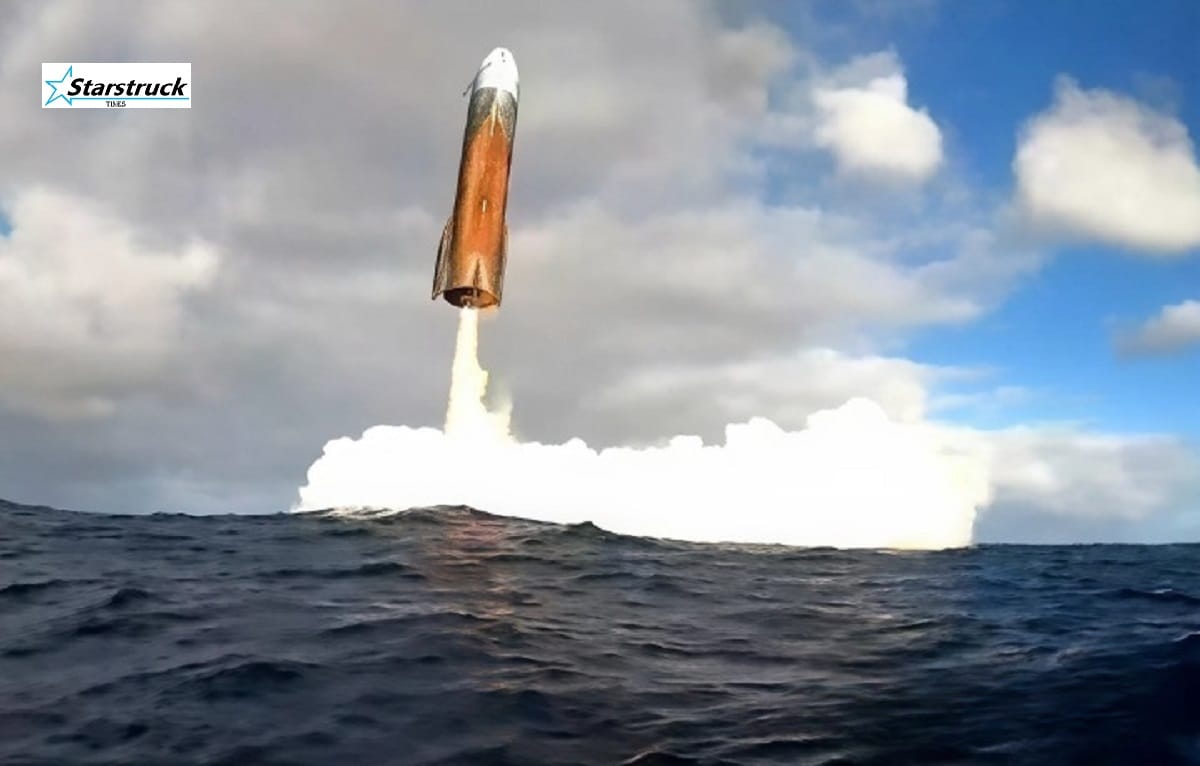
SpaceX Starship deploys 8 satellites and completes splashdown
SpaceX Starship achieved its most successful test yet.
The rocket deployed 8 dummy satellites in orbit.
For the first time, Starship executed a controlled splashdown in the Indian Ocean.
Elon Musk hails it as a “giant leap” toward making life multi-planetary.
Social media erupted as #StarshipSuccess trended worldwide.
The Night the Stars Came Closer
For decades, humans have dreamed of stepping beyond the Moon and setting foot on Mars. That dream, once confined to the pages of science fiction, inched closer to reality when SpaceX’s Starship roared into the sky in a flawless test flight that will be remembered as one of the defining moments of space exploration in the 21st century.
With millions watching live, the massive spacecraft — taller than the Statue of Liberty and capable of carrying more payload than any rocket in history — lifted off with thunderous power, carrying not astronauts but eight “dummy” satellites for a critical systems test.
But the biggest twist came nearly 70 minutes later: for the first time, Starship achieved a controlled splashdown in the Indian Ocean, surviving re-entry and proving that reusability — the holy grail of modern rocketry — may finally be within reach.
A Dream Years in the Making
When Elon Musk founded SpaceX in 2002, his vision seemed outlandish. A private company building rockets? Competing with NASA and Roscosmos? Few took him seriously. But flight after flight, failure after failure, SpaceX clawed its way to the top.
In 2008, SpaceX launched its first rocket, Falcon 1 — after three failed attempts nearly bankrupted the company.
In 2012, SpaceX’s Dragon spacecraft became the first private vehicle to deliver cargo to the International Space Station.
By 2015, Falcon 9 had nailed its first successful booster landing, revolutionizing reusability.
And now, in 2025, Starship — the crown jewel of Musk’s ambition — has pulled off a feat once thought impossible: launch, satellite deployment, and safe splashdown.
Each milestone has carried with it skepticism, ridicule, and doubt. Yet Musk has always returned with the same unshakable mantra: “We’re going to make life multi-planetary.”
Why This Test Was Different
Previous Starship tests ended in fiery explosions or partial victories — valuable data, but not headline-making wins. This flight was different.
Successful Liftoff & Stability – The rocket cleared the pad cleanly, avoiding the destructive engine failures that plagued earlier flights.
Satellite Deployment – The 8 dummy satellites proved Starship’s ability to function as a next-gen cargo carrier, critical for Starlink expansion and NASA partnerships.
Controlled Splashdown – Perhaps the most dramatic moment came as the spacecraft pierced back through Earth’s atmosphere, survived intense re-entry heat, and performed a precision splashdown in the Indian Ocean.
This trifecta of successes makes Starship not just a prototype, but a serious contender for future Moon and Mars missions.
Elon Musk’s Reaction
Moments after splashdown, Elon Musk posted a celebratory message on X:
“Starship landed intact. One step closer to making life multi-planetary”
The post ignited a storm of reactions — within hours, it was trending worldwide, sparking discussions not just among space enthusiasts but across pop culture, politics, and science.
Even rivals and skeptics acknowledged the milestone. NASA Administrator Bill Nelson congratulated SpaceX, tweeting: “A major leap forward in commercial space exploration. The Moon, Mars, and beyond are closer than ever.”
The Global Buzz
Social media lit up like a supernova:
#StarshipSuccess and #SpaceX trended in over 40 countries.
Celebrities including William Shatner, Neil deGrasse Tyson, and even Coldplay’s Chris Martin joined the chorus of excitement.
Memes flooded timelines — from comparing Musk to Tony Stark to celebrating Starship as the new “Millennium Falcon.”
The excitement wasn’t just about the flight. It was about what it symbolized: the dawning of a new era where space is no longer the domain of governments alone but a frontier open to human ambition.
The Stakes: Why Starship Matters
Starship is not just another rocket. It’s a moonshot within a moonshot — designed to carry up to 150 tons into orbit, ferry astronauts to the Moon under NASA’s Artemis program, and one day build the first human colonies on Mars.
The controlled splashdown proves SpaceX is inching closer to reusability at an unprecedented scale. If perfected, it could slash the cost of space travel and usher in a future where traveling to space becomes as routine as flying across the Atlantic.
The Road Ahead: From Earth to Mars
This successful test sets the stage for upcoming milestones:
Orbital refueling demonstrations, key for long-haul space travel.
Lunar landing rehearsals for NASA’s Artemis program.
Human crewed missions within the next few years.
According to insiders, the next big test could involve cargo delivery simulations to the Moon, a dress rehearsal for the Artemis III mission scheduled later this decade.
For Elon Musk, however, the ultimate goal remains clear: a self-sustaining city on Mars by the 2030s.
FAQs
Will Starship carry astronauts soon?
Yes. While this mission used dummy satellites, future Starship flights will test life-support systems for human crews. Crewed test flights are expected later this decade.
How big is SpaceX Starship?
Starship stands at 120 meters (394 feet) tall, making it the largest and most powerful rocket ever built.
What makes Starship different from Falcon 9?
Unlike Falcon 9, which can carry around 22 tons, Starship is designed for 150 tons of payload and interplanetary missions.
Why is the splashdown important?
The controlled splashdown proved Starship can survive re-entry and land safely, a step vital for its reusability and cost efficiency.
Do you believe humans will land on Mars in our lifetime thanks to Starship? Share your thoughts in the comments! Follow Star Struck Times for daily updates on SpaceX, Elon Musk, and trending space exploration news.
Hello! I'm M Muzamil Shami, the founder and lead editor of Star Struck Times, your trusted source for trending news, entertainment scoops, celebrity gossip, sports highlights, and global headlines.
With a passion for storytelling and journalism, I created this platform to bring you breaking news, viral moments, and deep insights into the worlds of Bollywood, Hollywood, sports, politics, tech, and more — all in one place.