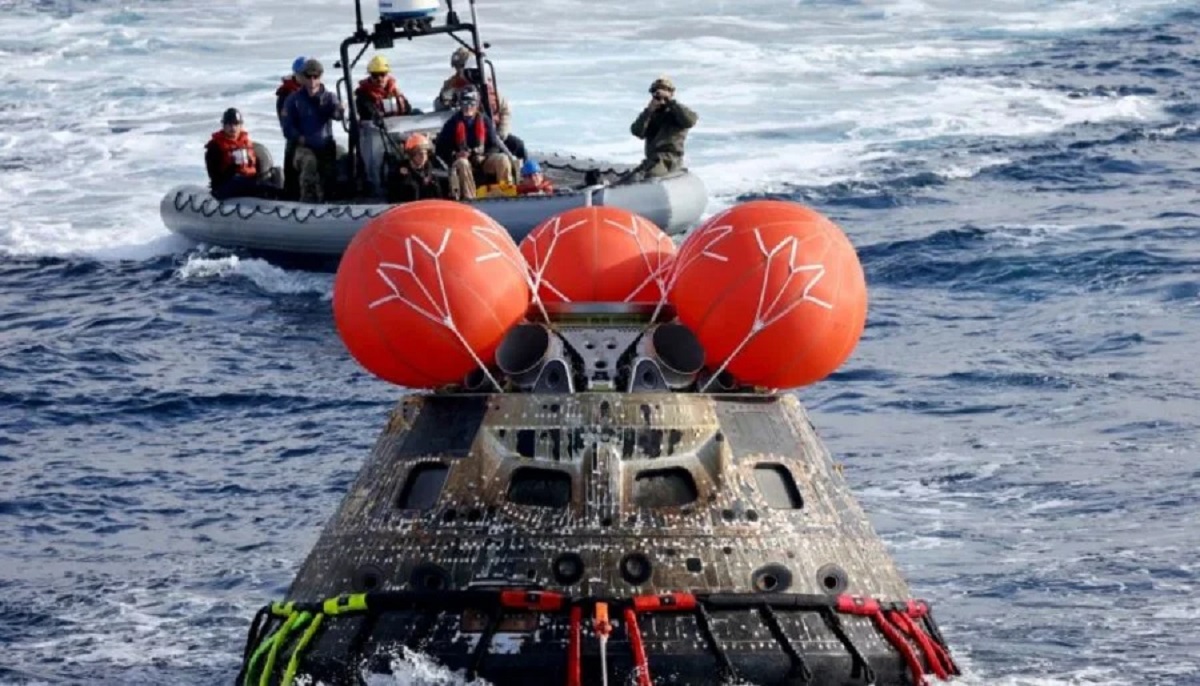
The NASA Artemis II splashdown NASA mission is entering its most critical and dangerous phase as the Orion spacecraft prepares to return to Earth after a historic lunar flyby. According to updates from NASA, the crew capsule is scheduled to splash down in the Pacific Ocean near San Diego after re-entering Earth’s atmosphere at extreme speed and temperature. Coverage from BBC News and Reutershighlights that while the mission has been successful so far, the final descent remains the most technically risky stage of the entire journey.
Key Highlights
Orion capsule set for Pacific Ocean splashdown near San Diego
Re-entry speed exceeds 34,000 feet per second
Heat shield must survive 5,000°F temperatures
Communication blackout expected for ~16 minutes
11 parachutes deployed in staged sequence
NASA calls landing phase “most dangerous moment”
What is Happening in the Final Stage?
The NASA Artemis II splashdown NASA mission is now focused on re-entry, where the Orion spacecraft must survive extreme atmospheric friction. The capsule will hit Earth’s atmosphere at around 7:53 p.m. EDT (23:53 GMT) before descending toward the Pacific Ocean.
At this stage, temperatures are expected to reach nearly 5,000°F (2,760°C)—hot enough to melt most metals. The spacecraft is traveling at over 34,965 feet per second, making this one of the fastest human-return speeds in modern spaceflight.
A senior NASA official, Amit Kshatriya, explained during a mission briefing that true success will only be declared once astronauts are safely onboard the recovery ship.
“When we can start celebrating is when we have a crew safely in the medbay of the ship,” he said.
Why This Re-Entry Is So Dangerous
Heat Shield Pressure Challenge
One of the biggest concerns in the NASA Artemis II splashdown NASA mission is the integrity of Orion’s heat shield.
During the earlier Artemis I test flight in 2022, unexpected erosion raised concerns about durability. This time, NASA has adjusted the re-entry trajectory to reduce stress.
Experts quoted by The Telegraph suggest even a small shielding failure could compromise mission safety.
An aerospace analyst explained:
“Re-entry is not just about speed—it’s about controlled survival through controlled destruction of heat.”
16-Minute Communication Blackout
Another critical phase is the radio blackout window, where plasma forms around the capsule due to extreme heat.
During this period, the NASA Artemis II splashdown NASA mission crew will lose all contact with Mission Control for about 16 minutes.
According to reports from ABC News, this happens because ionized air blocks radio signals completely.
Inside the capsule, astronauts must rely on onboard autonomous systems without any human assistance from Earth.
Parachute Deployment Sequence
Once Orion slows down, the final survival system kicks in: the parachutes.
11 parachutes in total
Nose cap detachment first
Two stabilizing chutes deploy
Three main parachutes gradually open
Each step must work perfectly. Even a slight delay could impact landing safety.
NASA engineers have described this system as a “carefully choreographed parachute ballet.”
Why This Mission Matters Globally
The NASA Artemis II splashdown NASA mission is not just a technical test—it is a stepping stone toward returning humans to the Moon.
Unlike previous missions, Artemis II includes a full crewed lunar flyby, making it the first of its kind in decades.
This mission also sets the stage for future deep-space exploration under NASA’s long-term Artemis program.
A space policy expert noted:
“If Artemis II succeeds, it proves we are ready for sustained lunar presence.”
Unique Angle: The Psychology of Re-Entry
Beyond engineering, there is a human factor rarely discussed.
During the blackout phase, astronauts experience complete isolation—no communication, no updates, no reassurance.
This psychological pressure, combined with extreme physical conditions, makes re-entry one of the most mentally intense experiences in spaceflight history.
NASA researchers have studied astronaut stress responses for years, noting that silence in space can feel longer than the mission itself.
Frequently Asked Questions
What time is Artemis II splashdown?
The NASA Artemis II splashdown NASA mission is expected around 7:53 p.m. EDT (23:53 GMT).
Where will Artemis II land?
It will splash down in the Pacific Ocean near San Diego, California.
Why is re-entry dangerous?
Extreme heat, high speed, and communication blackout make it the riskiest phase.
How fast is the capsule traveling?
Around 34,965 feet per second—over 30 times the speed of sound.
How long is the communication blackout?
Approximately 16 minutes during atmospheric re-entry.
What Happens Next
Once the capsule successfully lands, recovery teams will extract astronauts and transfer them to a medical ship for immediate checks. NASA will then begin full post-mission analysis, focusing on heat shield performance and parachute accuracy.
Success here will directly shape the future of lunar missions under the Artemis program.
Hello! I'm M Muzamil Shami, the founder and lead editor of Star Struck Times, your trusted source for trending news, entertainment scoops, celebrity gossip, sports highlights, and global headlines.
With a passion for storytelling and journalism, I created this platform to bring you breaking news, viral moments, and deep insights into the worlds of Bollywood, Hollywood, sports, politics, tech, and more — all in one place.