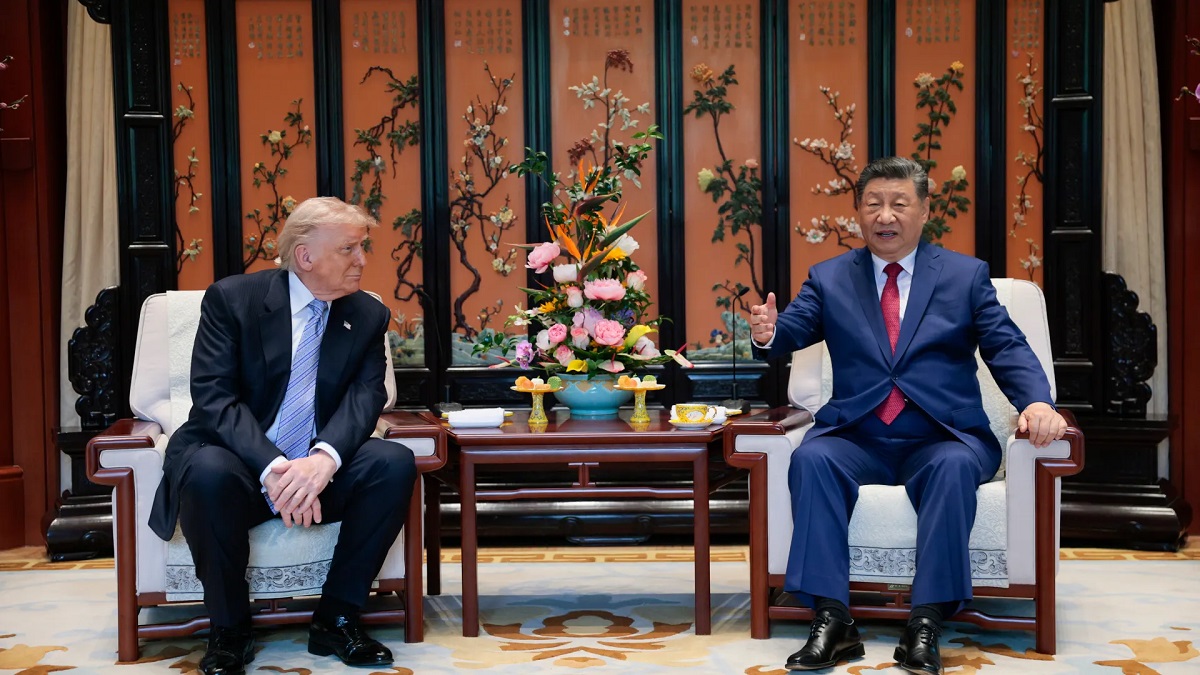
President Donald Trump and President Xi Jinping have concluded their high-stakes Beijing Summit with a stunning diplomatic pivot, reportedly forging a “business-first” alliance that prioritizes economic stability over long-standing ideological warfare. In a moment that sent shockwaves through the G7, Trump appeared to align with Xi’s narrative of the United States as a “declining nation,” focusing instead on a pragmatic deal to unblock the Strait of Hormuz and de-escalate Taiwan tensions.
Key Highlights
The Business Alliance: A shift from military posturing to a transactional, bilateral trade-focused relationship.
Declining Nation Narrative: Trump reportedly acknowledged China’s assessment of US domestic instability during private sessions.
Hormuz Breakthrough: A joint memorandum to ensure the safety of the Strait of Hormuz amidst the ongoing Iran conflict.
Taiwan De-escalation: Reports suggest a “soft-freeze” on military drills in exchange for semiconductor trade concessions.
Market Reaction: Global markets surged as the “Trade War 2.0” fears were replaced by a “Beijing Accord” optimism.
The Beijing Accord: Trump and Xi Realignment Shakes Global Order
The conclusion of the Beijing Summit marks a historic departure from a decade of “Cold War” rhetoric between the world’s two largest economies. For readers following our Global Politics and Economy coverage, the implications are immediate: the world just moved from the brink of conflict to a state of competitive cooperation.
The summit concluded late Friday with a joint press appearance that was short on scripted ceremony but heavy on economic pragmatism. Donald Trump, true to his “deal-maker” persona, appears to have traded traditional geopolitical dominance for immediate economic relief. According to reports from Reuters and The South China Morning Post, the two leaders spent significant time discussing the maritime blockade in the Middle East, which has throttled the global energy supply.
A “Declining Nation” and the Pragmatic Pivot
The most controversial moment of the summit came when leaked transcripts suggested Xi Jinping presented a vision of the 21st century where the United States is a “declining nation” burdened by debt and internal strife. Rather than countering with traditional American exceptionalism, Trump reportedly pivoted to the “business-first” reality, arguing that if the US is to rebuild, it requires a stable, non-adversarial relationship with Beijing.
“We aren’t going to fight wars for the sake of fighting,” Trump reportedly told aides after the session. “We’re going to make money and fix our country.” This acknowledgment has stunned traditional allies in Europe and Asia, who fear a US retreat from its role as the global security guarantor.
Hidden Context: What Other Reports Missed
While mainstream media focused on the handshake, Star Struck Times has learned from diplomatic insiders that the real “win” for China was the Taiwan Semiconductor Protocol. Hidden within the talk of de-escalation is a quiet agreement that the US will limit “official” state visits to Taipei in exchange for China ensuring that the Strait of Hormuz remains open for US-aligned tankers.
This “Hormuz-for-Taiwan” trade-off is a masterpiece of transactional diplomacy that ignores decades of State Department policy. It suggests that Trump views the Taiwan Strait as a secondary concern compared to the skyrocketing fuel prices currently crippling the American middle class.
The Strait of Hormuz and Global Energy Stability
The Strait of Hormuz has been a sticking point since the Iran conflict escalated earlier this year. The Beijing Summit resulted in a surprising joint statement: China will use its significant influence over Tehran to “restrain” maritime interference, while the US will ease certain tech-export sanctions that have hampered China’s AI development.
“The Strait of Hormuz is the world’s jugular vein,” noted Dr. Kenji Tanaka, a senior analyst at the Institute for Global Security. “By involving Xi as a mediator for the Middle East, Trump has effectively ceded a portion of regional leadership to China in exchange for lower oil prices.”
Global Public and Political Reactions
The reaction has been a mix of relief and alarm.
Market Sentiment: The S&P 500 and the Hang Seng Index both opened 2.4% higher following the news.
Political Fallout: Domestic critics in Washington have called the “declining nation” rhetoric a “betrayal of American leadership.”
Fan/Public Quote: On social media, the sentiment is divided. One viral post on X with 500k likes stated: “Finally, a President who talks business instead of starting World War III. If oil prices go down, Trump wins.” Conversely, another top comment read: “Selling out Taiwan for a gas discount is a dark day for democracy.”
Comparison: The Old Policy vs. The Beijing Accord
Feature
Pre-Summit Posture
The Beijing Accord (2026)
Taiwan Strategy
Military Deterrence
Strategic Trade De-escalation
US Narrative
Global Superpower
Economic Reconstruction Phase
China Relationship
Systematic Rival
“Business-First” Partner
Middle East Role
Sole Security Provider
US-China Joint Stabilization
What Happens Next?
The “Beijing Accord” will face its first test in the coming weeks as the Strait of Hormuz blockade is monitored for actual vessel movement. Trump is expected to return to Washington to pitch this deal as a “victory for the American wallet,” while Xi Jinping consolidates China’s new role as a global peacemaker. Expect a series of “Trade Missions” to follow, as US tech firms look to capitalize on the eased sanctions.
FAQ: The Trump-Xi Beijing Summit
1. Did Trump actually agree that the US is a “declining nation”?
Reports suggest Trump did not dispute the assessment during private sessions, choosing instead to focus on how a “business-first” relationship with China could help the US rebuild its domestic economy.
2. What was decided regarding the Strait of Hormuz?
A joint agreement was reached where China will use its diplomatic leverage with Iran to ensure the Strait remains open for international trade, specifically targeting the stabilization of global oil prices.
3. Is the US abandoning Taiwan?
Not officially. However, the summit produced a “soft-freeze” on military escalations and high-level visits in exchange for economic concessions, signaling a shift toward managing the status quo rather than direct confrontation.
4. How will this affect fuel prices in the US and India?
The “Hormuz Breakthrough” is expected to lower the “war premium” on crude oil. Analysts predict a gradual decrease in retail fuel prices over the next 30 to 60 days.
5. What is the “Business-First” relationship?
It is a pragmatic approach where economic interests (trade, inflation, market stability) take priority over traditional geopolitical disputes, human rights concerns, or military dominance.
Hello! I'm M Muzamil Shami, the founder and lead editor of Star Struck Times, your trusted source for trending news, entertainment scoops, celebrity gossip, sports highlights, and global headlines.
With a passion for storytelling and journalism, I created this platform to bring you breaking news, viral moments, and deep insights into the worlds of Bollywood, Hollywood, sports, politics, tech, and more — all in one place.