Beijing, China, May 16, 2026 — Star Struck Times
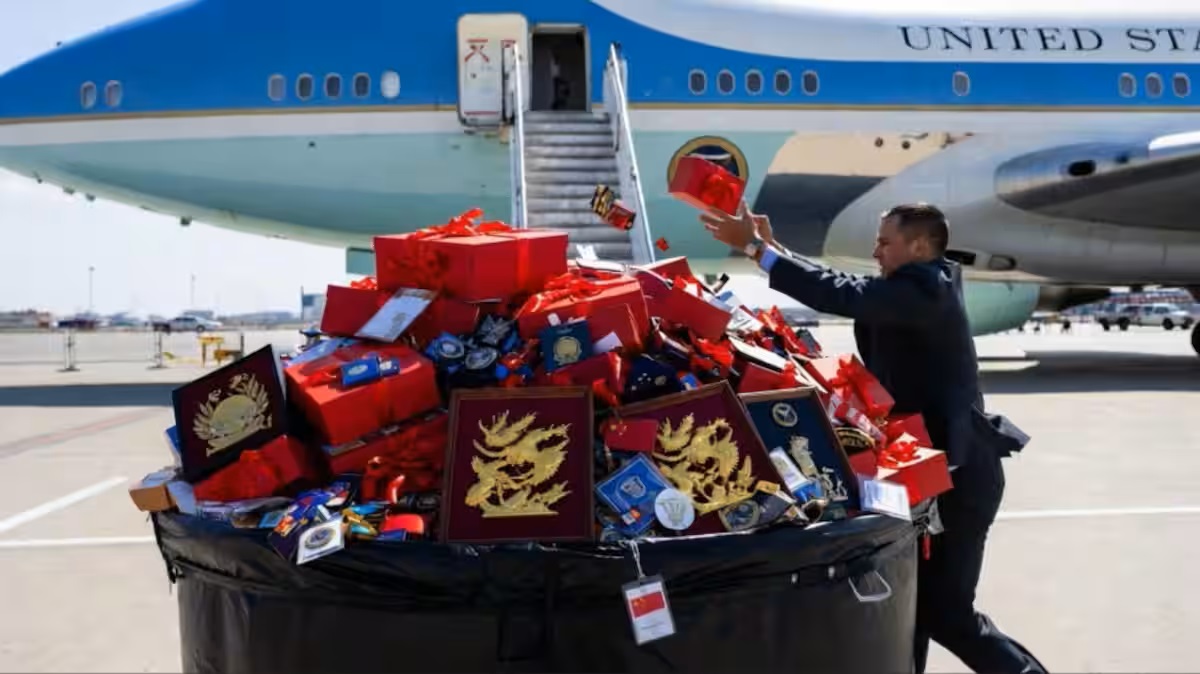
An extraordinary counterintelligence directive overshadowed the public cordiality of US President Donald Trump’s high-stakes bilateral summit with Chinese President Xi Jinping on Friday. Before boarding Air Force One at Beijing Capital Airport, members of the American delegation—including senior White House officials, corporate titans, and traveling journalists—were ordered to systematically discard every physical gift, credential badge, and electronic device issued by their Chinese hosts into a plastic trash bin positioned at the bottom of the aircraft’s stairs.
The move, which occurred in full view of tarmac witnesses, has sent shockwaves through social platforms, laying bare the deep-seated technological mistrust that continues to define US-China relations beneath the surface-level diplomatic handshakes. To understand the context behind this dramatic departure, readers can explore our comprehensive analysis of international defense measures in the World News section.

Key Highlights
- The Incident: White House staff, Secret Service personnel, and US media members were forced to surrender all Chinese-provided items directly into a trash container before ascending the boarding ramp of Air Force One.
- Items Discarded: Confiscated materials included state-issued burner phones, official delegation lapel pins, event credentials, and commemorative souvenirs.
- Digital Lockdown: Corporate leaders accompanying the delegation, including Nvidia CEO Jensen Huang and Apple CEO Tim Cook, left all personal electronics in the US, operating strictly on specialized “clean” devices stored in Faraday bags.
- Behind-the-Scenes Friction: The departure ritual capped a highly contentious two-day visit marked by physical standoffs between the US Secret Service and Chinese security forces over firearms and media access.
The Tarmac Purge: What Happened at Beijing Capital Airport
As the two-day diplomatic mission concluded, the public display of unity dissolved into a rigid exhibition of espionage counter-measures. According to eyewitness accounts from the White House press pool, security screeners established a strict checkpoint at the base of the presidential aircraft that functioned effectively as a digital decontamination center.
“American staff took everything Chinese officials handed out—credentials, burner phones from White House staff, pins for delegation—collected them before we got on AF1 and threw them in a bin at the bottom of the stairs. Nothing from China allowed on the plane,” reported Emily Goodin, the New York Post’s White House Correspondent, in a widely circulated dispatch on X.
The mandate from White House security and the US Secret Service was absolute: no item originating from the host country’s state apparatus was permitted to breach the threshold of the world’s most secure airborne command center.
Why the US Imposed an Absolute ‘Digital Blackout’ in Beijing
While the theatrical nature of throwing gifts into a bin appeared provocative to observers, intelligence experts emphasize that the protocol is rooted in routine, non-negotiable defensive strategies against state-sponsored cyber espionage.
Former Secret Service Special Agent Bill Gage provided an expert-style insight into the operational mindset dictating the trip:
“China is a mass surveillance state. Briefings for US officials begin well before the president arrives, and they make clear that everything—down to the fabric of a lapel badge or the interior lining of a commemorative teapot—is actively monitored. In high-level diplomacy, a gift is frequently viewed as a Trojan horse for data harvesting.”
To mitigate these tracking and data-extraction vulnerabilities, the Trump administration enacted a total digital lockdown prior to leaving Washington. High-profile delegation members, including tech executives Elon Musk, Tim Cook, and Jensen Huang, surrendered their everyday smartphones before departure.
The temporary burner phones and communication channels utilized in Beijing were strictly quarantined. Upon return to Air Force One, all devices that had interacted with Chinese telecommunication networks were discarded or secured in signal-blocking Faraday bags to prevent remote hacking via GPS, Wi-Fi, Bluetooth, or radio-frequency identification (RFID).

What Other Reports Missed: The Hidden Physical Escalations
While mainstream media has focused almost exclusively on the cyber security aspect of the trash bin incident, sources on the ground confirm that physical tensions between the rival security details had reached a boiling point hours prior to departure.
The shadow superpower battle manifested during a visit by Trump and Xi to Beijing’s historic Temple of Heaven. According to a traveling Agence France-Presse (AFP) reporter, an intense, 30-minute standoff occurred under the sun when unyielding Chinese officials attempted to block a US Secret Service agent from entering the complex because he was carrying his service firearm. Voices were raised as American agents and journalists eventually pushed past the local security cordon to maintain contact with the presidential motorcade.
Furthermore, ahead of a vital bilateral meeting at the Great Hall of the People, a White House aide was physically trampled and bruised during a chaotic melee when Chinese security forces aggressively corralled American journalists attempting to film the opening statements. One senior US official described the behind-the-scenes logistical management of the summit as a complete structural failure.
Geopolitical Fallout and Public Reactions
The stark contrast between the cordial public statements regarding Boeing aircraft purchases and the literal trashing of Chinese hospitality has sparked a massive wave of online debate, illuminating the public’s perception of modern spycraft.
On social media networks, geopolitical commentators and citizens alike pointed to historical precedents, such as the 2023 incident where a live listening device was discovered hidden inside a decorative teapot gifted to a British embassy staffer in Beijing.
“It’s one of those things because we spy like hell on them too,” President Trump casually remarked to reporters during a brief exchange regarding defensive cyber infrastructure, acknowledging the hyper-vigilant reality of modern statecraft.
On online forums, public reaction mixed humor with geopolitical cynicism:
- “This is peak performance art for the cameras, but it shows how terrifyingly advanced micro-bugging technology has actually become,” commented one user on Reddit’s world news forum.
- “Throwing out the pins and badges right by the plane stairs tells you everything you need to know about where the US-China ‘trust’ level genuinely sits,” shared another observer on X.
What Happens Next
President Trump and his core advisory team have returned to Washington to brief the National Security Council on the trade parameters established during the Beijing summit. However, the operational friction experienced on the ground will likely reshape security protocols for the remainder of the year. With President Xi Jinping scheduled to conduct a reciprocal state visit to the White House in September 2026, diplomatic insiders anticipate a series of tit-for-tat logistical restrictions. Both nations are expected to enforce highly restrictive quotas on personnel, press access, and electronic equipment, ensuring that the quiet shadow war between Washington and Beijing continues to intensify behind closed doors.
Frequently Asked Questions
Why did the US delegation throw away gifts from China?
The items were discarded due to strict counterintelligence protocols enforced by the US Secret Service. Foreign government gifts, electronic devices, and wearable security badges carry a high risk of containing embedded listening bugs, tracking malware, or remote surveillance hardware.
Did Donald Trump leave his personal phone in the United States?
Yes. As part of a mandatory digital lockdown, the President and all high-ranking delegation members left their personal mobile devices and computers in Washington, relying entirely on secure, temporary burner phones while on Chinese soil.
What are Faraday bags and why were they used on Air Force One?
Faraday bags are specialized cases lined with flexible metallic shields that block all external wireless signals. They prevent electronic devices from sending or receiving GPS, Wi-Fi, Bluetooth, or cellular data, protecting sensitive information from being hacked remotely.
Has a diplomatic gift ever been bugged before?
Yes, surveillance history contains numerous verified cases. Notably, in 2023, British intelligence discovered a hidden electronic listening device concealed inside a decorative teapot that had been gifted to a British embassy official working in Beijing.
Will China retaliate against the security measures taken by the US?
Diplomatic officials anticipate reciprocal security constraints when Chinese President Xi Jinping visits Washington in September 2026. Historically, both nations utilize strict tit-for-tat measures regarding media access, baggage screening, and communications tracking during state visits.
Sources
- Reuters International: https://www.reuters.com
- The New York Post White House Pool Dispatches: https://nypost.com
- Agence France-Presse (AFP) Diplomatic Reports: https://www.afp.com
- India Today World Desk: https://www.indiatoday.in