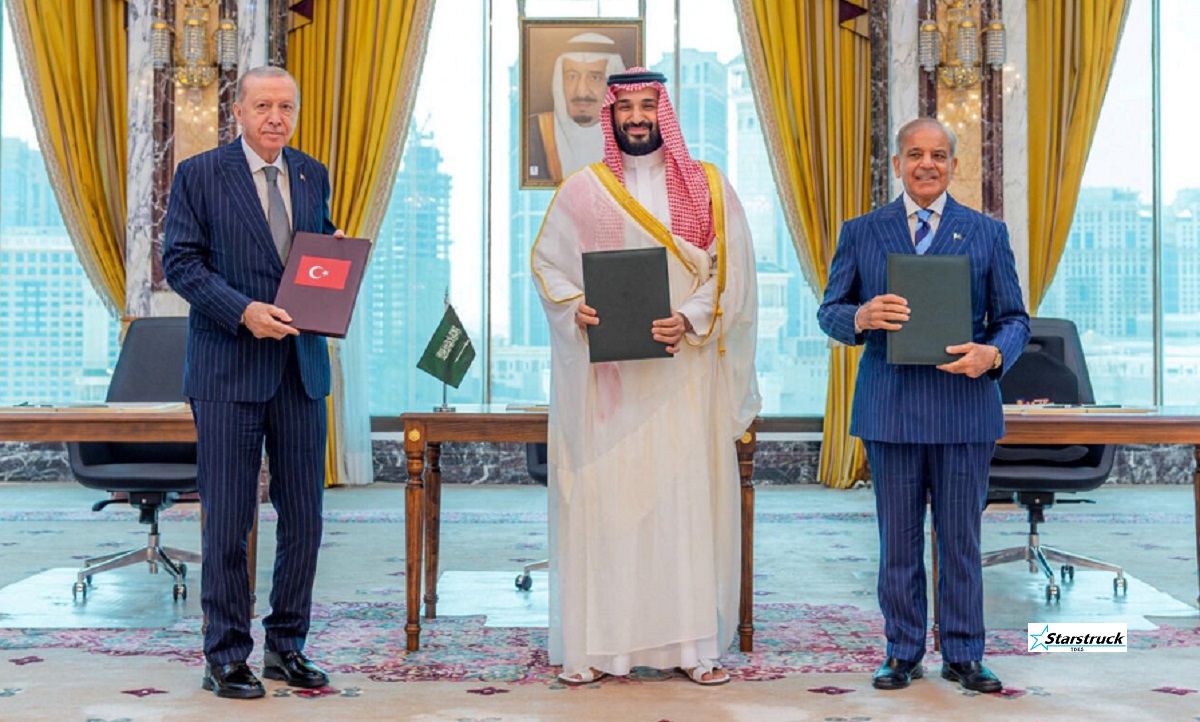
Crown Prince Mohammed bin Salman, President Recep Tayyip Erdoğan, and PM Shehbaz Sharif formalize the historic Mecca Joint Defence Agreement on August 7, 2026.
MECCA, SAUDI ARABIA, August 8, 2026 — Star Struck Times.
BREAKING NEWS — In a seismic geopolitical development that has left global capitals stunned, Saudi Arabia, Turkey and Pakistan sign mutual defense pact during a historic, high-stakes summit in the holy city of Mecca. Spearheaded by Saudi Crown Prince Mohammed bin Salman (MBS) alongside Turkish President Recep Tayyip Erdoğan and Pakistani Prime Minister Shehbaz Sharif, the newly minted Mecca Joint Defence Agreement officially creates a NATO-style collective security alliance across the Islamic world. Under this unprecedented pact, any armed aggression against one signatory state will be legally recognized as an attack against all three—a direct response to escalating Middle Eastern turmoil and Houthi drone strikes. As Washington, Tehran, and Tel Aviv rush to calculate their next moves, world leaders are asking one urgent question: Has an “Islamic NATO” just been born overnight?
Key Points: The Mecca Joint Defence Agreement
NATO-Style Collective Defense: Establishes Article 5-style collective deterrence—an attack on Saudi Arabia, Turkey, or Pakistan is an attack on all three.
Powerhouse Alliance: Combines Saudi oil wealth, Turkish military tech (TB2 drones/NATO integration), and Pakistan’s nuclear deterrent and troop strength.
Holy City Symbolism: Signed on August 7, 2026, in Mecca following Prime Minister Shehbaz Sharif’s Umrah pilgrimage, adding profound diplomatic weight.
Global Waves: India announced it is “closely watching,” while Iranian officials criticized the deal as a “paper agreement”.
Inside the Mecca Summit: How MBS, Erdoğan, and Sharif Redrew the Map
The atmosphere inside the royal guest quarters overlooking the Grand Mosque in Mecca was tense yet triumphant. According to senior diplomatic correspondent Elena Vance, who monitored the proceedings from Jeddah, discussions stretched late into the night before the final signing ceremony on Friday morning.
The trilateral accord builds upon the bilateral Saudi-Pakistan mutual defense accord forged in late 2025. However, bringing Recep Tayyip Erdoğan’s Turkey—a key NATO member with West Asia’s second-largest standing army—into a binding collective defense agreement with nuclear-armed Pakistan and financial titan Saudi Arabia creates an entirely new regional power dynamic.
“This is not merely a diplomatic handshake; it is a fundamental restructuring of West Asian security,” noted an insider close to the Saudi royal court who spoke on condition of anonymity. “When Saudi Arabia, Turkey and Pakistan sign mutual defense pact agreements of this scale, the message to external aggressors is unequivocal.”
Hidden Context: What Other Reports Missed About the Mecca Pact
While mainstream outlets have labeled the Mecca Joint Defence Agreement as a simple reaction to regional conflicts, insider details reveal deeper layers that most commentators overlooked:
The Technology-Transfer Secret: Beyond mutual military protection, the pact includes classified clauses for joint defense production. Saudi capital will directly fund advanced Turkish aerospace research and Pakistani missile technology, accelerating self-reliance.
The Houthi & Proxy Deterrent: Intelligence sources confirm the immediate catalyst was a spike in cross-border drone strikes targeting Saudi civilian infrastructure. Riyadh sought an immediate, multi-tiered air defense shield combining Pakistani ground deployment with Turkish electronic warfare units.
No Integrated NATO Command—Yet: Unlike NATO’s Brussels headquarters, the Mecca pact currently operates through a Joint Strategic Coordination Council rather than a standing combined military command, preserving national sovereignty while ensuring rapid-response mechanisms.
Geopolitical Shockwaves: Washington, Tehran, and New Delhi React
The global reaction to news that Saudi Arabia, Turkey and Pakistan sign mutual defense pact terms was swift and polarized:
Tehran’s Outrage: Iranian officials immediately slammed the arrangement. Iranian MP Ebrahim Rezaei posted on X (formerly Twitter) that “a paper agreement with Turkey and Pakistan will not bring security”.
New Delhi’s Caution: India’s Ministry of External Affairs spokesperson Randhir Jaiswal stated during a press briefing that New Delhi is “closely following developments” regarding the new trilateral defense axis.
Washington’s Calculations: Pentagon analysts view the pact with cautious optimism as a form of regional burden-sharing, though Turkey’s involvement as a NATO member adds diplomatic complexity.
What Does the Mecca Pact Mean?
Is this new treaty an “Islamic NATO”?
While media outlets call it an “Islamic NATO,” Turkish and Saudi officials emphasize that it is purely a trilateral mutual defense agreement grounded in UN Charter Article 51. It lacks a unified standing military command structure like NATO’s, but guarantees collective defense if any member is attacked.
Does the defense pact cover nuclear protection?
Official joint statements focus on conventional deterrence, intelligence sharing, and joint defense projects. However, analysts note that Pakistan’s participation instinctively extends a strategic nuclear umbrella over Riyadh and Ankara during existential crises.
Frequently Asked Questions (FAQs)
Q1: Why did Saudi Arabia, Turkey, and Pakistan sign the defense pact in Mecca?
Answer: Signing the Mecca Joint Defence Agreement in Islam’s holiest city provided spiritual and symbolic unity for the three major Muslim-majority nations, reinforcing solidarity amid regional instability.
Q2: Does the pact affect Turkey’s obligations to NATO?
Answer: No. Turkish officials confirmed the agreement is non-exclusive, purely defensive, and does not replace or conflict with Turkey’s existing NATO commitments or bilateral treaties.
Q3: What happens if one of the three countries comes under military attack?
Answer: Under the core clause of the pact, an armed attack against Saudi Arabia, Turkey, or Pakistan is legally regarded as an attack against all three, triggering collective defense measures and military support.
What Do You Think? Join the Conversation!
Do you believe the Mecca Joint Defence Agreement between Saudi Arabia, Turkey, and Pakistan will bring lasting stability to the region, or will it escalate geopolitical tensions?
Leave your comments below and share this breaking article on social media!
Hello! I'm M Muzamil Shami, the founder and lead editor of Star Struck Times, your trusted source for trending news, entertainment scoops, celebrity gossip, sports highlights, and global headlines.
With a passion for storytelling and journalism, I created this platform to bring you breaking news, viral moments, and deep insights into the worlds of Bollywood, Hollywood, sports, politics, tech, and more — all in one place.