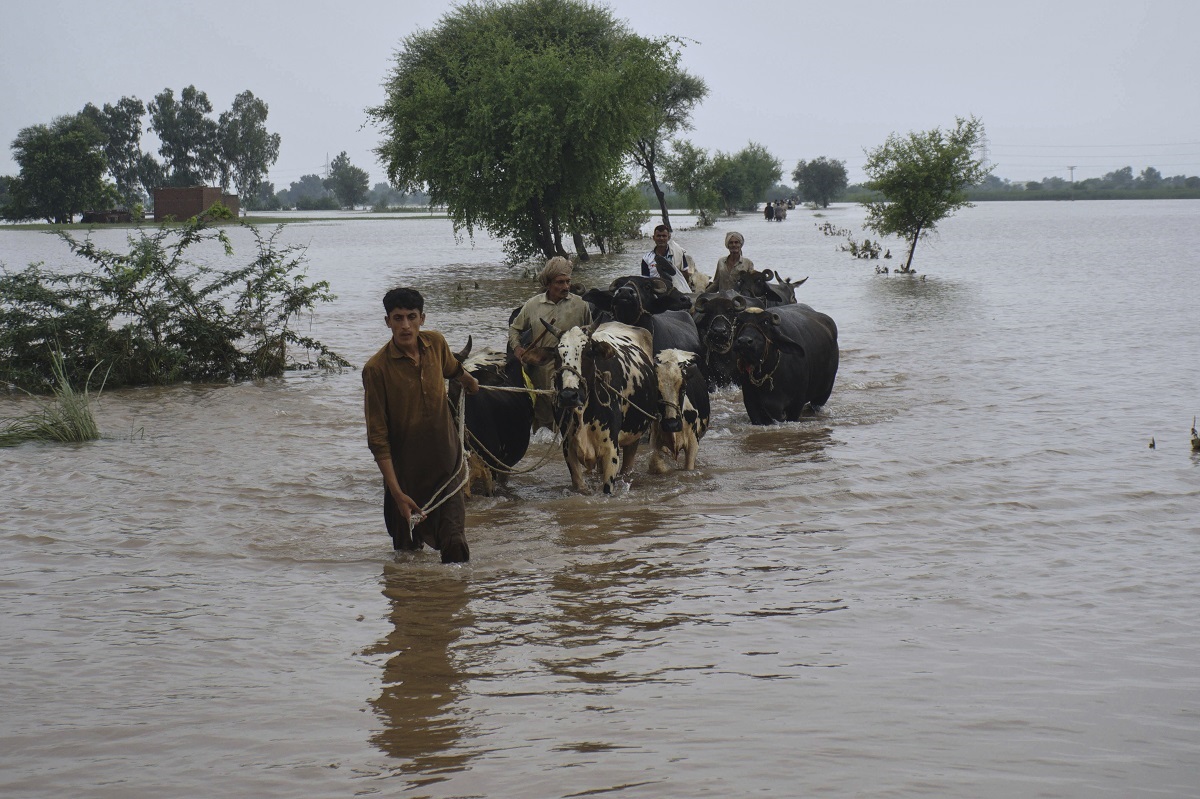
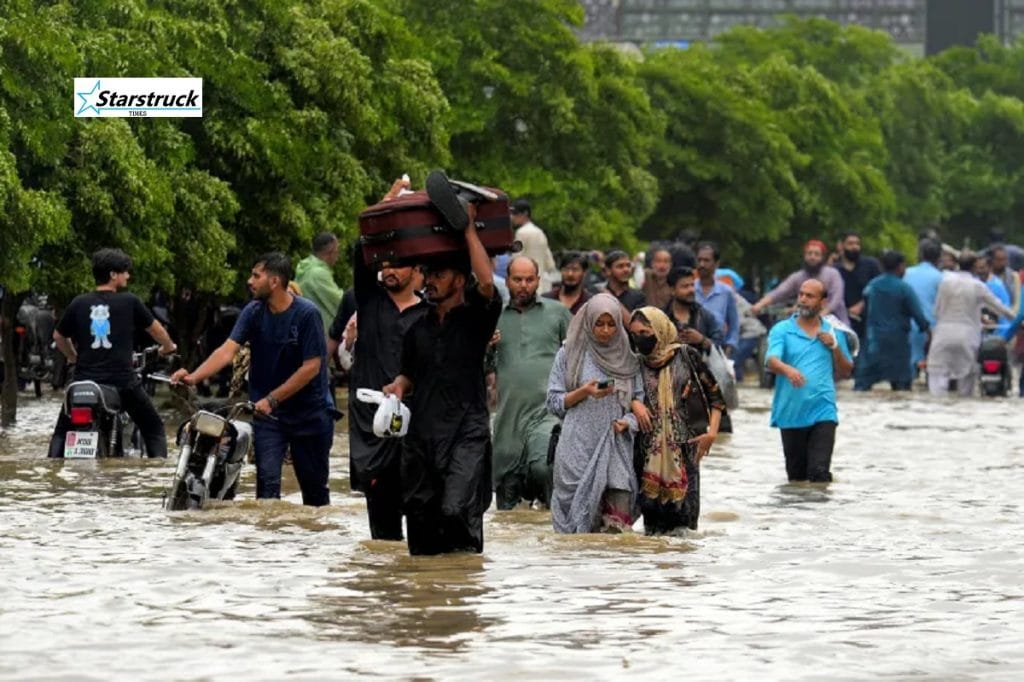
Villagers with their livestock navigate through a flooded area after torrential rains and rising water level in the rivers due to water release from Indian dams, in Pindi Bhattian, Pakistan, Sunday, Aug. 31, 2025. (AP Photo/A. Rizvi)
Historic displacement: Almost 2.5 million people have been forced from their homes in Punjab, Pakistan, amid devastating flooding.
High death toll and rising risk: At least 101 lives lost in Punjab alone. Rivers Chenab, Ravi, and Sutlej have surged to dangerous levels.
Agricultural ruin & livestock displacement: Millions of acres of farmland inundated; over 2.19 million cattle moved to safety.
Rescue in extreme conditions: Relief efforts employ boats, helicopters, drones; South Punjab tehsils like Jalalpur Pirwala and Alipur declared safe only after peak flood waves receded.
Humanitarian, economic, and psychological impact: Severe loss of homes and livelihoods, rising food inflation, risk of long-term trauma among survivors.
The Flood That Took Punjab Bruised — A Deeper Look Into the Disaster
A Surge of Water, A Surge of Fear
Lahore (Star Struck Times) —Trending now: as floodwaters swallowed whole villages and washed away roads, Punjab, Pakistan is witnessing a catastrophe few could have fully imagined. The focus keyword – Punjab floods has become synonymous with despair, displacement, and cries for rescue.
Monsoon rains, already brutal, teamed up with swollen rivers — the Chenab, the Sutlej, the Ravi — to overwhelm dera after dera (villages), submerge fields, and trap roughly 2.4 to 2.5 million people in a nightmare of water, loss, and uncertainty.
Residents still talk about the moment when water leapt into homes, rising sheet by sheet, leaving no time to gather memories or mementos. “The water came so suddenly that we couldn’t carry anything,” one survivor in Alipur tehsil said. “My cattle, my crops, all gone.”
Where the Floods Hit Hardest
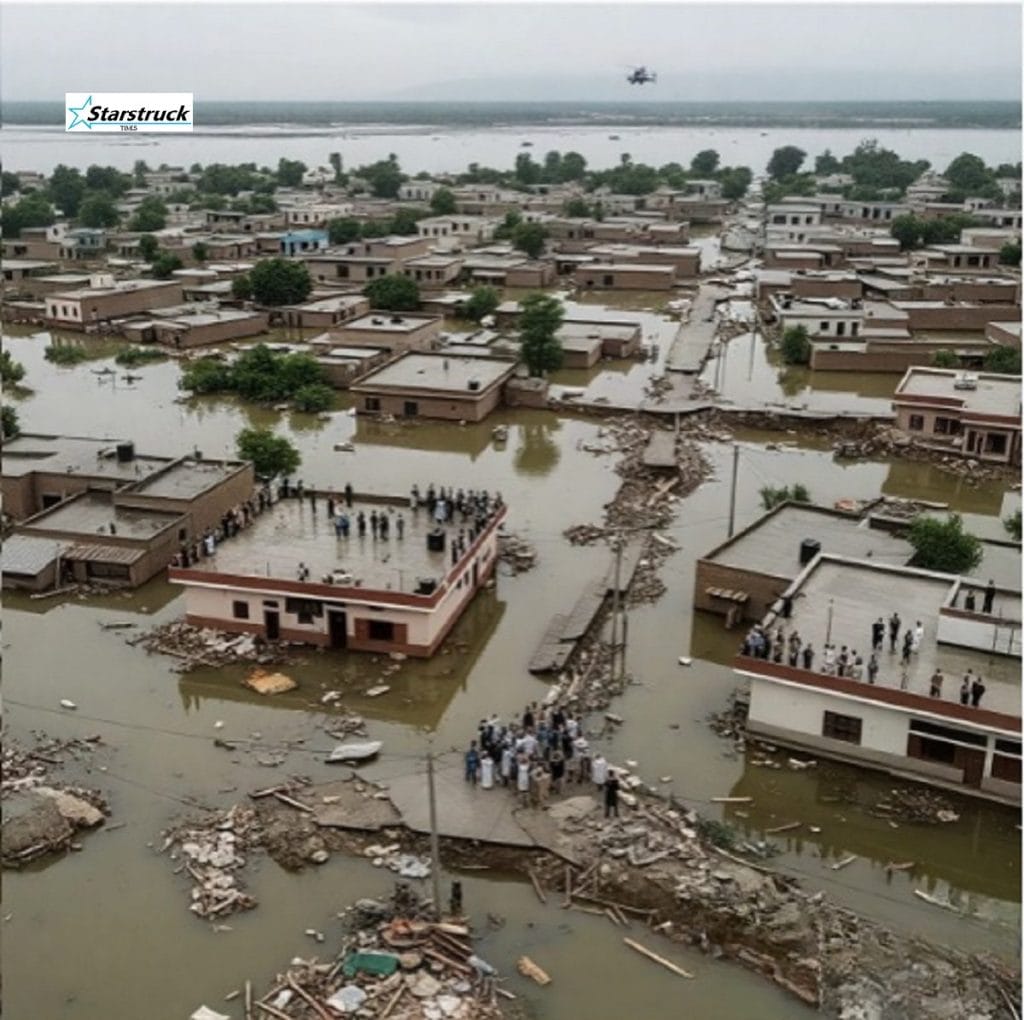
Certain districts are bearing the brunt: Multan, Muzaffargarh, Rahim Yar Khan, Alipur, Jalalpur Pirwala — low in elevation, close to the rivers, and with infrastructure already taxed. In many of these areas, entire mouzas (villages/unions) are underwater. The union council of Lati Mari, home to about 40,000 people, was fully submerged.
Public safety actors describe the evacuation operations as among the largest in recent memory in Pakistan’s history — more than 1,500 rescue boats in action, helicopters, drone drops, constant repairs on breaches in embankments.
Relief Efforts: Heroism Amid Chaos
Relief operations are stretched but racing against time. Authorities have declared areas like Jalalpur Pirwala and Alipur as “safe” only after flood waves passed through, but these declarations are small beacons in a vast sea of need.
Rescue teams report heart-wrenching scenes: people refusing rescue without their livestock, children crying in tents under blistering sun or driving rains, women praying for the waters to recede. In some villages, residents paid for private boats to flee, while the poorest waited hours, sometimes days, for government-assisted transport.
One local, Bilal Ahmed, recounts:
“I paid money to use a private boat to leave my village. We left behind everything — our animals, our food stocks. We had no idea what tomorrow would bring.”
Agriculture, Economy, What’s Lost Beyond Homes
If the human toll is tragic, what’s at stake in economic and food security terms is staggering.
Farms that feed millions are under water. Crops like rice, cotton, maize, vegetables — many completely destroyed.
Livestock (critical for rural income) are being moved — over 2.19 million cattle rescued or relocated.
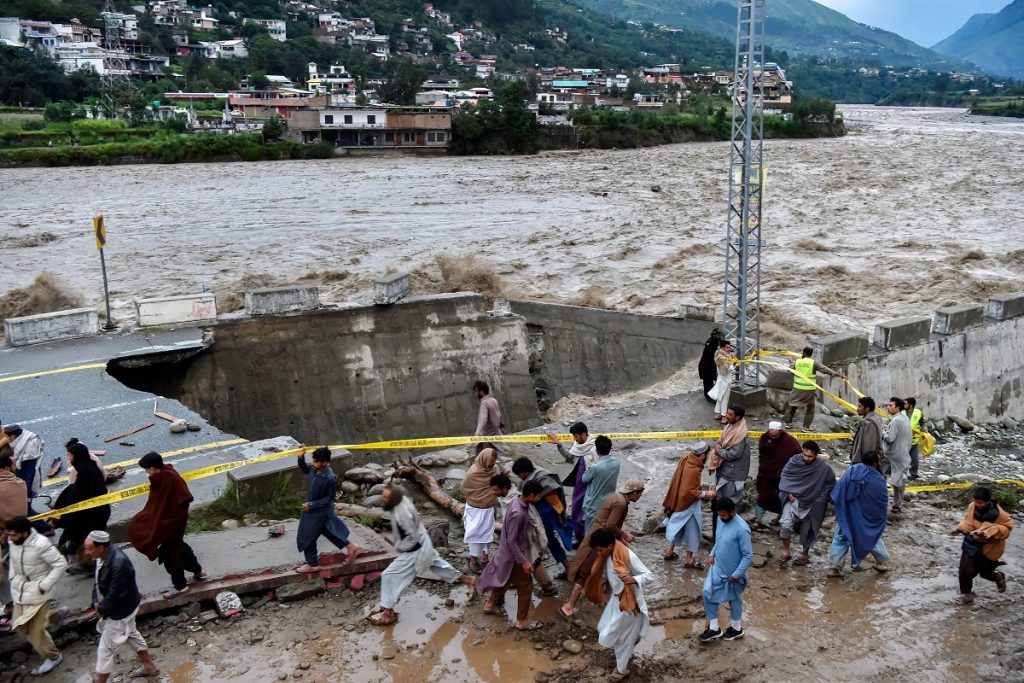
Infrastructure — roads, embankments, bridges — is damaged, making access to aid difficult. In remote zones, only helicopters or drones can deliver essentials.
Analysts warn that crop loss, combined with disrupted supply chains, could push food prices up, reduce export capacity, and stall economic recovery in rural Punjab.
The Cost in Lives and the Psychological Scars
The official death toll in Punjab stands at 101 victims so far, but rescues continue, and the missing may push this higher.
Any disaster this big also carries a less visible cost: trauma. Survivors speak of sleepless nights, children refusing to return to flood-ridden schools, parents terrified of aftershocks of rain or river release. Experts warn of long-term mental health impacts — post-traumatic stress, grief, anxiety.
Relief, Government Response & Future Preparedness
The Punjab Disaster Management Authority (PDMA), the national government, and military units are coordinating rescue and relief: camps, medical aid, food drops, livestock rescue.
Still, many argue that warnings were late or insufficient in remote zones. Many villagers report hearing warnings but seeing no transport or safe shelter options. Breaches in embankments only being repaired after major damage.
There’s growing debate around climate change, dam water management (including releases from dams in India), and the importance of stronger early-warning systems, better infrastructure, and resilient farming practices.
Context: Why Punjab’s Floods Are So Severe
Unprecedented Monsoon & River Behaviour
This year’s monsoon has been stronger, earlier, more prolonged. Rivers that usually flow within safe channels are bursting banks due to excess rain upstream, often in the mountains. Simultaneous swell in multiple rivers (Sutlej, Chenab, Ravi) is rare and amplifies the hazard.
Cross-Border Water Releases
Officials contend that the release of water from dams over the border has worsened downstream flooding inside Pakistan. While cross-border dam management is legally and diplomatically complex, many believe lack of coordination and timing awareness increases risks.
Climate Change as the Underlying Accelerator
In the background looms climate change — more intense rainfall, unpredictable weather, glacial melt in higher elevations. Scientists warn that what we are seeing is not “just another flood” but an escalating climate emergency which demands long-term adaptation strategies.
What Comes Next: Hope, Recovery, and Lessons
Short-Term Needs: Shelter, Food, Health
Thousands more tents and relief camps are critically needed. Many evacuees are still under the open sky or in shanties with no clean water.
Medical aid for waterborne diseases, heat exhaustion, injuries from flood; clean drinking water.
Ensuring livestock, which many rely upon for survival, are healthy; veterinary support too.
Re-planting crops, securing seed/fertiliser supply, possibly offering governments subsidies or insurance schemes to farmers.
Long-Term: Climate-Proofing & Preparedness
Investment in early warning systems.
Adoption of flood-resistant housing design and land-use planning to avoid high-risk zones.
Regional cooperation (e.g., with upstream dam operators), water management protocols.
Mental health support to address trauma — counseling, community programs etc.
FAQs About Punjab Floods
Q1: What caused the Punjab floods in 2025? A: A combination of factors — intense monsoon rains, overflowing rivers (Chenab, Sutlej, Ravi), and water releases from dams upstream, worsened by climate change-driven weather extremes.
Q2: How many people are displaced by the floods? A: Nearly 2.4-2.5 million people have been evacuated or displaced in Punjab province alone.
Q3: What are the biggest challenges for the displaced? A: Loss of homes, crops, and livestock; lack of proper shelter, clean water and food; healthcare access; risk of disease; psychological trauma.
Q4: What is being done by authorities? A: Evacuations using boats, helicopters, and drones; rescue camps; food and medical relief; embankment repair; livestock rescue; assessment of economic damages; discussions of international cooperation and climate resilience.
Conclusion:
Punjab’s story right now is one of both collapse and courage. Floods have torn apart lives, fields, futures. But there are moments of humanity — neighbours helping neighbours, rescuers risking their lives, communities refusing to give up hope. As the waters slowly recede, the challenge ahead looms just as large: rebuilding physical structures, restoring shattered livelihoods, and mending invisible wounds.
This flood is more than natural disaster: it’s a crystallising moment. Will Pakistan and the world heed the warning? Will policies catch up to climate reality? Punjab floods are not just a headline — they are a wake-up call.
What do you think? Should Pakistan push for stricter climate adaptation policies, or focus first on relief and rebuilding homes? Share your thoughts below — your voice matters.
Hello! I'm M Muzamil Shami, the founder and lead editor of Star Struck Times, your trusted source for trending news, entertainment scoops, celebrity gossip, sports highlights, and global headlines.
With a passion for storytelling and journalism, I created this platform to bring you breaking news, viral moments, and deep insights into the worlds of Bollywood, Hollywood, sports, politics, tech, and more — all in one place.