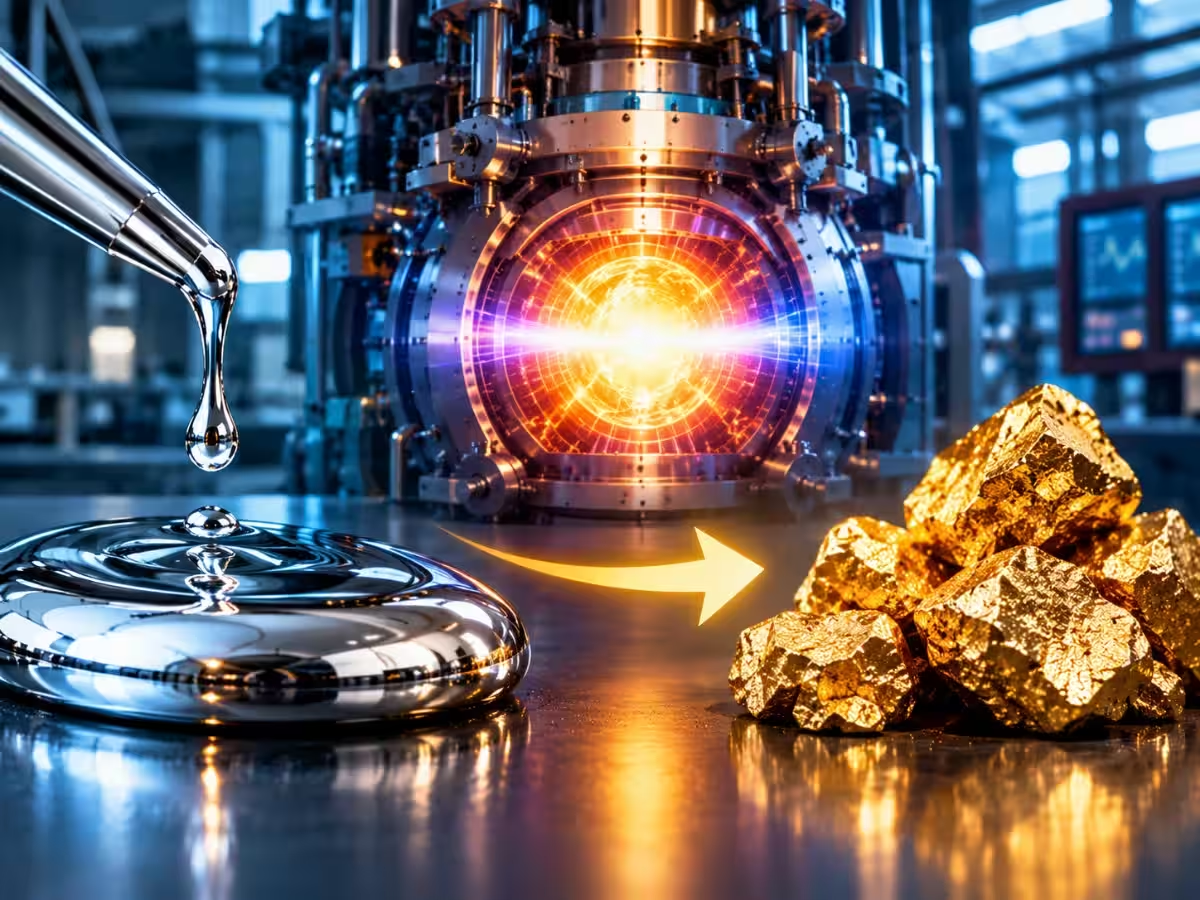
Marathon Fusion says it has converted mercury into stable gold, but independent verification and commercial viability remain unresolved.
SAN FRANCISCO, October 27, 2026
A US nuclear fusion startup, Marathon Fusion, says it has converted mercury into stable gold using neutrons generated by fusion reactions, raising fresh questions about whether gold could eventually be manufactured rather than mined. The company announced the claimed breakthrough on October 21, saying its production rate was 10 times a benchmark associated with CERN, the European particle physics laboratory. However, the amount of gold produced, the process’s cost and its commercial potential remain unclear, and the result has not been independently verified in public reporting.
Key points
Marathon Fusion says it converted mercury into stable gold using fusion-generated neutrons.
The company claims a production rate 10 times higher than CERN’s reported benchmark, although the two results may not be directly comparable.
The quantity and purity of the gold have not been publicly established, and independent verification remains outstanding.
A projection of tonnes of gold per year relates to a proposed future fusion plant, not demonstrated commercial production.
The announcement does not establish that lab-made gold could compete with mined gold or lower market prices.
How Does the Mercury-to-Gold Process Work?
The process described by Marathon Fusion relies on nuclear transmutation, which changes one element into another by altering its atomic nucleus. Unlike ordinary chemical reactions, nuclear reactions can change an atom’s identity.
According to technical descriptions of the company’s approach, high-energy neutrons strike mercury-198, producing radioactive mercury-197. That isotope subsequently decays into gold-197, a stable isotope of gold. The process depends on nuclear reactions rather than a chemical technique for extracting or refining existing gold.
The underlying physics is established, but that does not automatically validate Marathon Fusion’s specific experimental results. The key questions are whether the claimed conversion can be independently reproduced, how much gold can actually be recovered and what resources are required to produce it.
What Is the Difference Between Marathon Fusion’s Claim and CERN’s Results?
The comparison with CERN needs careful context.
In May 2025, CERN’s ALICE collaboration reported measurements showing that lead nuclei could be transformed into gold nuclei during high-energy collisions at the Large Hadron Collider. The researchers estimated that approximately 86 billion gold nuclei were produced across the four major experiments during the 2015–2018 operating period, corresponding to just 29 picograms of gold. The nuclei existed for extremely short periods before interacting with accelerator equipment.
Marathon Fusion says its mercury-based process exceeded CERN’s reported benchmark by a factor of 10. But the company’s headline comparison should not be treated as proof that it can produce commercially useful quantities of gold. The processes are different, and public reporting has noted that the startup has not disclosed enough information about its gold yield to establish the scale or commercial significance of the result.
That distinction matters: demonstrating that gold nuclei can be produced is not the same as operating a process that can deliver recoverable gold at a competitive cost.
Could Lab-Made Gold Affect Gold Prices?
The prospect of manufacturing gold has naturally raised questions about its long-term effect on the precious-metals market. But the current announcement provides no evidence that a new supply of commercially competitive gold is about to enter the market.
Marathon Fusion previously proposed that a future fusion power plant could produce gold as a byproduct alongside other outputs. Its earlier projections were based on a proposed plant design, not proof that the company can currently manufacture gold at that scale.
The difference between a laboratory result and commercial production is substantial. A viable process would need to produce gold in useful quantities, recover it efficiently, meet relevant safety and quality requirements, and justify its costs. Commercial fusion power itself also remains a major technological challenge.
For these reasons, it would be premature to conclude that the announcement will cause gold prices to fall or that mined gold is about to lose its market value.
What Evidence Is Still Needed?
The most important unanswered question is not simply whether mercury can be converted into gold. Nuclear physics already establishes that elements can be transformed through nuclear reactions.
The question is whether Marathon Fusion’s claimed result can be independently confirmed and whether the process can be scaled economically.
Publicly reported information has not established the amount of gold produced, its recoverable purity or the full cost of the process. Without those details, readers cannot reliably compare the technology with conventional gold mining or assess its potential effect on supply.
Marathon Fusion’s website describes its broader work on fusion systems and the potential co-production of gold, tritium and electricity in future plants. That provides context for the company’s ambitions, but its stated development goals should not be confused with an already operational commercial gold-production system.
For now, the announcement is best understood as a claim of scientific progress with potentially significant implications if it is verified and scaled. Whether it becomes a practical alternative to mined gold will depend on evidence that has not yet been publicly established.
Hello! I'm M Muzamil Shami, the founder and lead editor of Star Struck Times, your trusted source for trending news, entertainment scoops, celebrity gossip, sports highlights, and global headlines.
With a passion for storytelling and journalism, I created this platform to bring you breaking news, viral moments, and deep insights into the worlds of Bollywood, Hollywood, sports, politics, tech, and more — all in one place.