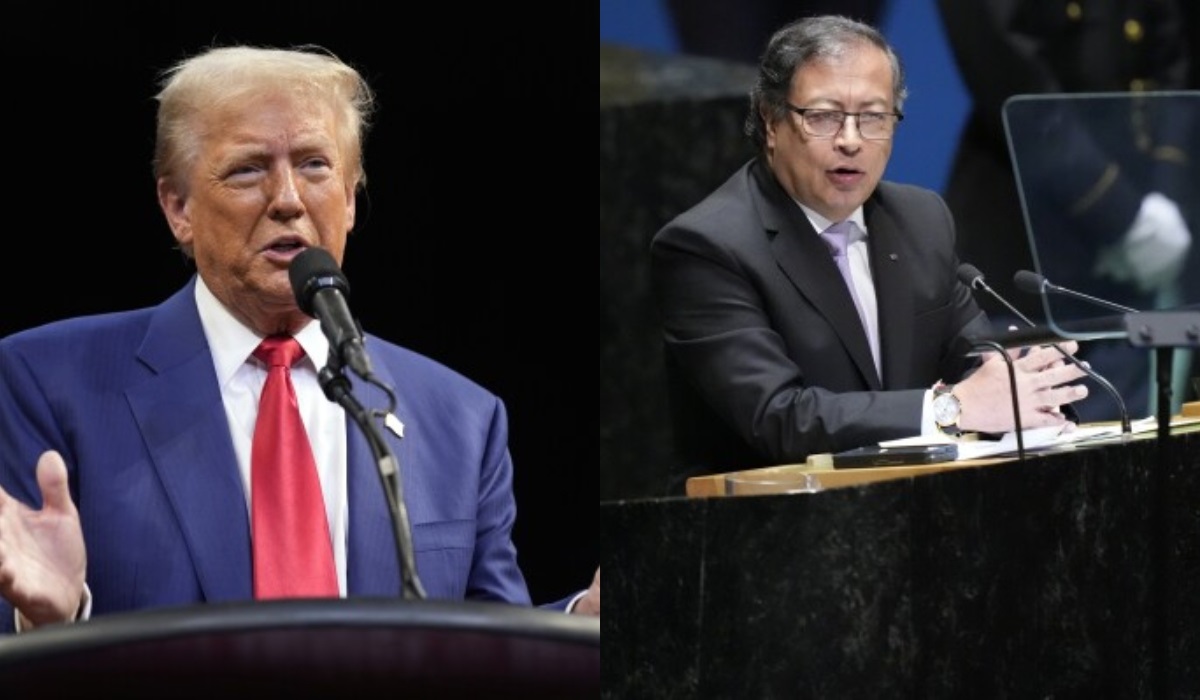
U.S. President Donald Trump addresses reporters aboard Air Force One after branding Colombia’s Gustavo Petro an “illegal drug leader.”
President Donald Trump accuses Colombian President Gustavo Petro of leading narcotics operations, threatens aid cuts and tariffs.
Palm Beach, Fla. (Star Struck Times) — In a dramatic escalation of diplomatic tensions, U.S. President Donald Trump publicly accused Colombian President Gustavo Petro of being an “illegal drug leader,” declaring that the U.S. will halt payments and subsidies to Colombia and impose major tariffs on its exports. According to a social-media post and later remarks on Air Force One, Trump said Colombia “is a drug manufacturing machine” and that America “will no longer make any payments, or subsidies, to Colombia.”
Trump’s allegations came after the U.S. military announced it struck a vessel in the Caribbean allegedly tied to Colombia’s left-wing rebel forces, the National Liberation Army (ELN). U.S. Defense Secretary Pete Hegseth said three people died in the strike and linked the ship to narcotics smuggling.
The Colombian government swiftly condemned the remarks. Colombia’s Foreign Ministry called Trump’s language “a direct threat to national sovereignty” and recalled its ambassador from Washington while reviewing next steps.
“This is not just a personal insult to our president — it’s a violation of our country’s dignity,” said an official from Bogotá. Meanwhile President Petro wrote on the social platform X: “Mr. Trump, Colombia has never been rude to the United States… The problem is with Trump, not with America.”
Trump justified his position by pointing to what he described as the “massive production of drugs” from Colombian territory entering the United States, stating: “It has become the biggest business in Colombia, by far, and Petro does nothing to stop it despite large-scale payments and subsidies from the USA that are nothing more than a long-term rip-off of America.”
Petro responded directly in a statement: “Trying to promote peace in Colombia is not being a drug trafficker. I am the main enemy of drugs in my country.” He added that the U.S. attacks on vessels had killed a humble fisherman and inflicted damage on Colombian families.
Reactions from analysts suggest the dispute signals a deeper breakdown in one of America’s longest-standing alliances in Latin America. Elizabeth Dickinson of the International Crisis Group commented that it is “profoundly unwise of the United States to alienate its strongest military partner in Latin America at a moment when tensions with Venezuela are at their highest.”
On the ground in Colombia, the move has sparked alarm among military and counter-narcotics experts who fear that cuts to U.S. aid and cooperation could undermine Bogotá’s ability to combat coca cultivation and insurgent groups. Colombia remains the world’s largest producer of cocaine and has seen a resurgence of violence in rural areas where government authority has weakened.
As this story develops, markets are watching the possibility of U.S. tariffs on Colombian exports – Trump suggested new tariffs will be revealed Monday – and diplomatic watchers are tracking how far Colombia’s government will push back, including potential appeals to multilateral bodies.
FAQs
Q: What exactly did President Trump accuse President Petro of? A: Trump called Colombian President Gustavo Petro an “illegal drug leader” who is “strongly encouraging the massive production of drugs, in big and small fields, all over Colombia.”
Q: What sanctions is the U.S. imposing? A: Trump announced that payments, aid or subsidies to Colombia “will no longer be made.” He also threatened major tariffs on Colombian exports, to be announced imminently.
Q: How did Colombia respond? A: Colombia’s Foreign Ministry condemned the remarks, recalled its ambassador, and President Petro stated, “The problem is with Trump, not with the U.S.” He rejected the drug-trafficking allegations.
Q: What is the broader context behind the dispute? A: Tensions had been brewing following U.S. military strikes on vessels in the Caribbean allegedly linked to narcotics trafficking, with Colombia claiming that one struck vessel was actually a fishing boat with no ties to drugs. Legal and human-rights groups have criticized U.S. actions.
Q: Why does this matter? A: U.S.–Colombia cooperation has been central to the wider war on drugs in Latin America for decades. A breakdown could destabilize counternarcotics efforts and shift geopolitical alignments in the region.
Stay tuned for updates as tariffs are announced and Colombia outlines its next diplomatic move. Sign up for alerts to get breaking coverage of this evolving U.S.–Colombia standoff.
Hello! I'm M Muzamil Shami, the founder and lead editor of Star Struck Times, your trusted source for trending news, entertainment scoops, celebrity gossip, sports highlights, and global headlines.
With a passion for storytelling and journalism, I created this platform to bring you breaking news, viral moments, and deep insights into the worlds of Bollywood, Hollywood, sports, politics, tech, and more — all in one place.









Your article helped me a lot, is there any more related content? Thanks!
Your point of view caught my eye and was very interesting. Thanks. I have a question for you. https://accounts.binance.com/es-MX/register-person?ref=A00OPRX4