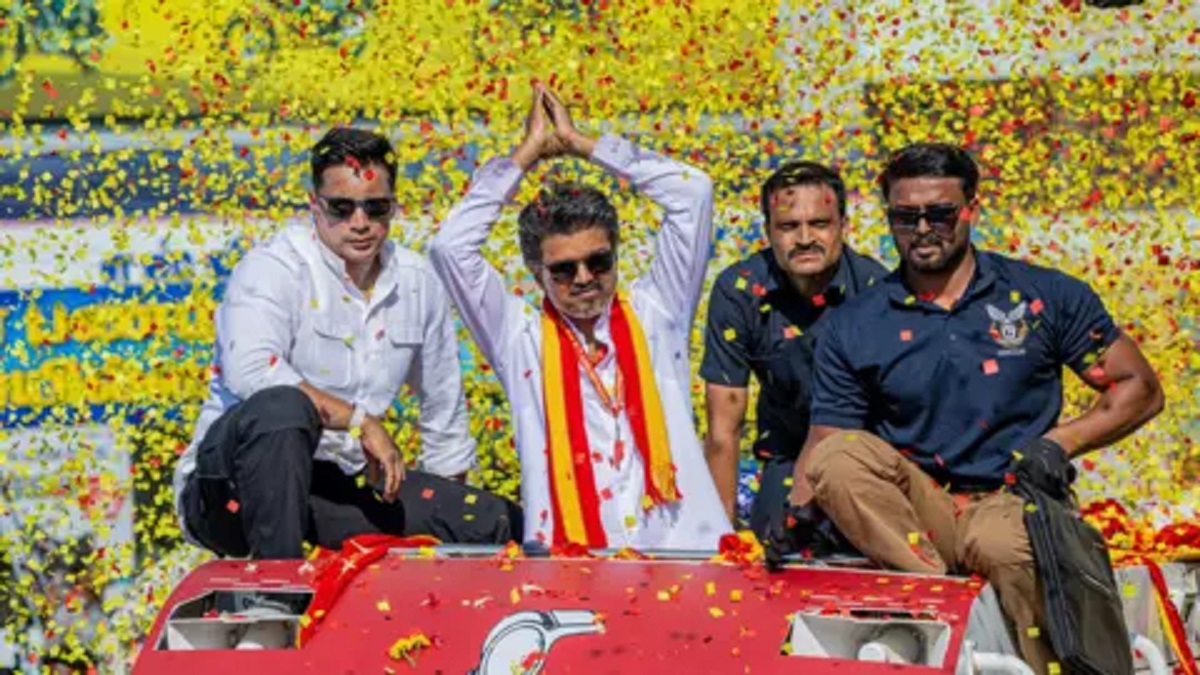
Chennai, India, May 11, 2026 — Star Struck Times
For years, critics dismissed Chandrasekhar Joseph Vijay as just another movie superstar testing the dangerous waters of Indian politics. But after a stunning election surge in Tamil Nadu, that narrative has collapsed almost overnight.
Now, the bigger question dominating political conversations is no longer whether Vijay can win — it’s whether India has just witnessed the birth of a completely new political playbook powered almost entirely by social media.

And what happened behind the scenes may be even more surprising than the results themselves.
Breaking: How Vijay Turned Online Fandom Into Real Votes
When Tamilaga Vettri Kazhagam (TVK) entered the Tamil Nadu assembly elections, most analysts expected the party to struggle against the entrenched machinery of the ruling regional giants — the Dravida Munnetra Kazhagam and the All India Anna Dravida Munnetra Kazhagam.
Instead, TVK reportedly secured 108 seats, coming astonishingly close to a majority in the 234-member assembly.
The biggest shock came from candidates few outside their constituencies had even heard of.
One of them was Madhar Badhurudeen, a meat shop owner from Madurai Central, who defeated heavyweight rivals despite running a comparatively modest campaign.
According to interviews reported by the BBC, Badhurudeen credited Vijay’s image, party ideology, and digital momentum as decisive factors behind his victory.
But many political observers now believe the real engine of TVK’s rise wasn’t traditional campaigning at all.

It was the internet.
Key Points
- Vijay’s TVK stunned Tamil Nadu politics with a massive electoral breakthrough
- Social media platforms reportedly became the backbone of the campaign
- Instagram Reels, YouTube Shorts, and WhatsApp sharing amplified Vijay’s speeches
- Traditional opinion polls reportedly underestimated the digital wave
- Young voters and women appeared to play a crucial role in TVK’s rise
- Analysts say Vijay may have rewritten the future of Indian election campaigns
The Viral Strategy Rivals Failed to Understand
Unlike conventional Indian political campaigns filled with endless press conferences and marathon speeches, Vijay adopted a strikingly different strategy.
The actor-turned-politician rarely interacted with mainstream media. Instead, his campaign leaned heavily into direct communication through digital platforms.
Every rally clip, speech fragment, emotional moment, and crowd reaction was rapidly transformed into viral-friendly content.
Short-form videos flooded:
- YouTube Shorts
- Instagram Reels
- Facebook clips
- WhatsApp groups
- Fan-run meme pages
One selfie-style video from a TVK event reportedly crossed nearly 90 million views within 24 hours, according to BBC reporting.
That level of organic digital amplification created something political strategists now describe as a “parallel campaign universe” — one largely invisible to traditional media tracking systems.
Media strategist Anup Chandrasekharan told BBC that this may have been “the first election in India won almost entirely with the help of social media.”
Why Gen Z Voters Connected With Vijay
For decades, Vijay built a carefully crafted on-screen image in Tamil cinema.
In many blockbuster films, he portrayed:
- an anti-corruption fighter
- a defender of ordinary people
- a challenger to powerful elites
- a voice against injustice
That cinematic identity appears to have seamlessly transitioned into politics.
Younger voters, especially first-time digital-native voters, already felt emotionally connected to the “Thalapathy” persona long before the election campaign officially intensified.
Political analysts say this emotional familiarity gave TVK an enormous advantage over conventional politicians who rely heavily on party structures and caste equations.
More importantly, Vijay’s fan clubs — reportedly numbering around 85,000 across Tamil Nadu — became a ready-made grassroots and online distribution network.
That meant TVK did not have to build digital reach from scratch.
It already existed.
What Other Reports Missed About Vijay’s Rise
Many reports focused heavily on Vijay’s celebrity status.
But the deeper story may actually be about timing.
Tamil Nadu politics has long been dominated by legacy parties with decades-old leadership structures. Younger audiences increasingly consume political content through short videos, memes, and influencer-style communication rather than traditional television debates.
Vijay’s campaign did not merely use social media.
It was designed for the social media generation from the ground up.
That distinction matters.
While rival parties treated digital outreach as a support tool, TVK appears to have treated it as the primary battlefield.
This shift could influence future elections far beyond Tamil Nadu.
The Hidden Risk Behind TVK’s Digital Success
Despite the celebrations, several analysts are urging caution.
Winning a viral campaign and governing a state are two very different challenges.
Critics continue to question Vijay’s lack of administrative experience, especially as expectations now rise dramatically.
There are also concerns about whether a movement fueled by online energy can maintain long-term political stability.
Anup Chandrasekharan warned that digital momentum alone may not sustain governance success, emphasizing that TVK must now strengthen its real-world party structure.
Political history in India is filled with charismatic figures who generated massive excitement but later struggled with governance pressures.
That may become Vijay’s toughest test yet.
Why This Election Could Reshape Indian Politics
The implications extend beyond one state election.
Political strategists across India are now closely studying TVK’s methods because they may represent a blueprint for future campaigns:
- influencer-style messaging
- rapid short-video dissemination
- meme-driven engagement
- emotional storytelling
- decentralized supporter networks
In an era where smartphone penetration continues to surge across India, Vijay’s model may become increasingly influential.
The success also highlights a growing reality:
Political narratives are no longer controlled solely by television channels or newspaper headlines.
They are increasingly shaped inside algorithms.
What Happens Next for Vijay and TVK?
Now that Vijay has crossed from cinema superstardom into political power, expectations are entering a far more dangerous phase.
Supporters see him as a reform-driven outsider capable of disrupting old political systems.
Critics see a celebrity experiment that may struggle under real governance pressures.
The coming months will likely determine whether Vijay’s digital revolution becomes a lasting political transformation — or simply one of the most dramatic election upsets in recent Indian history.
For now, one thing is undeniable:
Tamil Nadu politics may never look the same again.
FAQs
Did Vijay really win the Tamil Nadu election?
Reports indicate that Vijay’s party TVK secured major victories in the Tamil Nadu assembly elections, emerging as a dominant new political force.
What is Vijay’s political party called?
Vijay leads Tamilaga Vettri Kazhagam (TVK).
Is Vijay’s political party allied with BJP?
Public discussions continue around TVK’s political positioning, but reports have not conclusively established a formal BJP alliance.
Why is Vijay called Thalapathy?
“Thalapathy” means “Commander” and became Vijay’s popular nickname through his film career.
How did social media help Vijay politically?
Supporters used Instagram Reels, YouTube Shorts, Facebook, and WhatsApp to amplify campaign messages and reach younger voters rapidly.