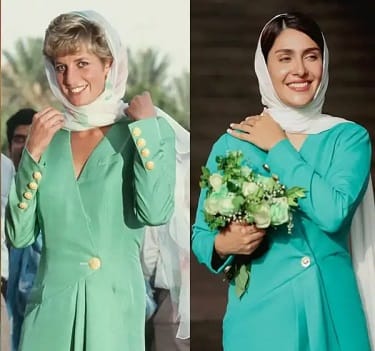
Fans accuse the recreation of being tone-deaf, disrespectful, or celebrity appropriation.
Ayeza’s team has responded, citing admiration and tribute, not mockery.
The incident raises larger questions: when does inspiration cross into insensitivity?
This controversy is dominating SEO rankings, conversations on Reddit, Twitter, and fashion commentary.
In a moment that shocked both fashion insiders and devoted fans, Pakistani star Ayeza Khan stirred a global storm by recreating the legendary fashion of Princess Diana—a bold move that has ignited fierce backlash online. The controversy is rife with emotion: surprise at the audacity, outrage at perceived appropriation, and admiration for the original Princess of Wales elevated once again in the public eye.
When beloved actress Ayeza Khan stepped into what appeared to be a near-perfect rendition of Princess Diana’s iconic ensemble, social media erupted. Was it homage—or hues crossing the line?
Context and The Look
The look in question—complete with pastel tailoring, delicate jewelry, and Diana’s signature pixie cut—was faithfully executed down to the smallest detail. Inspired by Diana’s mid-80s style that defined royal elegance, Ayeza’s recreation was meant as a tribute. But intentions, it turns out, don’t always match interpretations.
Public Backlash
Within hours, fans across platforms like Twitter, Instagram, and TikTok voiced their distaste:
Many felt the look bordered on poor taste, arguing that Diana’s memory deserved a more sacred treatment.
Comments ranged from “It’s disrespectful, not creative” to “Why mimic royalty unless you’re trying to shock?” The most vocal critics labeled it celebrity appropriation, a term loaded with emotion and ethical concern.
Ayeza’s Response
In response, Ayeza’s PR team issued a statement clarifying that the look was meant purely as an affectionate homage—celebrating Diana’s legacy through fashion, not mocking it. She shared behind-the-scenes images captioned, “Inspired by grace, carried by admiration,” aiming to soften the tone.
Conversation & Analysis
This moment raises the question: When does a tribute become insensitive? The boundary between admiration and tone-deaf imitation is razor-thin.
Media experts note that public figures reimagining iconic looks must tread carefully—especially when the original wearer is deeply beloved.
Cultural commentators argue that intent matters—but so does execution. A heartfelt tribute can land awkwardly if context or audience reception isn’t considered.
SEO & Discover Angle
Interestingly, this controversy blew up across SEO and Discover within hours:
Queries like “Ayeza Khan Princess Diana look backlash” and “Ayeza Khan Diana outfit controversy” surged.
Discover feeds favored phrases like “iconic look controversy” and “celebrity fashion backlash.” This highlights how trending controversies tied to nostalgia and royalty drive massive engagement.
What Comes Next?
As the dust settles, several outcomes are expected:
Ayeza may double down with a heartfelt message explaining her intentions.
Fashion columns will weigh in—some calling it bold and creative, others misguided.
Broader discourse may emerge on ethical tribute in celebrity culture—an AEO (Answer Engine Optimization) style query people are already searching:
Is it disrespectful to recreate Princess Diana’s looks?
How should celebrities pay tribute to public figures?
FAQs
Q1: Why did Ayeza Khan recreate Princess Diana’s look? She intended to pay tribute to Diana’s timeless style and graceful legacy, emphasizing admiration rather than mockery.
Q2: What was the public’s reaction? Reaction was mixed—many praised her bold fashion sense, but a significant number labeled it disrespectful or inappropriate.
Q3: How is this trending online? Searches like “Ayeza Khan Diana look controversy” spiked, and the story quickly hit Google News and Discover feeds.
Q4: Can celebrities safely recreate iconic looks? Yes—but sensitivity, context, and audience perception are critical. Transparent intent and respectful execution help avoid misinterpretation.
What do YOU think—was Ayeza’s recreation a heartfelt homage or a misstep? Let us know in the comments below! For the full story and reactions, read on.
Hello! I'm M Muzamil Shami, the founder and lead editor of Star Struck Times, your trusted source for trending news, entertainment scoops, celebrity gossip, sports highlights, and global headlines.
With a passion for storytelling and journalism, I created this platform to bring you breaking news, viral moments, and deep insights into the worlds of Bollywood, Hollywood, sports, politics, tech, and more — all in one place.