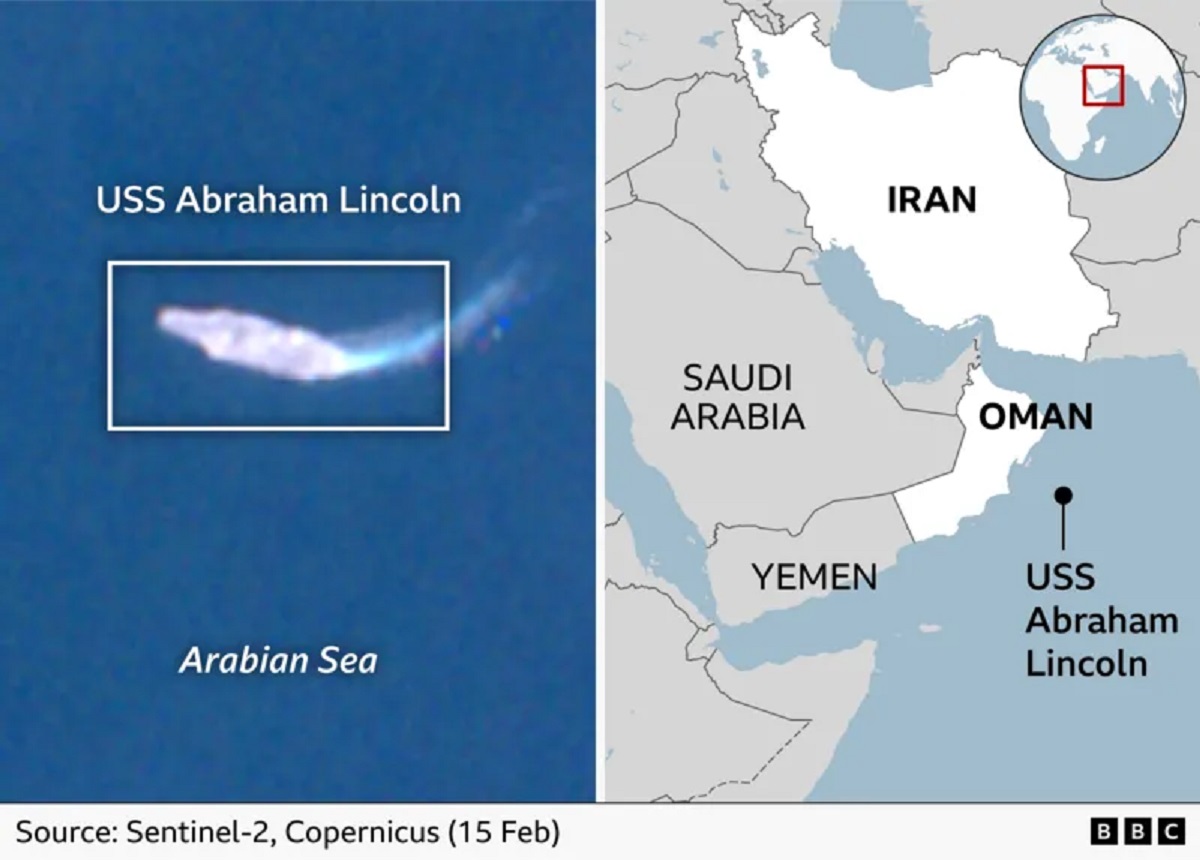
USS Abraham Lincoln, a Nimitz-class aircraft carrier, positioned in the Arabian Sea near Iran
Washington D.C., USA — Star Struck Times
The United States has positioned the aircraft carrier USS Abraham Lincoln in the Arabian Sea near Iran, marking a significant escalation in military presence amid ongoing diplomatic tensions. The carrier, accompanied by three guided missile destroyers and carrying 90 aircraft including F-35 fighters, is reportedly located approximately 700 km off the coast of Iran, near Oman. This deployment comes ahead of planned US-Iran talks in Switzerland focused on Iran’s nuclear program and potential sanctions relief.
Analysts suggest this move underscores Washington’s strategic intent to maintain pressure while signaling readiness in the region.
Key Highlights
USS Abraham Lincoln, Nimitz-class aircraft carrier, tracked near Oman, ~700 km from Iran
Carrier strike group includes three guided missile destroyers and 5,680 crew
USS Gerald R Ford, the largest warship, also en route to the Middle East
Iran conducts Strait of Hormuz maritime drills via IRGC in response
US military build-up includes 12 ships and increased fighter jet deployment in the region
What Happened: US Military Deployment
Satellite imagery from European Sentinel-2 satellites has confirmed the USS Abraham Lincoln’s location in the Arabian Sea, marking the first verified sighting since its late-January deployment. The carrier strike group comprises three Arleigh Burke-class destroyers, capable of long-range missile strikes, alongside three specialist combat ships stationed at Bahrain Naval Station.
In addition, the US has increased aerial assets, including F-15 and EA-18 fighter jets stationed in Jordan’s Muwaffaq Salti Air Base. Cargo planes, refueling aircraft, and communications support planes have also been redirected from Europe and the US to support potential operations.
Military intelligence expert Justin Crump told BBC Verify, “The current US deployment demonstrates more depth and sustainability than prior operations in Venezuela or last year’s strikes on Iran’s nuclear facilities. It’s not just strike preparation but a scalable deterrent posture.”
Public Reaction and Official Responses
Iran has responded with a show of force. On February 12, the Islamic Revolutionary Guard Corps (IRGC) conducted maritime drills in the Strait of Hormuz, a key global oil transit route. IRGC Commander-in-Chief Maj Gen Mohammad Pakpour oversaw the exercises, which included missile launches and naval maneuvers near Kharg Island, Iran’s primary oil terminal.
Locals expressed concern about potential disruptions. One Iranian resident told Reuters, “We are worried about tensions escalating. The Gulf is our lifeline for trade and oil, and such military movements make daily life uncertain.”
US Central Command released images on February 6 showing the Abraham Lincoln flanked by destroyers, fighter jets, and coastguard vessels, emphasizing the military’s preparedness while maintaining a deterrent posture.
Why It Matters
The deployment signals the US’s intent to deter escalation while maintaining leverage ahead of nuclear talks in Switzerland. Experts suggest this positioning ensures the US can rapidly respond to regional threats while safeguarding strategic interests, including Israel’s security and uninterrupted energy flows through the Gulf.
The presence of multiple aircraft carriers and destroyers indicates a shift from temporary strike readiness to a sustained deterrent capability. Analysts note this contrasts prior operations like the “Midnight Hammer” airstrikes on Iran’s nuclear sites, which were short-term and limited in scope.
Context: Past Deployments
Previously, the US conducted similar large-scale deployments in Venezuela and the Middle East. In the Caribbean, the USS Gerald R Ford supported operations to capture former Venezuelan President Nicolás Maduro. Last year’s “Operation Midnight Hammer” targeted Iran’s nuclear facilities, involving two carrier strike groups and five destroyers in the Mediterranean and Red Sea.
Crump explained, “This deployment has more depth than previous operations. It’s designed to sustain engagement and counter all potential Iranian responses, offering both deterrence and operational flexibility.”
What Happens Next
US-Iran negotiations are set for Tuesday in Switzerland, with discussions expected to focus on nuclear programs and sanctions. Both countries are likely to closely monitor military movements in the Gulf. Analysts anticipate that while diplomacy continues, US forces in the region will maintain a heightened posture to deter any aggressive actions.
FAQs
Q1: Where is the USS Abraham Lincoln currently located? The carrier is in the Arabian Sea, approximately 700 km off the coast of Iran near Oman, accompanied by three guided missile destroyers.
Q2: How many US ships are in the Middle East? Twelve US ships, including the USS Abraham Lincoln and multiple destroyers, are currently tracked via satellite imagery across the Gulf, Red Sea, and Eastern Mediterranean.
Q3: What is Iran’s response? Iran conducted IRGC maritime drills in the Strait of Hormuz, demonstrating missile launches and naval readiness in response to the US presence.
Q4: What is the significance of the Strait of Hormuz? It is a vital global oil transit point, with around one-fifth of the world’s oil and gas passing through, making it strategically crucial for international energy security.
Q5: Will this escalate military conflict? Experts indicate the deployment is intended as a deterrent rather than immediate conflict, with a focus on ensuring stability while diplomatic negotiations proceed.
Stay informed on the latest developments in the Middle East and US military movements. Follow Star Struck Times for timely updates and expert analysis on global news.
Hello! I'm M Muzamil Shami, the founder and lead editor of Star Struck Times, your trusted source for trending news, entertainment scoops, celebrity gossip, sports highlights, and global headlines.
With a passion for storytelling and journalism, I created this platform to bring you breaking news, viral moments, and deep insights into the worlds of Bollywood, Hollywood, sports, politics, tech, and more — all in one place.